
BFPPSI: Solving the Privacy-Efficiency Trade-off in P2P Social Networks
Privacy Preserving Intersection of Neighbor Sets Exploiting Cross Checking Capability in a Peer to Peer Social Network Service
The paper introduces BFPPSI, a novel method for computing common neighbor sets in Peer-to-Peer (P2P) Social Networks using Bloom filters. It achieves high accuracy and privacy by leveraging a unique "cross-checking" mechanism that exploits the bidirectional nature of social relationships.
TL;DR
In the era of decentralized Social Network Services (SNS), protecting the "who knows who" graph structure is paramount. This paper presents a Bloom filter-based approach that allows two nodes to find their common friends without exposing their entire contact lists. By introducing a clever "cross-checking" step, the authors reduce the mathematical noise of Bloom filters to nearly zero, making private discovery both fast and accurate.
Problem & Motivation: The Paradox of Private Discovery
In a Decentralized SNS, nodes (users) don't want to upload their friend lists to a central server like Facebook. However, features like "Friend Recommendations" require knowing how many friends two users have in common.
The technical challenge is a classic Private Set Intersection (PSI) problem. Prior solutions like Homomorphic Encryption (using polynomials where roots are set elements) are mathematically elegant but computationally "heavy" for mobile or P2P nodes. Conversely, simple hashing is vulnerable to brute-force attacks. The authors identified an opportunity: can we use the "errors" in a lightweight structure like a Bloom filter to our advantage for privacy, while fixing them for accuracy?
Methodology: The Power of the Double-Check
The core of the paper is the Bloom Filter based Privacy Preserving Set Intersection (BFPPSI) algorithm.
1. The Bloom Filter Shield
Each node creates a Bloom filter (a bitmask) of its neighbors. This mask is "noisy" by design—you can't easily reverse a bitmask to see the original IDs, but you can check if a specific ID might be there.
2. The Cross-Checking Insight (The "How")
If Node X wants to find common friends with Node Y:
- Step 1: X tests its own neighbors against Y's Bloom filter. This generates a list of candidates. Some are real common friends; others are "false positives" (mathematical accidents of the Bloom filter).
- Step 2 (Cross-Check): For every candidate Z, X checks if Y is in Z's Bloom filter.
The physical intuition is simple: For Z to be a "False Common Neighbor," it must fail the test twice in a specific, consistent way. The probability of this happening drops from to .
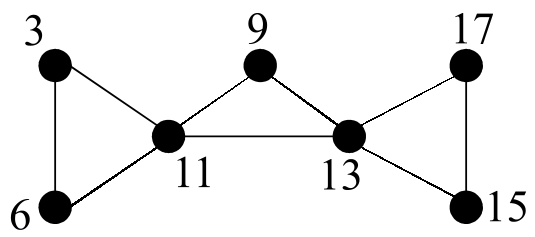 Figure 1: A social graph sample used to demonstrate how Node 11 and 13 find common neighbors.
Experiments & Results: Precision vs. Privacy
The authors tested BFPPSI using a 80,000-node Flickr dataset.
Privacy under Brute-Force
The authors simulated a "Brute-force attack" where an attacker tries to guess a node's entire friend list by testing every person in the network against a filter. Because the network is large (), the number of "false neighbors" generated by the attack is high (around 200-800 for ), effectively camouflaging the real friends.
Accuracy of Intersection
Despite the high noise for attackers, the intersection for legitimate nodes was remarkably clean.
- Precision: With a filter error set to , the precision was nearly 100%.
- Impact of Node Degree: Interestingly, the algorithm is more accurate when run by "low-degree" nodes (users with fewer friends) because they have fewer candidates to filter, reducing the total statistical chance of a error.
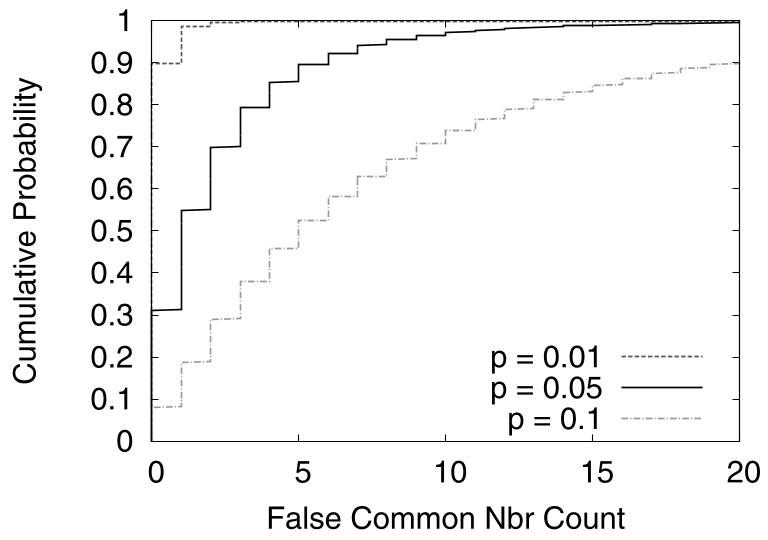 Figure 2: Distribution of false common neighbors. Most queries result in zero or only one error.
Critical Analysis & Conclusion
Takeaway
The genius of this paper lies in its simplicity. Instead of using complex multi-party computation (SMC), it uses the inherent bidirectional structure of social networks (if I am your friend, you are my friend) to verify probabilistic results.
Limitations & Future Work
- Scalability: While the authors argue that increasing (total users) improves privacy, it also increases the storage cost of the Bloom filters.
- Adversarial Nodes: The paper assumes nodes provide "honest" Bloom filters. An adversarial node could potentially lie about its neighbor set to manipulate results.
In conclusion, BFPPSI shows that we don't always need "heavy" cryptography to solve privacy problems. Sometimes, understanding the data's structural context allows for much more efficient, "near-perfect" solutions.