
Decoupling Identity from Motion: A Privacy-First Framework for IoT Healthcare
Privacy-preserving IoT Framework for Activity Recognition in Personal Healthcare Monitoring
The paper introduces a privacy-preserving IoT framework for Human Activity Recognition (HAR) in healthcare, utilizing a localized processing pipeline on smartphones. By decoupling temporal features (utility) from frequency features (identity), the authors achieve 87% activity recognition accuracy while reducing user re-identification to 33%.
TL;DR
Wearable devices are a goldmine for healthcare monitoring, but they also act as digital fingerprints, allowing hackers to re-identify you based on how you walk. This paper proposes a clever solution: keep the "how you move" data (temporal domain) for doctors, while "scrambling" the "who you are" data (frequency domain) directly on your smartphone before it ever reaches the cloud.
The result? A 53% improvement in privacy with only a minor 9% hit to utility, all while saving 81% in server costs.
Problem & Motivation: The "Biometric Leak" in Your Pocket
When your smartwatch tracks your steps, it doesn't just see "walking." It sees the unique rhythm of your gait—the specific intensity of your swing and the frequency of your stride.
Existing solutions face a "Trilemma":
- Utility: High accuracy in activity recognition (e.g., detecting a fall).
- Privacy: Preventing an "Honest-but-Curious" cloud server from identifying the patient.
- Efficiency: Running on battery-constrained smartphones without the lag of complex encryption.
The authors observed that while traditional methods (like adding Gaussian noise) protect privacy, they often "blind" the machine learning model, making it unable to distinguish between sitting and lying down.
Methodology: The Core Insight
The researchers discovered a fundamental split in how data represents human movement:
- Temporal Domain (Time): Statistical features like Mean, Max, and Min in the time domain are excellent at identifying actions.
- Frequency Domain (Hertz): Signal energy and entropy at specific frequencies act as unique biometric identifiers.
The Privacy Pipeline
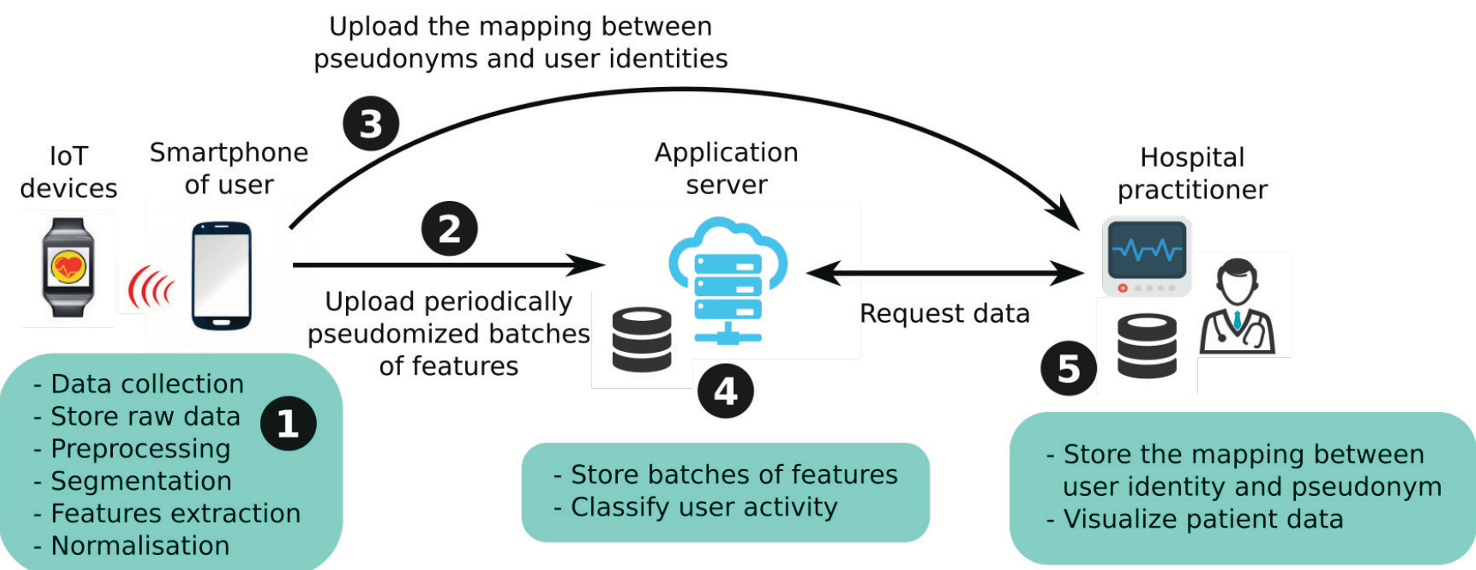
The framework moves the heavy lifting to the Edge (Smartphone):
- Local Extraction: 19 vital features are extracted on-device.
- Selective Normalization: Instead of encrypting everything, the framework applies mathematical normalization (Mean, IQR, StdDev) specifically to frequency features to "average out" individual differences.
- Pseudonym Rotation: Data batches are sent with random IDs, preventing the server from linking long-term behavior to a single profile.
Experiments & Results
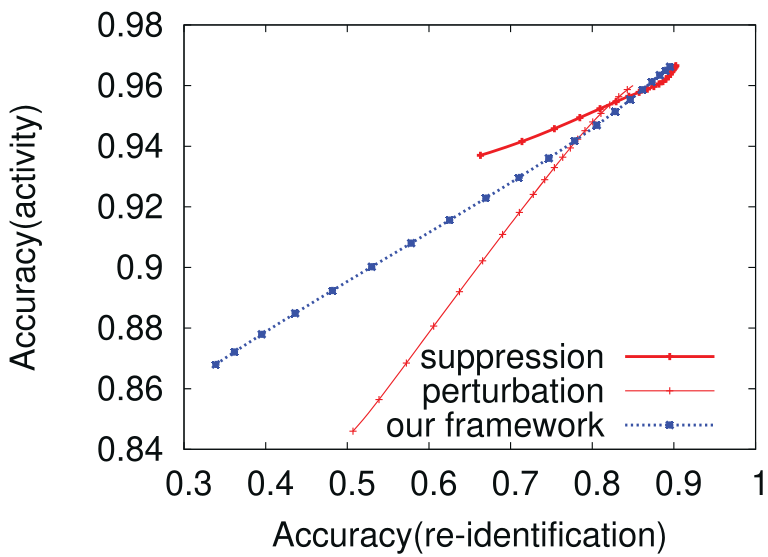
The framework was tested against two major datasets (UCI HAR and MotionSense). Using a Random Forest classifier, the system achieved a remarkable balance.
Privacy-Utility Tradeoff
Unlike suppression (deleting data) or perturbation (adding noise), the normalization method maintains high utility.
| Metric | Traditional (Raw) | Proposed Framework | Improvement |
|---|---|---|---|
| Activity Accuracy | 97% | 87% | -9% (Acceptable) |
| Re-identification | 90% | 33% | +53% (Significant) |
The "Edge" Advantage
By processing signal segmentation and feature extraction on the smartphone, the server load drops by 81%. This makes the framework not only safer but significantly cheaper to scale for millions of users.
Critical Analysis & Conclusion
The Takeaway
The genius of this work lies in its surgical approach to privacy. By identifying which mathematical features leak identity, the authors avoid the "sledgehammer" approach of total encryption, allowing useful medical data to flow while keeping the user anonymous.
Limitations & Future Work
- Static Activity Noise: The framework struggles with "static" activities (standing vs. sitting) when sensors are in the pocket rather than the waist, as the Signal-to-Noise Ratio (SNR) drops.
- The Trusted Edge: The model assumes the smartphone OS hasn't been compromised. If the "client" is hacked before normalization, the privacy gains vanish.
- Next Steps: Future research could apply this to more complex metrics like heart rate variability (ECG) or sleep stage analysis to see if the frequency/temporal split holds true across all medical biometrics.
Scientific Citation: Theo Jourdan, Antoine Boutet, Amine Bahi, and Carole Frindel. 2020. Privacy-preserving IoT Framework for Activity Recognition in Personal Healthcare Monitoring. ACM Trans. Comput. Healthcare 2, 1, Article 3.