
Encrypted Matchmaking: Securing Geosocial Networks Against Untrusted Servers
Privacy-Preserving Matchmaking in Geosocial Networks with Untrusted Servers
This paper presents a privacy-preserving matchmaking system for Geosocial Networks (GSNs) that uses a novel Searchable Encryption (SE) scheme. It allows users to find nearby friends with matching profiles without revealing sensitive location or attribute data to honest-but-curious service providers.
TL;DR
In the age of Geosocial Networks (GSNs), finding nearby friends often means sacrificing privacy to service providers. This paper introduces a Privacy-Preserving Matchmaking System that leverages a novel Searchable Encryption (SE) scheme. It allows users to perform proximity-based friend discovery and attribute matching (including range queries like "age > 25") without the central server ever "seeing" the actual location or profile data.
The Motivation: The Privacy-Utility Tradeoff
Most location-based services (LBS) operate on an "open-to-all" policy regarding user data. To find a nearby user with similar interests, you must tell the server exactly where you are and what you like. This creates a massive honeypot for hackers and a goldmine for untrusted service providers.
Existing solutions fall short:
- Obfuscation/Anonymity: Often degrade the quality of service or require a "trusted" middleman.
- Private Information Retrieval (PIR): Mathematically sound but computationally ruinous for mobile devices.
- Existing SE: Often limited to simple keyword matching, failing to handle numerical ranges or flexible friend discovery.
The authors' insight was to treat profiles as vectors and use Matrix-based Encryption to enable comparisons directly in the encrypted domain.
Methodology: Matrix Inversion and Vector Splitting
The core of the system is a specialized Searchable Encryption scheme. Here is the high-level logic:
- Vectorization: Profiles are converted into numerical vectors . Strings are hashed, and numbers are kept as-is.
- Encryption (Enc): The data is multiplied by two secret invertible matrices (). A random binary string acts as a splitting indicator to add noise and prevent statistical attacks.
- Token Generation (TokenGen): When a user searches, the "Base Station" (a localized trusted entity) helps generate an encrypted trapdoor .
- Secure Comparison: The server performs a dot product-like operation between the encrypted profile and the trapdoor. The sign of the result determines if the match is successful (Supports ).
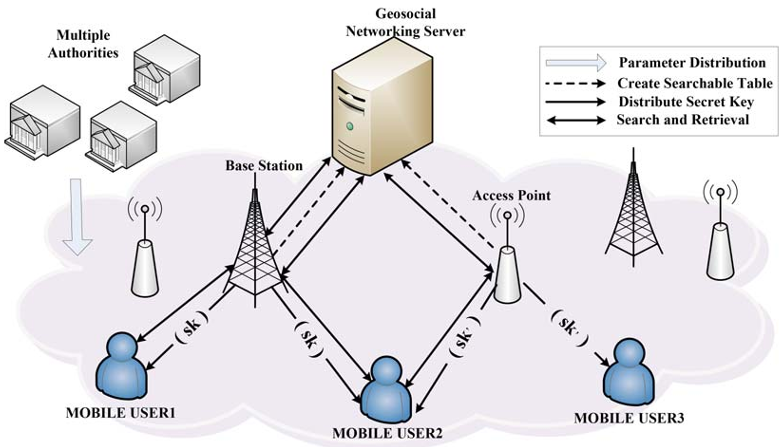 Fig 1: The architecture involving multiple authorities and a localized infrastructure (Base Station) to manage authentication.
Experimental Results
The authors evaluated the system using a C++ implementation on a 1.4 GHz machine. They focused on three key metrics: index generation, search time, and update efficiency.
- Scalability: Even with the attribute count increasing to 200, the search time remains within acceptable limits for real-time mobile interactions.
- Computational Offloading: A major highlight is the system's ability to move heavy key updates to the service provider without compromising the underlying secret matrices.
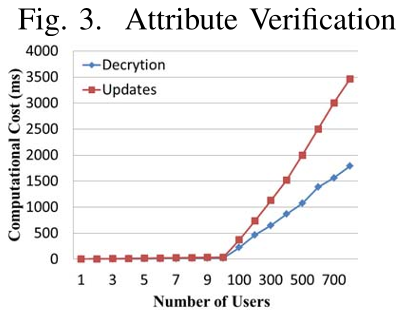 Fig 4 & 5: Performance metrics showing the linear growth of search time and efficient handling of updates.
Critical Insights & Future Outlook
This paper moves beyond the "all-or-nothing" approach to privacy. By using a localized trusted infrastructure (like a Base Station) to handle the heavy lifting of authentication and trapdoor generation, it reduces the burden on the end-user's mobile device.
Limitations: While the matrices provide efficient search, they are susceptible to certain "Known Plaintext Attacks" if the attacker can guess enough profile-trapdoor pairs. Furthermore, the reliance on a "Trusted Base Station" implies that privacy is localized; if the Base Station is compromised, the security of local users is weakened.
Takeaway: This work is a significant step toward Functional Encryption in social media. It proves that we don't need to trust big-tech servers with our data to enjoy the benefits of "finding friends nearby."