
Beyond Simple Matching: A Two-Phase Privacy Safeguard for Mobile Social Networks
A Privacy Preserving Matchmaking Scheme for Multiple Mobile Social Networks
The paper introduces a novel hybrid privacy-preserving matchmaking scheme for Mobile Social Networks (MSNs) using polynomial evaluation and homomorphic encryption. It enables an "initiator" to identify best-matches among multiple candidates across different networks while only disclosing common attributes to users who meet a specific similarity threshold.
TL;DR
As we move from static social networks to dynamic Mobile Social Networks (MSNs), the risk of "attribute leakage" to strangers grows exponentially. This paper presents a hybrid framework that uses Homomorphic Encryption and Secret Sharing to allow users to find "best-matches" across multiple networks. Crucially, it ensures that your private interests are only revealed to people who are already remarkably similar to you, while offloading the heavy math to auxiliary servers.
Context & Motivation: The Privacy-Efficiency Tradeoff
In the world of MSNs, "Matchmaking" is the process of finding people with shared interests. However, standard Private Set Intersection (PSI) protocols have a fatal flaw in social contexts: they are often "all-or-nothing." If you try to match with 100 strangers, you might end up leaking bits of your profile to 99 people you will never talk to again.
The authors identify two core challenges:
- Privacy Leakage: Minimizing information disclosure to non-matches.
- Resource Constraints: Mobile devices can't handle the heavy cryptographic load of comparing sets with hundreds of candidates simultaneously.
Methodology: The Two-Phase Hybrid Approach
The genius of this scheme lies in its Two-Phase Architecture, which separates the "Do we have enough in common?" question from "What exactly do we have in common?".
1. The Hybrid Architecture
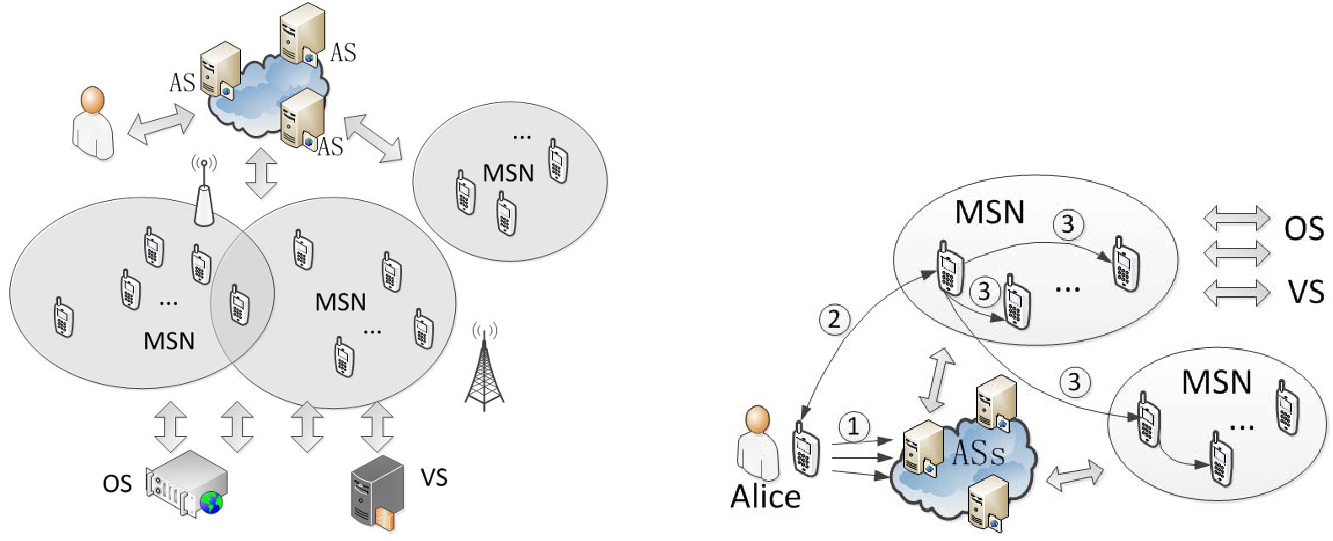
The system introduces Anchor Servers (ASs)—semi-honest entities that perform the heavy lifting. By using ()-Shamir Secret Sharing, the initiator's attribute set is distributed across multiple ASs. No single server can see the data, but collectively they can perform computations.
2. The Matchmaking Protocol
The protocol utilizes Polynomial Evaluation. An attribute set is represented as roots of a polynomial .
- Phase 1 (Filtering): The initiator broadcasts a request. Candidates interact with Anchor Servers to calculate the size of the intersection (). The initiator is not even involved here, saving battery and bandwidth.
- Phase 2 (Exchange): Only if the intersection size exceeds a threshold , the initiator and candidate proceed to exchange the actual common attributes using homomorphic encryption.
Experimental Results: Scalability in Real-World Graphs
The authors tested their protocol using the Epinions social network dataset (up to 5,341 nodes) on the PeerSim simulator.
Hit Rate vs. Network Hops
One critical metric is the Hit Rate (Hr)—the percentage of actual "best-matches" the initiator finds. The results show that with a "Time To Live" (TTL) of 3-4 hops, the initiator can discover roughly 60-80% of all potential matches in the network.
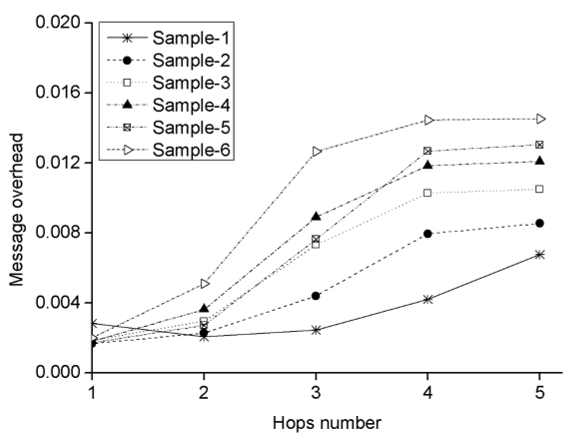 (Note: Fig 3. indicates the relationship between search depth and discovery success)
Efficiency
The Message Overhead (Mo) was found to be exceptionally low (less than 0.01), meaning the protocol doesn't choke the network with administrative metadata. Computationally, by utilizing ElGamal and offloading to ASs, the mobile device only performs a linear number of exponentiations relative to its own attribute set size.
Critical Insight & Conclusion
By moving away from a traditional client-server model to a Hybrid Anchor-based model, this paper solves the "Scan Attack" where a malicious user tries to guess your attributes one by one. The Anchor Servers can set a minimum attribute threshold, effectively filtering out "profile scammers."
Summary: This work is a robust step toward making MSNs both socially useful and cryptographically secure. It correctly identifies that in social discovery, the size of the connection is a prerequisite for the content of the connection.
Limitations
While the "semi-honest" assumption for Anchor Servers is standard in academic cryptography, deploying this in the real world requires absolute trust that these servers won't collude. Future versions might explore Zero-Knowledge Proofs (ZKP) to further harden the protocol against fully malicious servers.