
Beyond Binary Access: A Purpose-Driven Privacy Framework for Social Data
Towards a privacy preserving policy based infrastructure for social data access to enable scientific research
The paper proposes a policy-based infrastructure for social data access that enables scientific research while preserving individual privacy. It introduces a multi-modal access framework (Complete, Abstract, and Statistical) based on the SecPAL authorization language to go beyond traditional binary allow/deny semantics.
TL;DR
This research addresses the fundamental tension between individual privacy and the collective value of social data. By introducing a policy-based infrastructure that supports Abstract and Statistical access modes, the authors move beyond the "all-or-nothing" approach of traditional security, allowing researchers to gain insights through Differential Privacy while respecting user-defined "Sticky Policies."
The "Binary" Bottleneck: Why Traditional Security Fails
In standard operating systems, access is a switch: you either have the read bit or you don't. In social networks, this logic collapses. If Alice doesn't want strangers to see her location, but a traffic app needs aggregate data to predict a jam, a binary system forces Alice to either "leak" her privacy or "break" the app's utility.
Furthermore, the paper identifies a unique Shared Presence problem: if Will tags Alice in a photo he owns, Alice’s privacy is at the mercy of Will’s (potentially weak) policy. The authors argue that a formal framework must reason across multiple overlapping policies to prevent such leaks.
Methodology: The Core Mechanism
The proposed system relies on three pillars: Purpose, Identity, and Granularity.
1. Sticky Policies & Purpose-Based Access
Policies are "stuck" to the data. Unlike traditional systems that only ask "Who are you?", this framework asks "Why do you want this?". A user might allow their phone number for "Emergency Contact" but deny it for "Marketing."
2. The Delegation Chain
The architecture uses a hierarchical delegation model implemented in SecPAL. The Local Administrator delegates authority to Data Providers (like Facebook or HealthVault), who in turn delegate specific granular permissions to users.
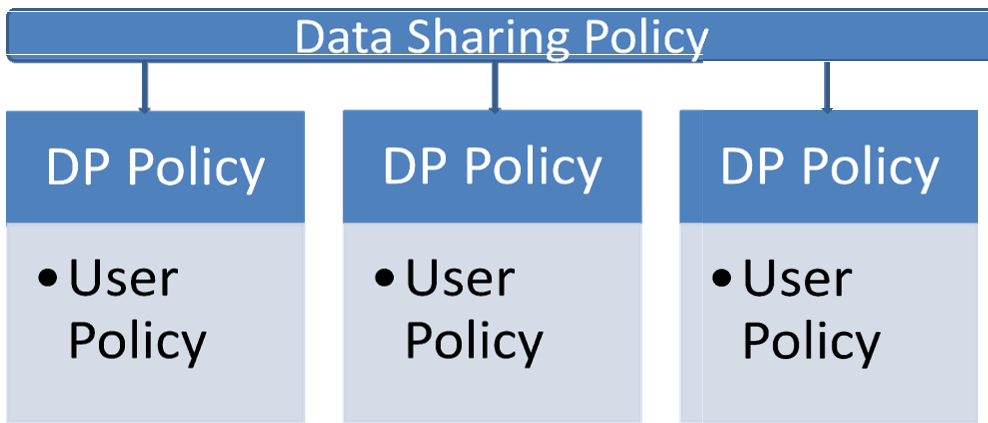 Figure 1: Policy hierarchy realized through a delegation chain where users and providers jointly define access rules.
3. Multi-Modal Access
This is the paper's most significant departure from SOTA:
- Complete Access: The raw data (e.g., exact Age: 39).
- Abstract Access: Data at a higher level of hierarchy (e.g., Age Group: 30-40).
- Statistical Access: Purely aggregate results for researchers, protected by Differential Privacy to ensure no individual can be re-identified.
Experiments and Results
To validate the framework, the authors tested it on the UCI Census dataset. They demonstrated that the system can dynamically adjust output based on the requester's role and the target privacy parameter ().
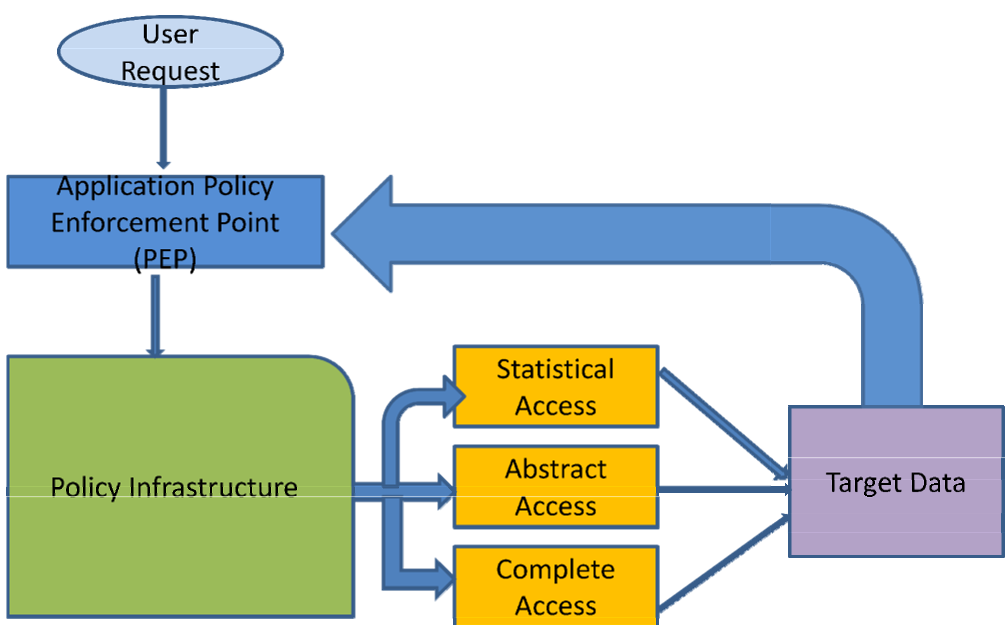 Figure 2: The high-level system architecture showing the interaction between the Policy Layer and the Privacy-Preserving Data Analysis module.
As seen in their implementation, when a friend (Cathy) requests Alice's age, she receives a range (30-40), whereas a researcher only receives statistical distributions. This proves that "Privacy" is not a single state, but a spectrum of data resolution.
Critical Analysis & Conclusion
Takeaway
The paper successfully shifts the privacy conversation from interdiction to negotiation. By treating "Purpose" as a first-class citizen in the authorization language, it provides a blueprint for how future social platforms can balance monetization/research with user trust.
Limitations
- Usage Tracking: The framework does not track data once it is released. If a researcher gets "Complete Access," there is no technical barrier to them using it for a different purpose later (though auditing is suggested as a solution).
- Conflict Resolution: When a user's policy is "weaker" than the provider's legal requirements, the system defaults to the more conservative provider policy, which might frustrate users seeking maximum openness.
Future Outlook
As privacy laws like GDPR and CCPA evolve, the demand for Statistical Access via Differential Privacy will likely become a standard requirement for all data-hosting platforms. This work serves as an early but robust foundation for that transition.