
Asynchronous Friendship: Privacy-Preserving Profile Matching via the Social Graph
Privacy-preserving profile matching using the social graph
The paper presents a privacy-preserving profile matching protocol for Online Social Networks (OSNs) that utilizes social graph trust and secret distribution. It allows a user to test similarity with a potential friend using a modified FNP set intersection cardinality protocol, uniquely supporting offline matching where the target user does not need to be active.
TL;DR
Matching with strangers in Online Social Networks (OSNs) usually requires a trade-off: reveal your interests to find common ground or stay private and isolated. This paper introduces a cryptographic protocol that allows "Alice" to check if she shares interests with "Bob" even if Bob is offline. By splitting Bob's encrypted profile between the OSN and his friends, the system ensures that no single party—including the social network itself—can see his private data.
Context & Motivation
Most secure matching protocols (like Private Set Intersection) are interactive, meaning both parties must be online at the same time to perform the cryptographic "handshake." However, research shows that random pairs of social media users are rarely online simultaneously.
Current solutions are often binary:
- Option A: Give the OSN all your data (High utility, Zero privacy).
- Option B: Encrypt everything locally (High privacy, Zero discovery/utility).
The authors aim for a middle ground where the OSN facilitates the match as a proxy but remains "blind" to the actual profile content.
Methodology: The Secret is in the Graph
The core innovation is the Secret Distribution Scheme combined with Proxy Re-Encryption (PRE).
1. Profile Decomposition
Instead of storing the profile as a single file, Bob represents his attributes as roots of a polynomial . This polynomial is split into two parts:
- : Given to the OSN in plaintext.
- : Encrypted and distributed through Bob's friends.
2. The Chain of Trust
To reconstruct the profile for matching, Alice needs . The OSN finds a path in the social graph from Bob to Alice. Using Proxy Re-Encryption, the encrypted is transformed step-by-step along this path until it can be decrypted by Alice's private key.
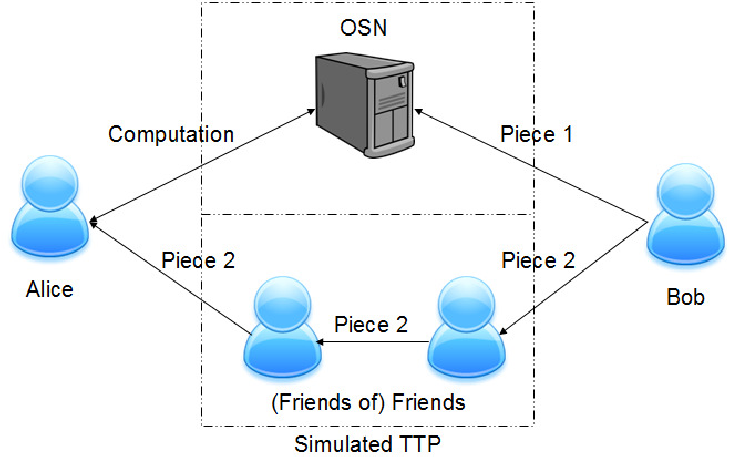 Fig 1: The basic matching workflow where the OSN acts as an intermediary.
3. The Matching Protocol
The matching itself uses a variant of the Paillier homomorphic cryptosystem. Alice computes the intersection size locally by combining her share, the OSN's share, and her own attributes, while the OSN performs "blinded" calculations.
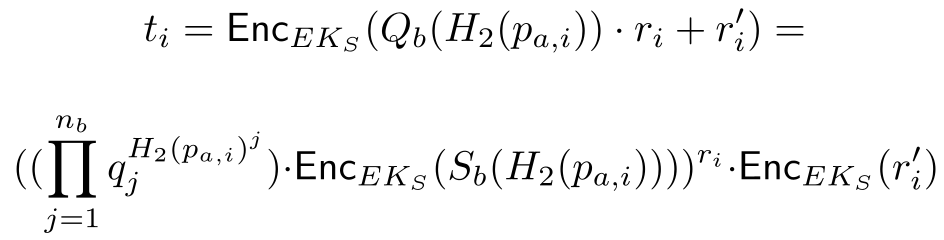 The mathematical logic used by Alice to obliviously evaluate Bob's polynomial without seeing the coefficients.
Experiments & Security Analysis
The paper's "experiment" is a formal security proof within the Honest-but-Curious framework:
- Alice's Privacy: The OSN only sees "blinded" values (random-looking numbers) because Alice uses fresh ephemeral keys for every request.
- Bob's Privacy: The OSN has but lacks . Alice has but only has an encrypted version of . Only by colluding can they reconstruct Bob's full profile.
(Note: This diagram illustrates the four-step handshake between Alice and the OSN server as detailed in Section 7.2.2)
Critical Insight: Why This Matters
The brilliance of this work lies in leveraging the social graph as a cryptographic infrastructure. Most people trust their friends more than a faceless corporation. By turning "friends" into "key distribution nodes," the authors create a decentralized trust layer on top of a centralized platform.
Limitations
- Collusion: If the OSN colludes with even one person in the friendship chain, Bob's privacy is compromised.
- Computational Overhead: Homomorphic encryption and polynomial evaluations are significantly slower than simple database lookups, posing a challenge for web-scale deployment.
Conclusion
This paper provides a robust blueprint for asynchronous privacy. It proves that we can discover people with shared interests without revealing our souls to the platform. Future work will likely focus on making these "social-graph-encrypted" lookups efficient enough to handle the billions of queries processed by networks like Facebook or X (formerly Twitter).