
PRIN: Decentralizing Privacy-Preserving Navigation via Vehicular Crowdsourcing
Privacy-Preserving Real-Time Navigation System Using Vehicular Crowdsourcing
This paper introduces PRIN, a Privacy-preserving Real-Ime Navigation system that utilizes vehicular crowdsourcing and Roadside Units (RSUs) to calculate optimal paths. By leveraging randomizable signatures and decentralized path computation, the system achieves SOTA security in conditional privacy preservation while maintaining low computational overhead for vehicles.
TL;DR
PRIN (Privacy-preserving Real-Ime Navigation) is a distributed architecture that solves the tension between real-time traffic awareness and driver privacy. Instead of a centralized server tracking your every move, RSUs (Roadside Units) collaboratively compute your route segments using crowdsourced data. By employing randomizable signatures, the system ensures your identity remains anonymous to the network while retaining "traceability" for security enforcement.
Background: The Privacy-Efficiency Paradox
In modern Intelligent Transportation Systems (ITS), traffic-aware navigation is a double-edged sword. To avoid a traffic jam, you must tell the system where you are and where you are going. This "Location Privacy" is often the first casualty of efficiency. Existing VANET (Vehicular Ad-hoc Network) research tried to solve this, but earlier models like VSPN suffered from two fatal flaws:
- The Relay Bottleneck: The vehicle had to retrieve final results from the first RSU, which is nearly impossible if the vehicle has already driven miles away.
- Computational Bloat: Using heavy cryptographic pairings for every retrieval made real-time processing sluggish on mobile hardware.
Methodology: The Core Insight
PRIN's genius lies in the Optimality Principle. A global optimal path from Point A to Point B is simply a collection of local optimal sub-paths.
1. Distributed Sub-path Computation
Instead of one global calculation, the task is handed off hop-by-hop. As you drive, the next RSU in your path gathers real-time speed and hazard data from vehicles currently in its range (Crowdsourcing). It then calculates the best exit strategy for its specific zone.
2. Anonymous & Randomizable Credentials
To keep the system secure but private, PRIN uses Randomizable Signatures.
- The Workflow: A vehicle randomizes its credential into a unique, non-linkable group signature .
- The Result: RSUs can verify you are a valid "legal vehicle" without knowing which vehicle you are. Even if an RSU is compromised, the attacker cannot link two queries to the same driver.
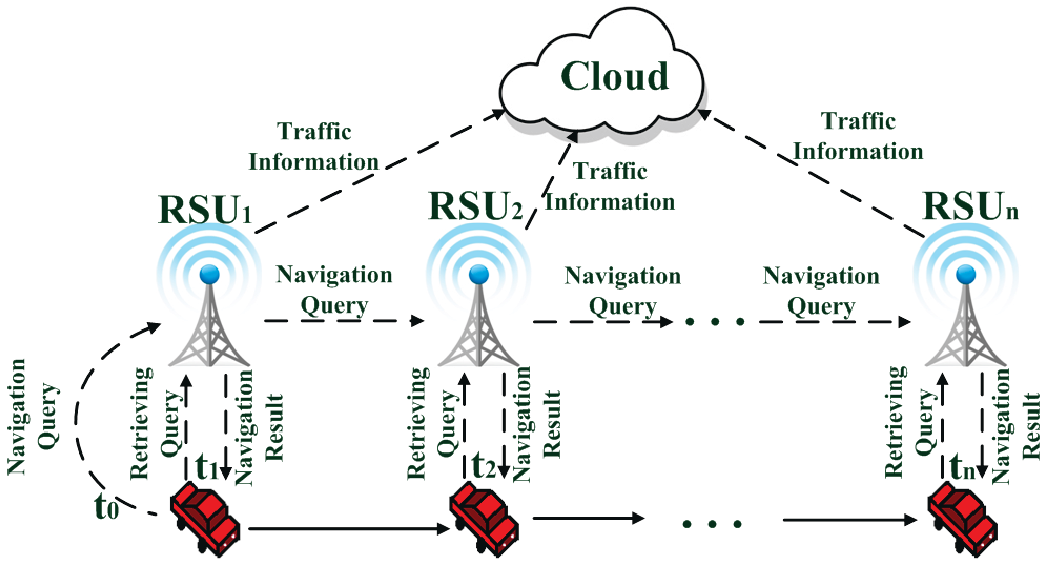 Figure 1: The PRIN System Model showing the interaction between TA, Cloud, RSUs, and Vehicles.
Detailed Mechanism
The navigation process is divided into five segments:
- Initialization: TA issues base credentials.
- Querying: The vehicle sends an encrypted to .
- Crowdsourcing: Local vehicles report traffic status anonymously.
- Result Retrieving: As the vehicle enters a new RSU's coverage area, it pulls the sub-route using a temporary key .
- Identity Tracing: If a vehicle uploads "fake" traffic jams to clear the road for itself, the TA can break the anonymity and identify the culprit.
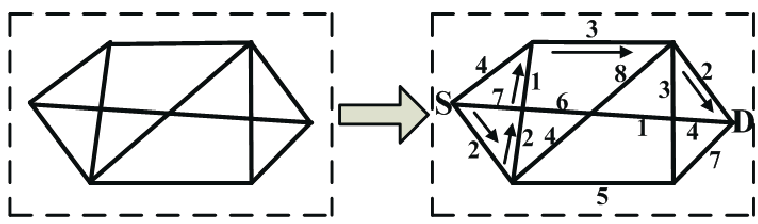 Figure 2: Example of finding the optimal sub-path within an RSU's coverage area using Dijkstra’s algorithm on crowdsourced weights.
Experiments & Results
The authors benchmarked PRIN against VSPN using a Kirin 910 CPU setup. The performance gains are most visible in the Retrieving Phase.
- Computation: While VSPN requires bilinear pairings (very expensive), PRIN reduces this to scalar multiplications and AES decryptions. In cryptographic terms, this is moving from "heavyweight" to "lightweight."
- Latency: Generating a query takes only 21.6ms, and retrieving the next segment takes 25.2ms. This is well within the safety margins for a vehicle moving at highway speeds.
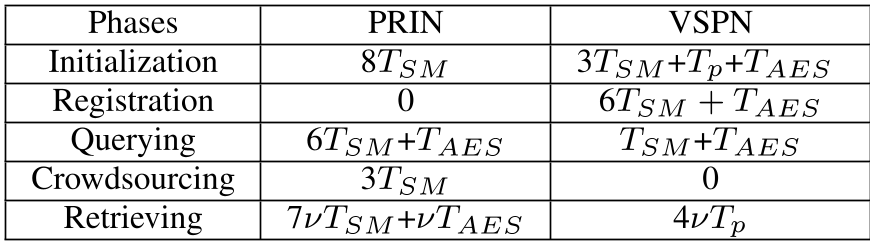 Table 1: Comparative computational burden for vehicles across different phases.
Critical Analysis & Conclusion
PRIN represents a significant shift from "centralized monitoring" to "collaborative intelligence."
Strengths:
- Superior Scalability: By processing locally at the RSU level, the system doesn't bog down as the number of users grows.
- Robust Privacy: Identity, location, and destination linkability are successfully broken.
Limitations:
- RSU Density: The system’s efficacy is highly dependent on a dense deployment of RSUs. In rural areas with sparse infrastructure, the "handoff" logic may fail.
- Crowdsourcing Integrity: While it has traceability, the system still requires a critical mass of honest vehicles to provide accurate traffic weights.
Future Outlook: The authors hint at extending this to on-street parking sharing, a domain where location privacy is even more sensitive. As we move toward 6G and Edge Computing, the PRIN framework's emphasis on local processing will likely become the standard for privacy-preserving AI on the move.