
MHARW & DFP: Solving the Scalability-Privacy Paradox in Decentralized Social Networks
Enabling Privacy-Preserving Rule Mining in Decentralized Social Networks
The paper introduces a privacy-preserving frequent itemset (FI) mining framework for Decentralized Online Social Networks (DOSNs). It combines Metropolis-Hastings Anonymous Random Walk (MHARW) for graph sampling with a Distributed FP-Growth (DFP) algorithm, achieving over 96% precision with as little as 1% sample size in well-connected networks.
TL;DR
Recommender systems are the lifeblood of modern social networks (OSNs), yet they typically require invasive centralized data harvesting. This paper presents a breakthrough for Decentralized Online Social Networks (DOSNs): a hybrid framework that uses Metropolis-Hastings Anonymous Random Walks (MHARW) and Distributed FP-Growth (DFP) to mine global association rules from tiny, local data samples. It achieves 96% accuracy while keeping communication costs constant regardless of the number of frequent items—a massive leap over traditional cryptographic methods.
The Problem: The High Cost of Privacy
In a centralized world, Facebook or Spotify sees everything. In a decentralized world, hardware like local "pods" or P2P nodes protects user data, but "global" knowledge is lost.
Previous attempts at Privacy-Preserving Association Rule Mining (PPARM) relied on heavy cryptographic lifting:
- Apriori-based Cryptography: Requires multiple passes over the data and messages.
- Computational Bloat: As the number of users () grows to millions, the complexity makes these protocols stall.
The authors realized that we don't need all the data to find frequent patterns; we just need a representative sample that doesn't leak who owns what.
Methodology: Sampling Meets Distributed Mining
1. MHARW: Graph Sampling with a Privacy Twist
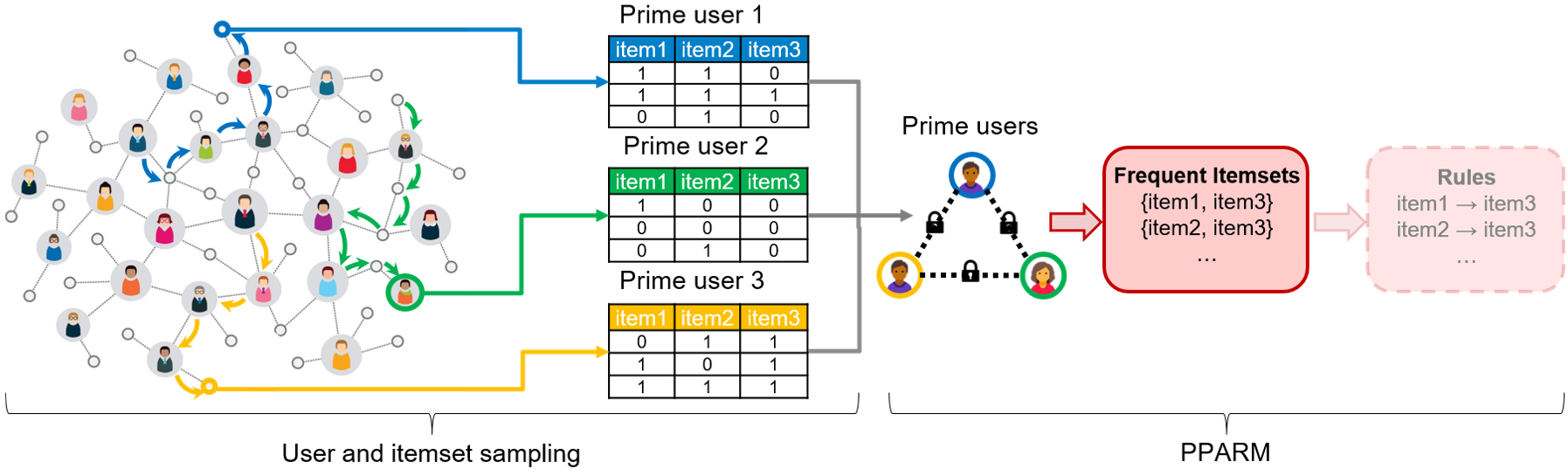
The authors adapt the Metropolis-Hastings Random Walk to ensure Unlinkability.
- The Insight: Standard Random Walks are biased towards "celebrities" (high-degree nodes). MHARW uses a proposal function to equalize the probability of visiting any node.
- Anonymity: They introduce a "Contributing Probability" (). A node might be visited but choose not to contribute data, making it impossible for a neighbor to know if the data came from the current node or was passed along from a predecessor.
2. DFP: Efficiency through Parallelization
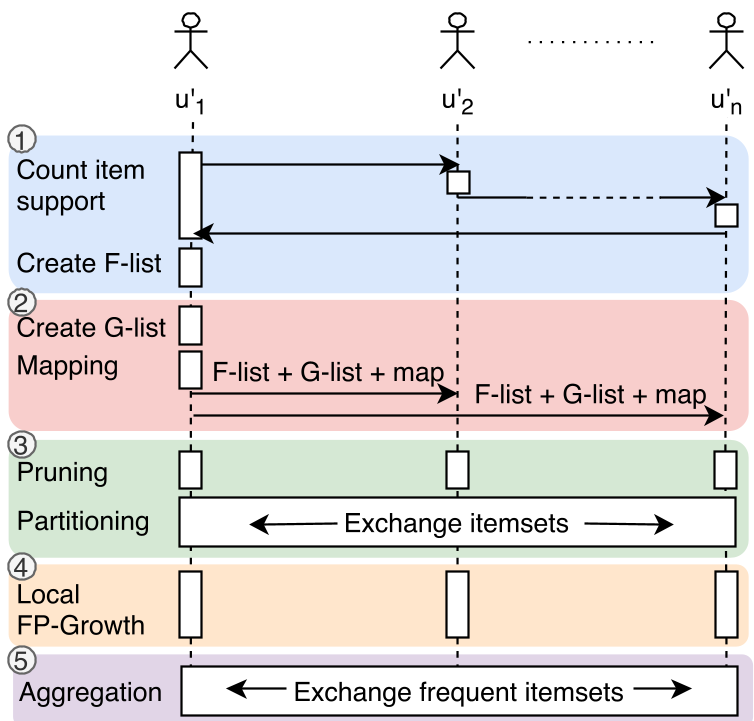
Instead of the multi-pass Apriori algorithm, they use Distributed FP-Growth.
- Secure Sum: Prime users (the sample collectors) use a ring-based secure sum to count item supports without revealing individual counts.
- G-List Partitioning: Items are grouped and assigned to different prime users. By only sending partial itemsets to specific "reducers," no single user ever sees a participant's full profile.
Experimental Battleground: Real-World OSNs
The researchers tested the system on three massive datasets: Flickr, LiveJournal, and Orkut.
- Precision/Recall: In the Orkut dataset (a highly connected graph), MHARW achieved an Average Precision (AP) of 0.96 with only 1% of the users sampled.
- Resistance to Sparsity: In Flickr, where many users have few interests, MHARW significantly outperformed Uniform (UNI) sampling. This is because the walk-based approach naturally finds the "communities" where interest groups are actually active.
- Message Efficiency: While the baseline UNIFI-KC protocol's message count explodes as the size of the mined itemsets () increases, the proposed DFP approach stays flat.
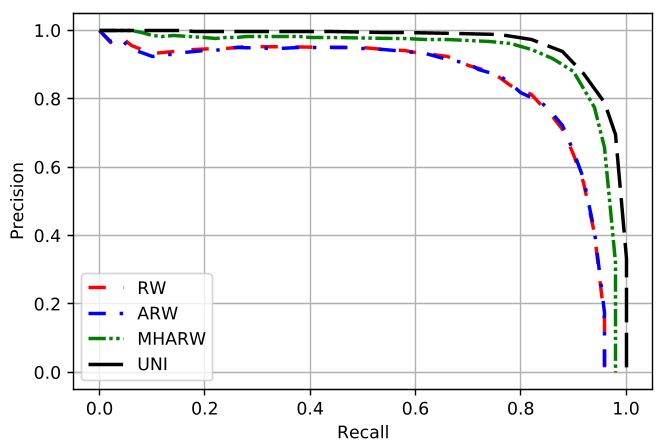 Fig: Results showing how MHARW maintains high performance even at low sample sizes in the Orkut dataset.
Critical Insight: Why This Works
The "magic" here lies in the Inductive Bias of social graphs. Interests are not distributed randomly; they are clustered. By using a specialized Random Walk (MHARW), the algorithm "hunts" through the topology to find these clusters. Because FP-Growth compresses the dataset into a tree structure (FP-tree), it only needs two passes, drastically reducing the "chatter" between decentralized nodes.
Summary & Future Outlook
Takeaway: This paper proves that decentralized networks can offer "Netflix-style" suggestions without a "Big Brother" database. By reducing the sample size to 1%, the attack surface for data leaks is shrunk by 99%.
Limitations:
- Sink Nodes: In directed graphs, walkers can get "stuck." The authors suggest treating the graph as undirected, which assumes bidirectional trust—a big assumption in some P2P scenarios.
- Collusion: If the "Prime Users" in the ring collude, they could potentially isolate a victim's data. Future work could integrate Homomorphic Encryption to further harden the system against malicious prime users at the cost of some speed.
Is this the end of centralized social mining? Perhaps not yet, but it provides the technical blueprint for a future where Privacy is the Default, not a feature.