
Reclaiming Privacy in the "Like" Economy: Decentralized Selective Disclosure
Allowing privacy-preserving analysis of social network likes
2013-07-01
Summary
Problem
Method
Results
Takeaways
Abstract
This paper introduces a privacy-preserving protocol for social network "Likes" that decouples user identity from their preferences while allowing selective attribute disclosure. By utilizing DHT-based P2P architectures and partially blind signatures, it enables verifiable resource evaluation that supports population-level data analysis without risking individual de-anonymization.
## TL;DR
Social network "Likes" are more than just digital nods; they are high-dimensional data points capable of predicting your religion, politics, and personality with startling accuracy. This paper presents a decentralized protocol that allows you to click "Like" while choosing exactly which attributes (e.g., your age bracket or region) to reveal for data analysis, without ever revealing *who* you are to the platform or third parties.
## The Motivation: The "Innocuous" Click
Research has shown that Facebook Likes can predict sensitive traits better than a user's friends can. Most current systems offer two extremes:
1. **Full Exposure**: Your identity is tied to every preference, enabling invasive data mining.
2. **Full Anonymity**: Votes are cast into a black box, making it impossible to perform valuable demographic analysis (e.g., "What do people in their 20s think of this content?").
The authors argue that the solution lies in **Selective Disclosure**. They propose a system where the "Like" is untraceable to the person, yet carries certified, non-identifying metadata that the user chooses to share.
## Methodology: Cryptographic Balancing Act
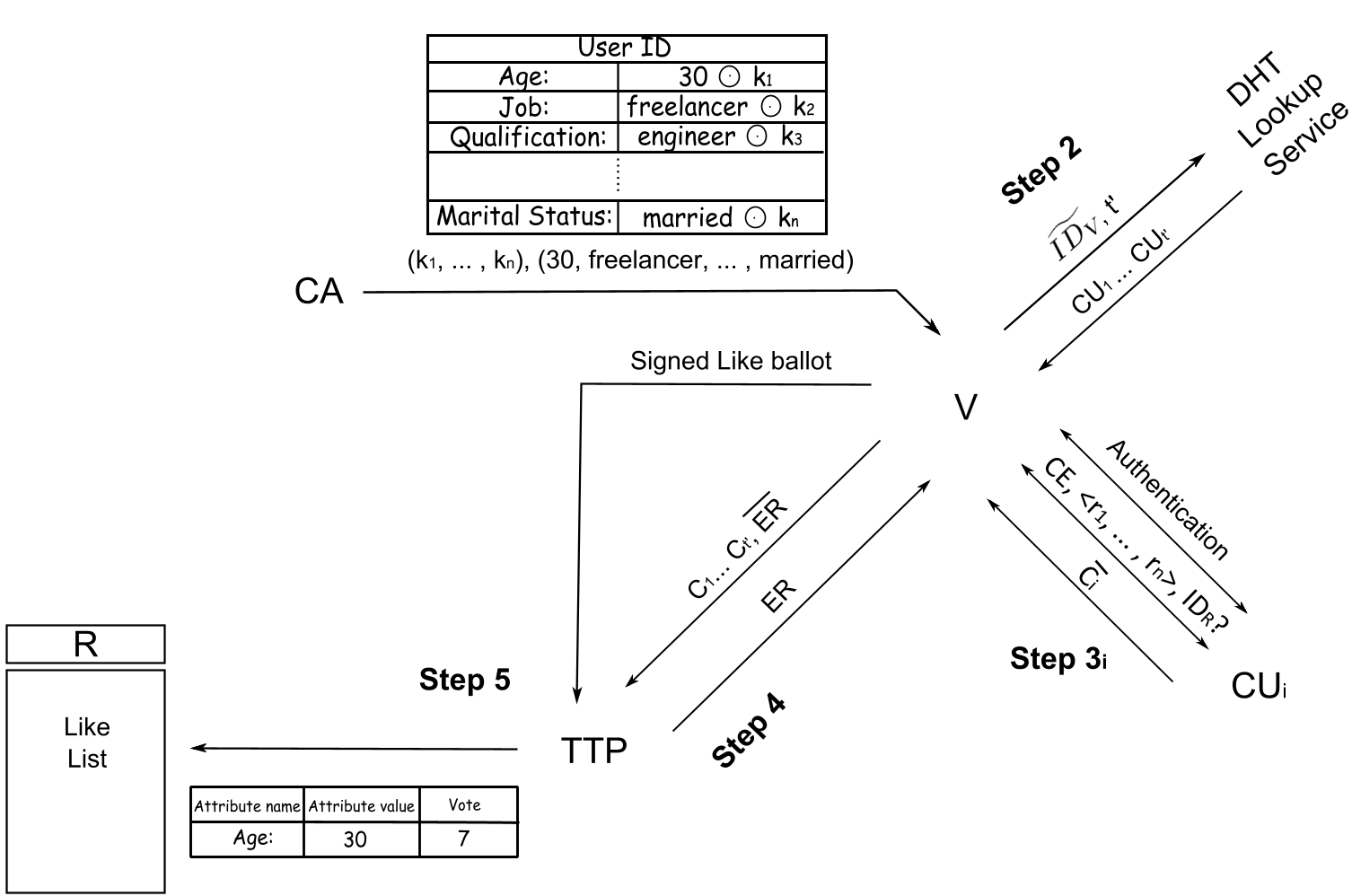
The system moves away from centralized servers to a **DHT-based P2P infrastructure**. The core workflow involves four key entities: the User (V), a Certification Authority (CA), Credential Users (CU) acting as decentralized distributors, and a Trusted Third Party (TTP) acting as a collector.
### The Architecture
The protocol relies on the **Discrete Logarithm Problem** and **Partially Blind Signatures**. When a user likes a resource, they obtain "credentials" from a randomly selected set of peers. These credentials allow the user to submit a "Like" ballot that includes:
* The resource ID.
* A score.
* User-selected attributes (obscured via modular power functions).
The "Blind" nature of the signature ensures that even the TTP collecting the likes cannot see the score or the user's identity during the signing phase, effectively breaking the link between the profile and the preference.
## Experiments & Security Analysis
The protocol addresses several classic challenges in decentralized voting:
* **Uncloneability**: By including a 128-bit random sequence $r$ in the ballot, the system detects any attempt to duplicate a "Like."
* **Robustness**: By using $t' = 2t + 1$ credential providers, the system remains secure even if up to $t$ nodes behave maliciously.
* **Attribute Secrecy**: Unless the user explicitly chooses to disclose an attribute, it remains hidden behind a modular power function. Finding the original attribute value from the obscured form is as difficult as solving a discrete logarithm.
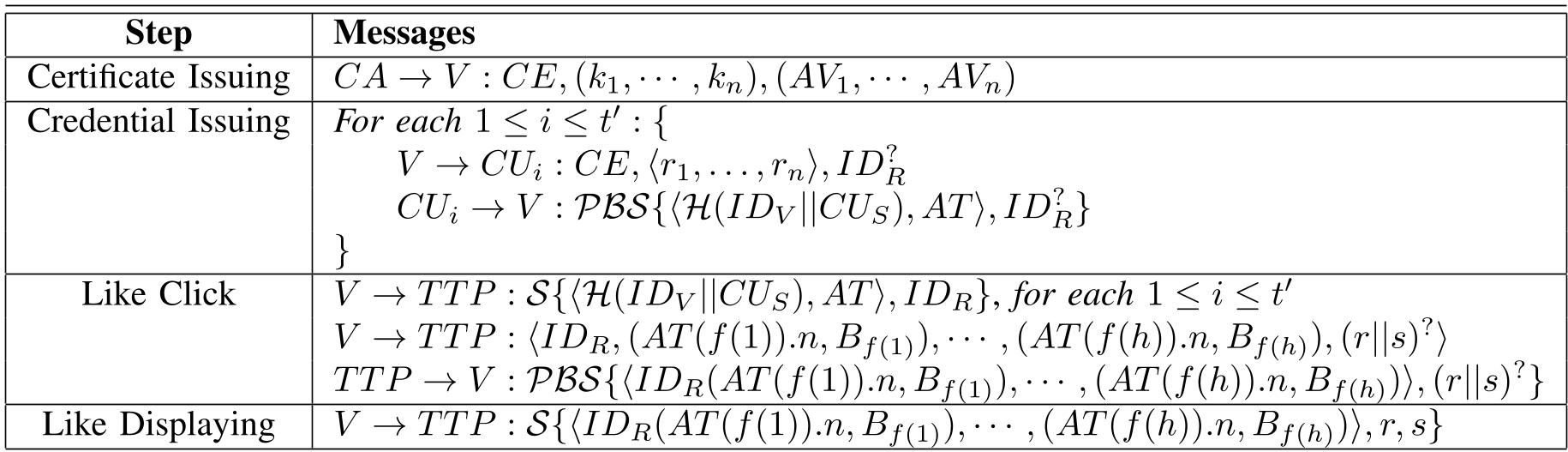
### Message Exchange Flow
The following table outlines how credentials and messages are exchanged to ensure that no single entity has the full picture of the user's identity and their preferences.
## Critical Insights & Conclusion
The brilliance of this work is its **Inductive Bias** toward decentralization. By shifting the "source of truth" for credentials from a single social network provider to a peer-to-peer network, it removes the "Big Brother" risk inherent in centralized platforms.
**Takeaways:**
* **Scalability**: The number of peers required for a transaction is constant (parametric to $t$), meaning the network remains fast even as users grow.
* **Hybrid Potential**: You don't need a total P2P revolution to implement this; the "Like" logic can be distributed via cloud/P2P modules while the content remains hosted centrally.
**Limitations**: The paper assumes the existence of a robust DHT and an anonymization layer like Tor. In high-latency environments, the multiple steps of credential issuing and unblinding might introduce a lag that modern UX-focused apps might find challenging.
In an era where "data is the new oil," this research provides the "refinery" that separates valuable demographic insights from private personal identities.