
Safeguarding Social Ties: Defending Against Mutual Friend Attacks in Network Data
Privacy Preserving Social Network Publication Against Mutual Friend Attacks
This paper introduces the "Mutual Friend Attack," a novel privacy vulnerability in social network data where adversaries re-identify edges (relationships) using the number of mutual friends (NMF). To mitigate this, the authors propose k-NMF Anonymity and develop algorithms (ADD and ADD&DEL) that ensure every edge shares the same NMF with at least k-1 others while preserving graph utility and the original vertex set.
In the era of big data, social networks are goldmines for researchers. However, publishing these datasets without compromising individual privacy is a tightrope walk. While we've long known how to mask names and even vertex degrees, a new shadow has emerged in the privacy landscape: the Mutual Friend Attack.
TL;DR
Researchers have identified that the number of mutual friends (NMF) can serve as a unique fingerprint to re-identify specific relationships in an anonymized graph. This paper introduces k-NMF Anonymity, ensuring every relationship is hidden among at least identical looking ties. By using a clever combination of edge additions and deletions guided by graph geometry, the authors protect privacy without destroying the scientific value (utility) of the data.
The Vulnerability: Why Degree Anonymity Isn't Enough
Existing methods mostly focus on k-degree anonymity—making sure every person has the same number of friends as others. But consider this: even if Alice and Bob both have 10 friends, the fact that they share exactly 4 mutual friends might be unique in the entire network. An attacker seeing "4 mutual friends" on a Facebook profile can cross-reference this with a "de-identified" research graph to pinpoint exactly which edge represents Alice and Bob.
The Core Insight: Triangles and ATPP
The technical heart of this paper lies in Proposition 1: The number of mutual friends of an edge is exactly equal to the number of triangles that edge participates in.
To solve this, the authors propose the Anonymized Triangle Preservation Principle (ATPP). The challenge is that adding an edge to fix one part of the graph might create a new triangle elsewhere, accidentally changing the NMF of an edge you already "fixed." ATPP ensures that:
- No new triangles are created involving already anonymized edges.
- No existing triangles are destroyed if they contain anonymized edges.
Methodology Detail: The ADD & DEL Approach
The authors suggest two primary algorithms:
- ADD (BFS-based Edge Anonymization): To increase an edge's NMF, the algorithm searches for candidate vertices in a Breadth-First Search (BFS) manner. It prefers adding edges to "close" neighbors (1-hop or 2-hop) to keep the graph's structure as natural as possible.
- ADD&DEL: This is the more sophisticated "Goldilocks" approach. It calculates a target NMF and uses a mix of adding edges and deleting weak ties (those with the fewest mutual friends) to reach the anonymity threshold with minimal distortion.
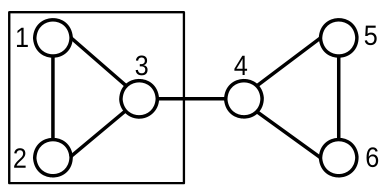 Figure: An example showing how an edge (D, E) can be re-identified in a degree-anonymized graph using the mutual friend count (the numbers on the edges).
Experimental Results: High Security, Low Distortion
The team tested their methods on three major datasets: ACM (citations), Cora (collaboration), and Brightkite (friendship).
The results were impressive:
- Utility Preservation: The Average Path Length (APL) of the anonymized graphs remained almost identical to the originals.
- Efficiency: The ADD&DEL algorithm consistently outperformed pure addition, requiring fewer changes to the graph's edge set.
- Dual Protection: The authors also demonstrated a "KDA" algorithm which layer k-degree anonymity on top of k-NMF, proving you can have both node-level and edge-level privacy simultaneously.
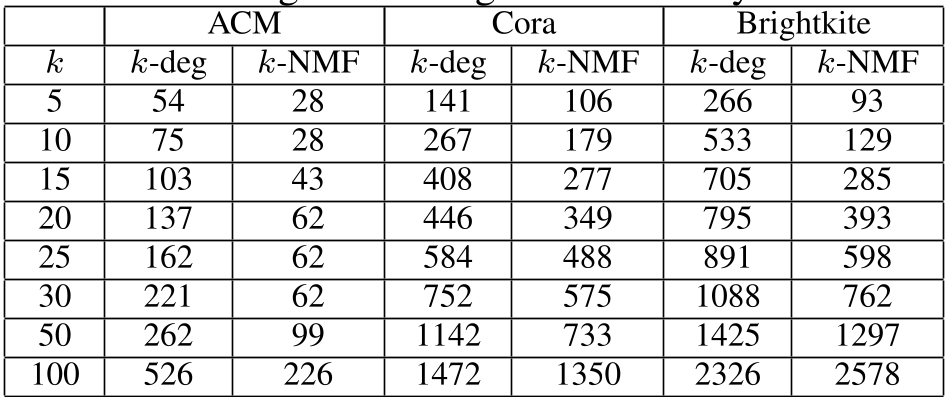 Table: The number of edges violating privacy is staggering in raw data (e.g., over 2,500 edges in Brightkite at k=100), highlighting the urgent need for NMF-specific anonymization.
Deep Insight: The Value of Logic over Brute Force
What makes this work stand out is the maximum mutual friend criterion. When the algorithm needs to add an edge, it doesn't do it randomly. It chooses pairs that already have many mutual friends. This mimics how real social networks evolve (homophily), which is why the resulting "fake" data still looks and acts like a "real" social network for researchers.
Conclusion
As social data becomes more interconnected, our privacy models must evolve from simple "node hiding" to "structure hiding." This paper provides a robust framework for neutralizing mutual friend attacks, ensuring that while the "forest" (the network's statistical properties) remains visible for science, the "trees" (individual relationships) remain safely hidden in the crowd.
Future Outlook: While effective, these methods currently assume a static graph. Extending k-NMF anonymity to dynamic, evolving networks is the next big frontier in social data privacy.