
CFP Attacks: Why Celebrities in Your Network Pose a Threat to Your Privacy
Preserving privacy in social networks against connection fingerprint attacks
This paper introduces the Connection Fingerprint (CFP) attack, a novel re-identification threat in social networks that exploits the relationship between private users and public entities (e.g., celebrities, media). The authors propose two k-anonymization algorithms—Dummy Vertex Addition and Edge Modification—to protect identity privacy while maintaining network utility and SOTA performance in rank-based centrality preservation.
TL;DR
Most social network anonymization research assumes a "blackout" where all identities are hidden. This paper argues that the existence of Public Users (celebrities, brands, government accounts) creates a "Connection Fingerprint" (CFP) that can lead to 100% accurate re-identification of private users. The authors introduce two k-anonymity algorithms—adding dummy nodes and modifying edges—that successfully mask these fingerprints without destroying the network's analytical value.
The Hidden Vulnerability: Public Anchors
In modern datasets like Sina Weibo or Facebook, about 1% of users are public. While your name might be removed from a dataset, your connection to The BBC, Elon Musk, and NASA is likely unique. If an attacker knows you follow those three specific accounts, they can find the "anonymous" node in the graph with those exact connections and unmask you.
The authors define this as the Connection Fingerprint (CFP) Attack. Their risk analysis shows that if just the top 1% of high-degree nodes are treated as public, up to 70% of private users in some networks can be pinpointed.
Methodology: Two Paths to K-Anonymity
1. Dummy Vertex Addition (The -Hop Defense)
For protection against sophisticated attackers who know your connections up to hops away, the authors suggest adding "decoy" users.
- The Intuition: If a user is unique, create digital twins.
- Mechanism: The algorithm clones a real private node's connections but then performs "Edge Switching" to make the dummy nodes less obvious while mathematically preserving the connection fingerprint to public nodes.
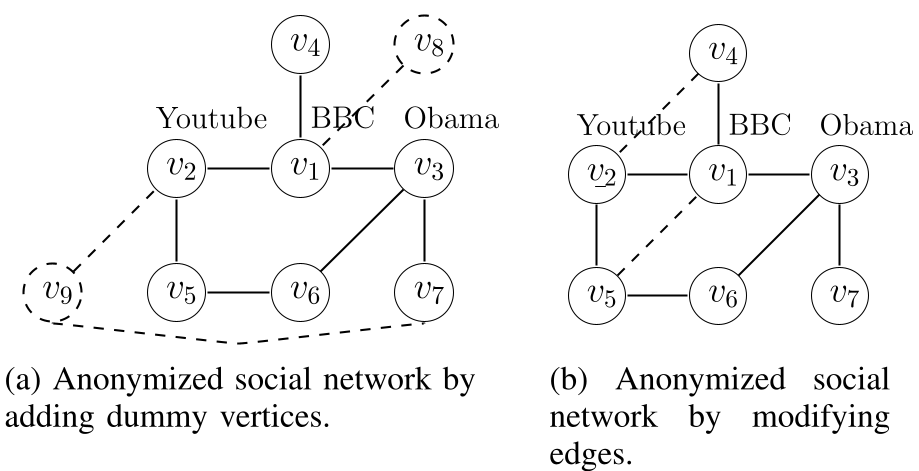 Figure 1: By adding dummy vertices (v8, v9) and edges, the network ensures no single private user has a unique path to public anchors.
2. Greedy Clustering (The 1-Hop Efficiency)
When only immediate (1st-hop) connections are the concern, adding nodes is overkill. Instead, the authors use Edge Modification.
- The Intuition: Convert connection profiles into binary vectors and group users. Use a greedy approach to move users toward a "Median Center" of their cluster.
- Mathematical Goal: Minimize the Hamming distance (number of edge changes) required to make users look identical in their connections to public entities.
SOTA Performance and Utility
A major contribution of this work is the evaluation of Network Utility. Anonymization is useless if it ruins the graph for researchers.
The authors focus on Centrality Preservation. While raw centrality scores (like PageRank or Betweenness) might shift, the Rankings remain incredibly stable.
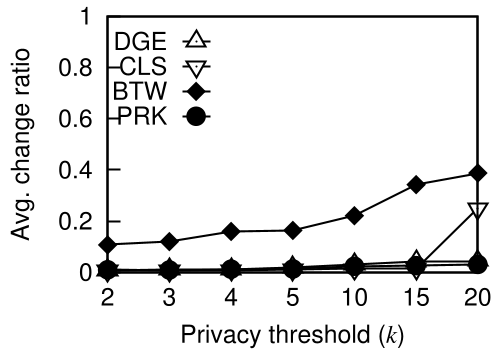 Figure 2: Spearman’s Rank Correlation (SRCC) remains near 1.0, proving that the relative "influence" of nodes is preserved even after privacy modifications.
Key Results:
- Efficiency: Algorithms run in under 12 seconds even on large networks (route-view, 6k+ nodes).
- Utility: Beyond centrality, the edge modification method preserves Community Structure (Rand Index close to 1) and Shortest Path lengths, ensuring the "Small World" property of the network remains intact.
Critical Analysis & Conclusion
The core insight of this paper is the shift from "Global Anonymity" to "Contextual Anonymity." By acknowledging that some information is already public, the authors create a more realistic threat model.
Takeaway: If you are building Graph Neural Networks (GNNs) or social analytics tools, you cannot assume that removing names is enough. You must mask the structural fingerprints left by connections to "hub" nodes.
Limitations: The Dummy Vertex method, while robust for -hops, increases the graph size, which might interfere with density-sensitive algorithms. Future research should look into whether these dummy nodes can be detected by structural anomaly detection algorithms.