
Secure Crowdsourcing: Decentralizing Privacy-Preserving Surveys via Smartphones
Privacy-preserving survey by crowdsourcing with smartphones
The paper introduces a secure crowdsourcing platform for privacy-preserving surveys that leverages the Paillier Homomorphic Cryptosystem and Secure Multi-party Computation (SMC). By shifting the computational burden to personal smartphones, the system achieves scalable, aggregated data analytics while ensuring that neither the platform nor the service requestor can access individual raw data.
TL;DR
This paper presents a novel crowdsourcing architecture designed for privacy-preserving surveys. Instead of uploading sensitive data to a central server, users keep their data on their smartphones. By utilizing Paillier Homomorphic Encryption and Secure Multi-party Computation (SMC), the platform coordinates smartphones to compute aggregated statistics (like average or max values) without the server ever seeing individual or final results.
Background: The Cost of Centralized Privacy
In the digital age, surveys are essential for market research and governance. However, they face a "Privacy-Utility Trade-off." Current solutions usually involve Secure Data Outsourcing, where encrypted data is stored on a semi-trusted server.
The bottleneck here is performance: executing complex queries on encrypted data is computationally "heavy." The authors note that some existing systems take nearly 40 seconds just to process a single standard query. Moreover, once data leaves the user's device, the user loses control—an issue of Data Sovereignty.
Methodology: The Power of the Crowd
The core insight of this paper is to treat a network of smartphones as a distributed computer.
1. Collaborative Architecture
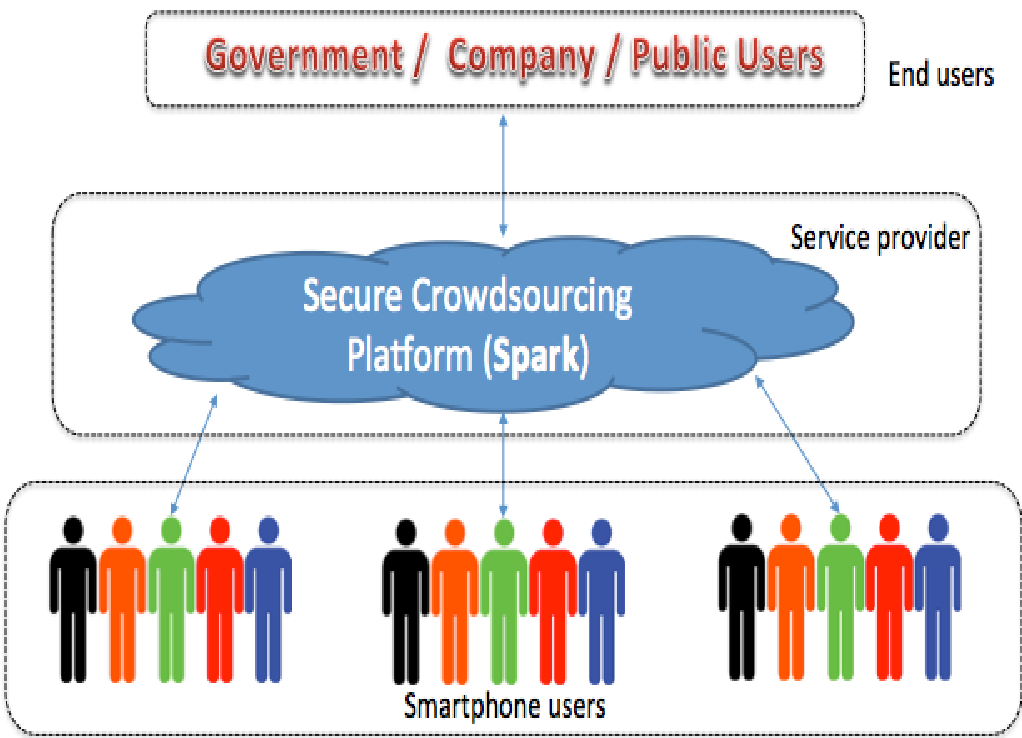
The system involves three parties:
- Service Requestors: They ask the questions (e.g., "What is the average salary?").
- Crowdsourcing Platform: The orchestrator. It decomposes tasks and aggregates encrypted partial results.
- Mobile Users: The data owners. They perform the heavy lifting of encryption and local computation.
2. Secure Operators (Summation & Max)
The authors implement two fundamental primitives that enable most survey analytics:
-
Secure Summation: Using the Paillier Cryptosystem, which is additively homomorphic. Users encrypt their values; the server simply multiplies these ciphertexts. Because of the homomorphic property, the product of ciphertexts decrypts to the sum of the plaintexts. The server never sees the raw data, and only the requestor holds the decryption key.
-
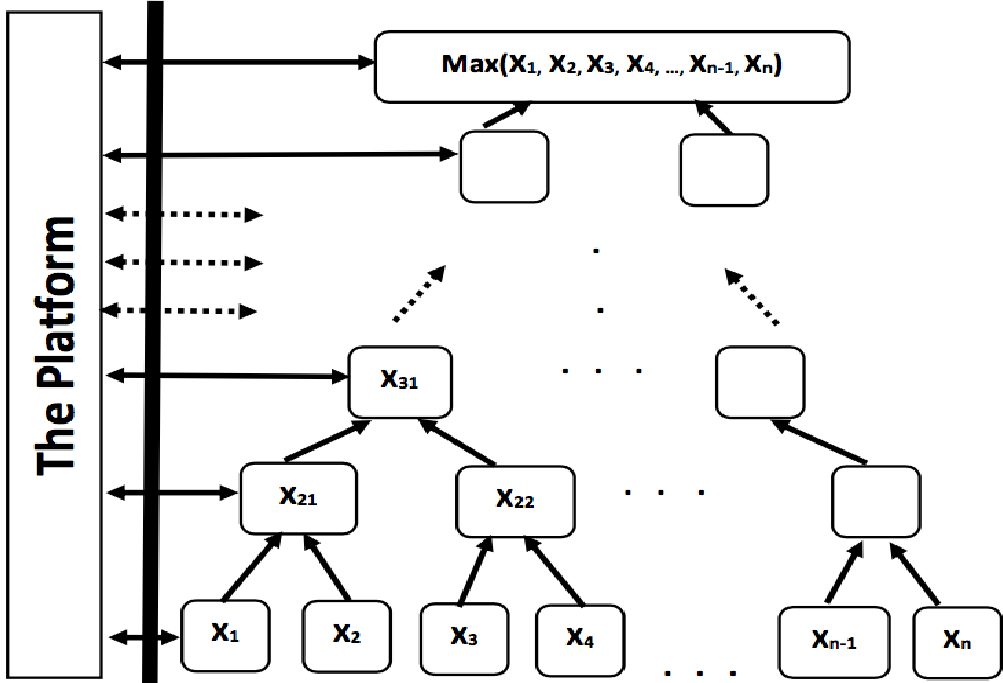
Secure Max: This is achieved through a hierarchical tree. Pairs of users compare their values using a Secure Comparison (CMP) protocol. The winner moves up the tree. This ensures that the global maximum is found in steps without revealing which specific user held the value.
Experimental Insight & Scalability
The authors emphasize Scalability. In traditional models, a server's workload scales linearly with the number of users. In this model, the server's work is limited to simple multiplications.
For a massive deployment—say, 30 million users—the Secure Max tree only has a depth of 26. This parallelization makes the platform "lightweight" and capable of handling large-scale urban surveys in real-time.
Critical Analysis: Data Control & Future Outlook
One of the most valuable aspects of this research is the Data Access Control (DAC) list. Because data never leaves the phone, users can:
- Set economic incentives (e.g., "Pay me $1 to access my financial data").
- Apply context-aware rules (e.g., "No data sharing while I'm on a phone call").
Limitations
While the architecture is robust against "honest-but-curious" entities, it may face challenges if participants are malicious (providing fake data to skew the average). Future work could integrate Zero-Knowledge Proofs (ZKPs) to verify the integrity of the data being submitted without compromising privacy.
Conclusion
This paper successfully bridges the gap between massive data collection and individual privacy. By shifting the computational paradigm from the cloud back to the edge (the smartphone), it provides a scalable, secure, and user-centric solution for the next generation of social and market research.