
Toward Efficient Privacy: RSA-Based Blind Signatures for Mobile Healthcare Matching
Toward Privacy-Preserving Symptoms Matching in SDN-Based Mobile Healthcare Social Networks
This paper proposes two privacy-preserving symptom matching schemes (coarse-grained and fine-grained) for SDN-based Mobile Healthcare Social Networks (MHSNs). By utilizing RSA-based blind signatures and Bloom filters, the system enables patients to find others with similar health conditions without revealing sensitive medical data to strangers or relying on a Trusted Third Party (TTP).
TL;DR
Researchers have developed a highly efficient way for patients in mobile networks to find peers with similar symptoms without revealing their actual medical data. By replacing heavy "Bilinear Pairing" cryptography with optimized RSA-based blind signatures and Bloom filters, the authors achieved a 300x speedup in matching efficiency, making real-time mobile healthcare social networking a reality.
The "Privacy vs. Utility" Dilemma in Healthcare
Mobile healthcare social networks (MHSNs) allow patients to share experiences and find support. However, sharing a list of symptoms with a stranger is a major privacy risk. Previous solutions either required a Trusted Third Party (TTP)—which is a security bottleneck—or used complex math that drained a smartphone's battery in seconds. The core challenge: How can two strangers verify they have common symptoms without showing each other their list first?
Methodology: High-Speed Privacy
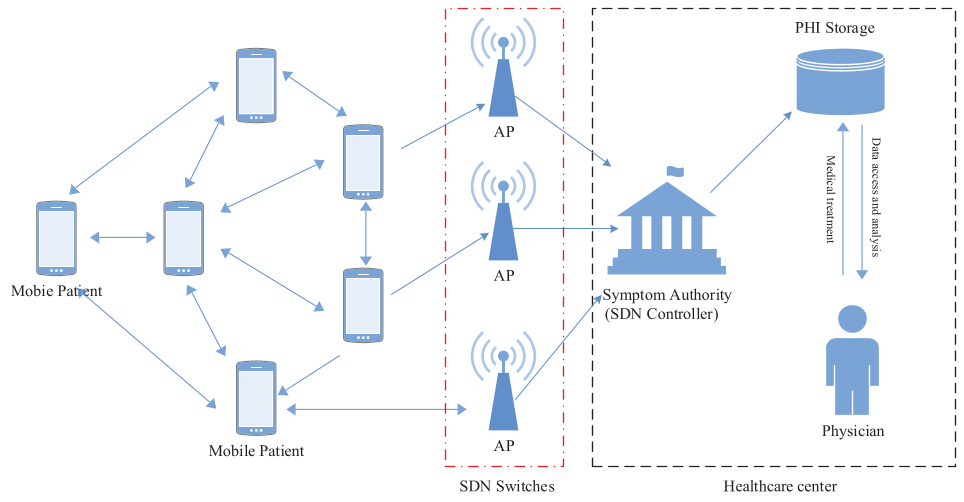
The authors suggest that the "Software Defined Networking" (SDN) paradigm can manage data flows, but the privacy heavy-lifting is done by blind signatures.
1. Coarse-Grained Matching (Yes/No)
In this mode, patients just want to know if they share the same symptoms.
- Mechanism: The initiator (Alice) signs her symptoms and stores them in a Bloom Filter.
- The "Blind" Trick: The responder (Bob) sends his symptoms to Alice in a "blinded" (encrypted) format. Alice signs them and sends them back. Bob unblinds them to get a signature.
- The Logic: If Alice’s signature for a symptom matches the one Bob just unblinded, they have a match. Crucially, Alice never saw what she signed, and Bob can't reverse the Bloom filter to see Alice's other symptoms.
2. Fine-Grained Matching (Degree of Severity)
Often, just having the same symptom isn't enough; you want to find someone with a similar severity level. The paper uses a Weighted Euclidean Distance formula. Alice and Bob exchange hashed priority levels tied to their common symptoms, allowing Alice to calculate a similarity score without knowing Bob's non-matching symptoms.
Experimental Results: The Performance Gap
The most striking part of this research is the performance comparison.
- RSA vs. Pairing: Traditional Pairing-based schemes (like Zhu et al.) take roughly 70 seconds to process 100 symptoms.
- This Scheme: The proposed RSA-based approach completes the same task in under 0.2 seconds.
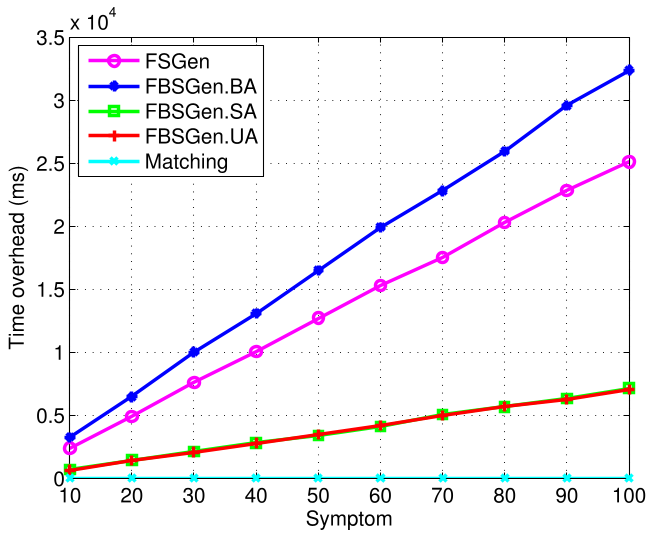
The power analysis further confirms that the CPU load remains low (~17%), ensuring the app doesn't crash or overheat the user's phone during the discovery process.
Deep Insight & Conclusion
This paper serves as a reminder that "cutting-edge" cryptography isn't always the best for "edge computing." By revisiting RSA-based blind signatures and combining them with space-efficient data structures like Bloom filters, the authors solved a high-latency problem in MHSNs.
Limitations: While the scheme protects symptom names, the fine-grained version does share priority levels for matching symptoms. Future research could focus on hiding these levels further using homomorphic encryption or functional encryption, provided they can meet the same high-efficiency bar set by this work.