
PriTA: Decentralizing Spatial Crowdsourcing with Perfect Privacy and Near-Optimal Efficiency
Toward Privacy-Preserving Task Assignment for Fully Distributed Spatial Crowdsourcing
The paper introduces PriTA, an online, fully distributed spatial crowdsourcing framework that performs task assignment while preserving location privacy for both workers and requesters. It leverages Fan-Vercauteren (FV) homomorphic encryption and innovative mechanisms like "wait-and-decide" and "proportional-backoff" to achieve near-optimal task assignment performance without a centralized server.
TL;DR
PriTA is a breakthrough framework for Spatial Crowdsourcing that removes the need for a central server (and thus a central point of data leakage). By combining Homomorphic Encryption with a clever Proportional-Backoff mechanism, it allows workers and requesters to match based on exact distances without ever revealing their actual GPS coordinates to anyone—including each other.
The Problem: The Privacy-Efficiency Paradox
In the world of Uber, Meituan, or Amazon Mechanical Turk, location is the ultimate currency. To assign a task efficiently, a system needs to know exactly where the requester and the worker are.
Current solutions face a double-bind:
- Centralization Bottlenecks: Relying on a central server creates privacy risks (what if the server is hacked?) and scalability issues.
- The Noise Trade-off: Privacy-preserving techniques like Differential Privacy add "noise" to locations. While this protects the user, it makes the distance calculation inaccurate, leading to 20-30% drops in assignment efficiency.
Methodology: Distance Calculation in the Dark
PriTA’s core innovation is performing geometry on ciphertexts.
1. Homomorphic Distance Matching
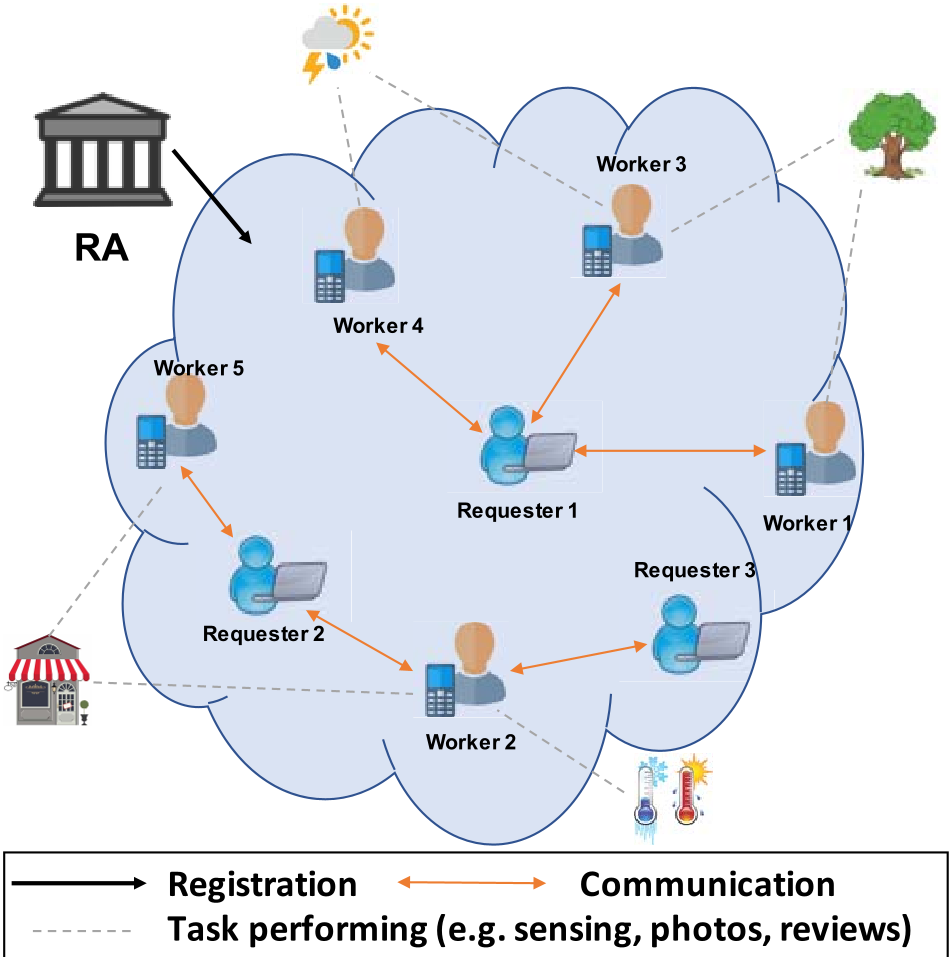
Instead of sending (x, y) coordinates, a requester broadcasts an encrypted location using a Somewhat Homomorphic Encryption (SHE) public key. A worker receives this and, using the properties of homomorphic addition and multiplication, calculates the squared Euclidean distance inside the encrypted envelope.
2. The Proportional-Backoff Mechanism
In a distributed system with no "boss" to decide who gets which task, how do we ensure the closest worker wins? PriTA uses a Time-as-Signal approach:
- Wait-and-Decide: Workers wait for a window () to collect multiple task offers.
- Proportional Backoff: The worker sets a timer: .
- The Result: The closest worker’s timer expires first. They broadcast a "Task Proposal" first, and other (further) workers who hear this "overhear" that the task is taken and abort their own timers.
Experimental Performance
The researchers tested PriTA using real-world NYC taxi trip data.
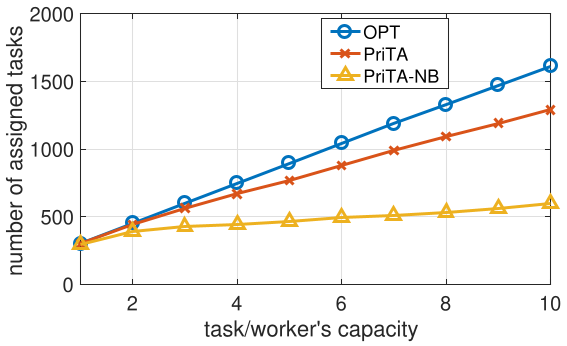
- Accuracy: Despite being fully distributed, the number of successful assignments was nearly identical to a "Global Optimal" (OPT) central server.
- Privacy: It significantly outperformed Differential Privacy (DP) baselines. In DP, an attacker can still guess the location within a probability radius; in PriTA, the raw location remains mathematically hidden behind the RLWE (Ring Learning with Errors) hardness problem.
- Speed: Total computation is roughly 379ms for workers and even less for requesters—perfectly viable for modern smartphones.
Critical Insight: Why This Matters
The "magic" of PriTA is that it proves Location Privacy doesn't have to mean Location Inaccuracy. By moving the matching logic from a central server to the secure edge (the users' devices) and using time-delays to represent physical distance, the authors have created a blueprint for truly private, "invisible" logistics networks.
Conclusion & Future Work
PriTA represents 1st-generation distributed spatial crowdsourcing. The primary limitation is the assumption of a stable network without packet loss during the backoff phase. Future research will likely focus on making this protocol robust against network jitter and exploring its application in Autonomous Vehicle coordination and Decentralized Delivery (Web3) applications.