
Privacy-Preserving Task Recommendation: A Win-Win for Mobile Crowdsourcing
Privacy-preserving task recommendation with win-win incentives for mobile crowdsourcing R
This paper introduces a privacy-preserving task recommendation scheme for mobile crowdsourcing that utilizes advanced Attribute-Based Encryption (ABE) with preparation/online encryption and outsourced decryption. The core contribution is a dual-policy matching framework that aligns requester requirements with worker capabilities and interests to ensure a SOTA "win-win" incentive structure.
Executive Summary
TL;DR: This paper tackles the inherent conflict between personalization and privacy in mobile crowdsourcing. By utilizing a "dual-policy" Attribute-Based Encryption (ABE) framework, the authors enable a service platform to match tasks to workers based on both capabilities and interests without ever seeing the raw data. The result is a system where requesters get high-quality data and workers get relevant, high-reward tasks, all while maintaining near-zero computational strain on mobile devices.
This work sits at the intersection of Applied Cryptography and Optimization, moving beyond simple data anonymity to a functional, privacy-aware recommendation engine.
Problem & Motivation: The Crowdsourcing Paradox
Mobile crowdsourcing (MCS) is a powerful paradigm, but it suffers from two major friction points:
- Privacy Leakage: Requesters publishing tasks (e.g., medical data collection) might reveal sensitive corporate or health information. Workers, by expressing interest, reveal their habits, locations, and personal preferences.
- Resource Asymmetry: Prior SOTA methods often relied on complex cryptographic primitives that drained mobile batteries. Without a "win-win" incentive—where workers find tasks they actually want to do—the system collapses as users abandon the platform.
The authors identified that existing schemes were either private but inefficient, or effective but intrusive. They aimed to break this trade-off using Outsourced Decryption and Preparation/Online Encryption.
Methodology: The Dual-Policy Engine
The core innovation is the Dual-Policy Bipartite Matching. The system involves four entities: the Authority, the Service Platform, the Requester, and the Worker.
1. Dual-Policy Architecture
Unlike standard ABE where only one side sets a policy, this scheme uses two:
- Requester Side: Encrypts task content with a Requirement Policy (e.g., "Worker must have 5-star rating AND be in Category A").
- Worker Side: Encrypts their profile with an Interest Policy (e.g., "Only show me tasks paying > $10 OR tasks related to Environment").
2. Outsourced Matching & Decryption
To solve the efficiency problem, the authors shifted the heavy lifting:
- Preparation Phase: The requester pre-calculates task-independent encryption parameters during idle times.
- Matching Phase: The Service Platform performs a "Match Test" on ciphertexts. It can verify if a worker's attributes satisfy the task's policy without learning the attributes themselves.
- Outsourced Decryption: The platform pre-decrypts the task, sending a "Temporary Key" (TK) to the worker. The worker only needs to perform one exponentiation to retrieve the data.
 Figure 1: The overall workflow of the privacy-preserving recommendation scheme, highlighting the interactions between the authority, platform, and users.
Experiments & Results
The researchers implemented their scheme using the RELIC library with 256-bit Bareto-Naehrig curves, testing on ARM Cortex-A9 (mobile) and Intel i5 (server) platforms.
Key Performance Markers:
- Worker Efficiency: As shown in the performance charts, the worker's decryption time remains constant regardless of the complexity of the task's attributes. This is a game-changer for battery-constrained devices.
- Encryption Speed: By splitting the process into preparation and online phases, the "online" part of the task encryption is virtually instantaneous, scaling linearly with very a small slope compared to the PAB-MKS baseline.
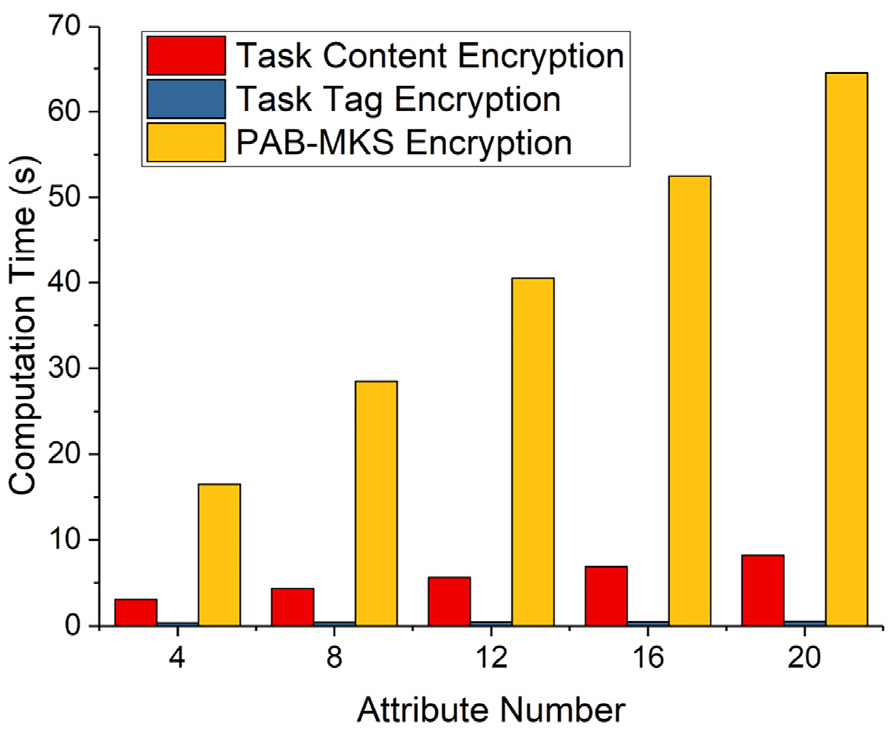 Figure 2: Computation overhead comparison showing the efficiency gains in task content and tag encryption.
Critical Analysis & Conclusion
The "Win-Win" Takeaway
The paper successfully proves that privacy doesn't have to be a barrier to utility. By allowing the platform to act as a "blind matchmaker," the system ensures that:
- Requesters get the most capable workers.
- Workers conserve battery and only see relevant tasks.
Limitations & Future Work
While the scheme is mathematically robust (proven under Decisional Bilinear Diffie-Hellman), it assumes an "honest-but-curious" platform. In real-world scenarios, a malicious platform might try to perform side-channel attacks. Future extensions could look at Verifiable Computing to ensure the platform performs the matching correctly, or incorporating Dynamic Interest Updates where workers can change their preferences without re-registering their entire key set.