
Beyond Algorithms: Empowering Social Trust Without Sacrificing Privacy
Privacy preserving trusted social feedback
The paper introduces a Privacy Preserving Trusted Social Feedback (TSF) system that enables users to solicit non-automated, query-specific ratings from friends via social graphs. By leveraging the Paillier homomorphic cryptosystem, it provides personal recommendations while keeping both individual trust levels and friend feedback hidden from the hosting cloud service.
TL;DR
Modern recommender systems are great, but they often lack the "human touch" of asking a specific friend for advice. This paper presents Trusted Social Feedback (TSF), a system that lets you ask your friends for their opinions while using Paillier Homomorphic Encryption to ensure that neither the Social Network (the Cloud) nor your friends can see your private trust rankings or individual responses.
The Problem: The Over-Automation of Trust
Most social recommender systems try to "calculate" who you should trust using complex graph math (Trust Propagation). However, the authors argue that trust is idiosyncratic, context-sensitive, and asymmetric.
- The Subjectivity Gap: You might trust Bob for camera advice but not for cooking tips.
- The Privacy Paradox: Sharing these granular trust levels or specific feedbacks on a public cloud (like Facebook or Google App Engine) exposes your social dynamics and private opinions to the service provider.
Methodology: The "Secret" Weighted Average
The core of TSF is a two-stage lifecycle. First, an automated system suggests an item. Second, the user asks their social circle for feedback. To keep this private, the system uses the Paillier Cryptosystem, which allows mathematical operations (like addition and multiplication by a plain text constant) to be performed directly on encrypted data.
1. The Mathematical Intuition
The goal is to compute a weighted average where the "Weights" are your trust in your friends () and the "Values" are their opinions ().
The system computes:
By performing this in the encrypted domain, the Cloud only sees a "blob" of data. It can sum up the responses without ever knowing what the individual numbers were.
2. Guarding Against "Honest-but-Curious" Clouds
A clever trick used here is the Encryption of Zero. To prevent the Cloud from guessing a friend's rating by brute-forcing potential values, the friend adds an encrypted zero () to their response. Because Paillier is probabilistic, looks different every time, making it mathematically impossible for the Cloud to distinguish a correct guess from a wrong one.
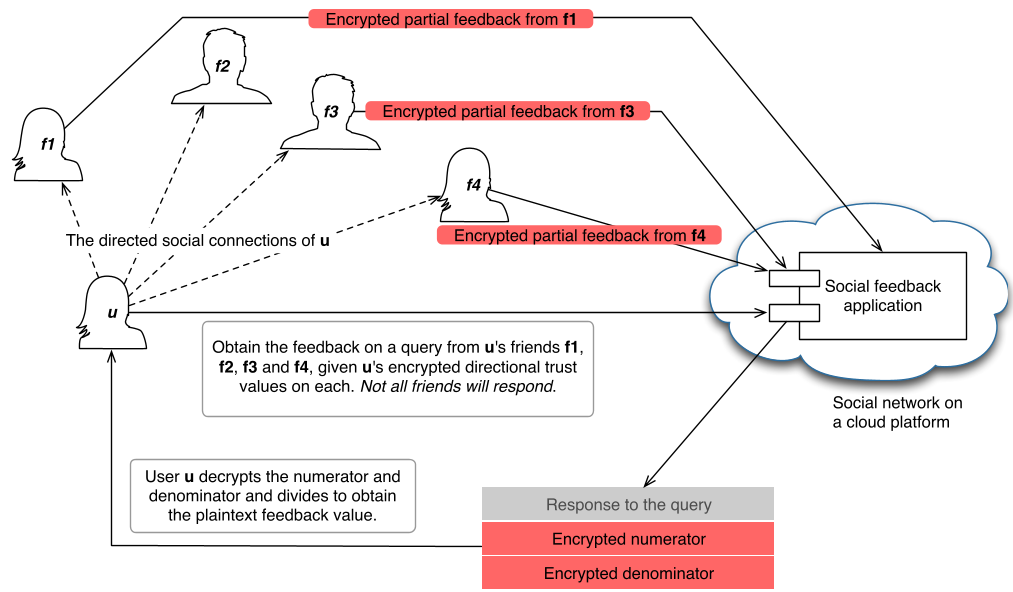 Figure 1: Architectural overview showing the interaction between the User, the Cloud (Social Network), and Friends.
Experimental Results: Is it Fast Enough?
The authors built a prototype on Google App Engine using the Facebook social graph.
- User Perception: In user studies, participants reported a significant drop in "uncertainty" regarding their privacy. 67% of users felt more certain about the application's ability to protect their personal trust levels after using it.
- Performance: The bottleneck isn't the cloud; it's the user's browser. While Chrome and Firefox handled 512-bit encryption in under 25ms, older browsers like IE and Safari struggled, highlighting the need for highly optimized JavaScript crypto libraries.
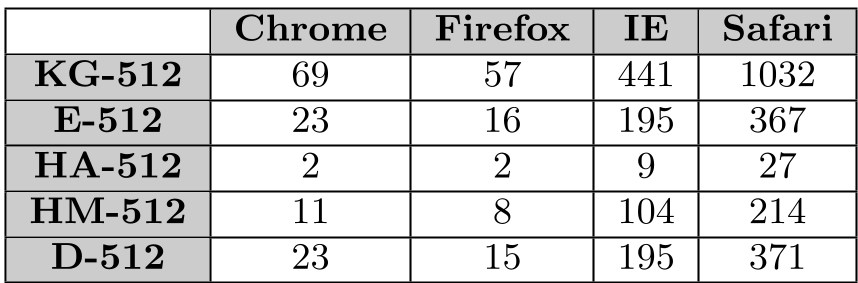 Figure 2: Cryptographic primitive performance across different browsers (Time in ms).
Critical Insight: The "Sybil" Reality Check
While the system is robust against a curious Cloud, it has a notable vulnerability: Sybil Attacks. If a user creates multiple fake accounts (Sybils) and asks one real friend a question along with five fake ones, the user can isolate the real friend's response. The authors candidly acknowledge this as a focus for future work, potentially involving range checks or identity verification.
Conclusion: Trust as an Interaction, Not an Output
This paper is a significant step toward Trust Empowerment. It stops trying to "solve" trust with a black-box algorithm and instead provides a secure tool for humans to perform trust-based interactions. For developers of future social apps, the takeaway is clear: Privacy-preserving homomorphic encryption is no longer just a theoretical concept—it's ready for the web.