
PVOC: Balancing Privacy, Quality, and Dynamicity in Global Crowdsourcing
Privacy-preserving and verifiable online crowdsourcing with worker updates
The paper proposes PVOC (Privacy-preserving and Verifiable Online Crowdsourcing), a novel protocol that enables secure multi-class data aggregation using a lightweight masking mechanism. It achieves state-of-the-art efficiency by eliminating decryption operations and supports dynamic worker management (addition and revocation) while maintaining high classification accuracy on MNIST and CIFAR datasets.
Executive Summary
TL;DR: PVOC is a privacy-preserving framework for online crowdsourcing that uses a unique zero-decryption masking mechanism to aggregate multi-class labels. It allows for the dynamic addition or removal of workers and features a novel verification mechanism to track worker skill levels without exposing their private data.
Academic Positioning: This work bridges the gap between Secure Multi-party Computation (SMC) and Truth Discovery. It moves beyond static aggregation models by introducing an amortized key agreement architecture that handles the reality of "churning" workers in large-scale platforms like Amazon Mechanical Turk.
The Problem: The Intellectual Property of an Answer
In crowdsourcing, a worker's answer is more than a data point—it is a product of professional expertise and computational effort. Standard platforms require these answers in plaintext, exposing workers to:
- Privacy Leaks: Sensitive diagnosis or classification data becomes visible to the platform.
- Intellectual Property Theft: The platform gains the value of the expert's knowledge without long-term protection.
Current cryptographic solutions fail because they are either too slow (Standard SMC) or too rigid to allow workers to join or leave a group mid-task. Furthermore, if the data is encrypted, how does the platform know which workers are experts and which are just guessing randomly?
Methodology: The Logic of Geometric Masking
The core intuition of PVOC is cancelable blinding. Instead of heavy encryption, each worker adds a blinding factor to their confidence vector .
1. Collaborative Blinding
Based on the Diffie-Hellman key exchange, workers generate shared secrets . The blinding factor is constructed such that worker adds a value and worker subtracts the same value. When the platform multiplies (aggregates) all submissions: The construction ensures that , leaving only the product of the true answers.
2. Architecture Overview
The system involves a synchronized workflow between the Platform () and the Workers ().
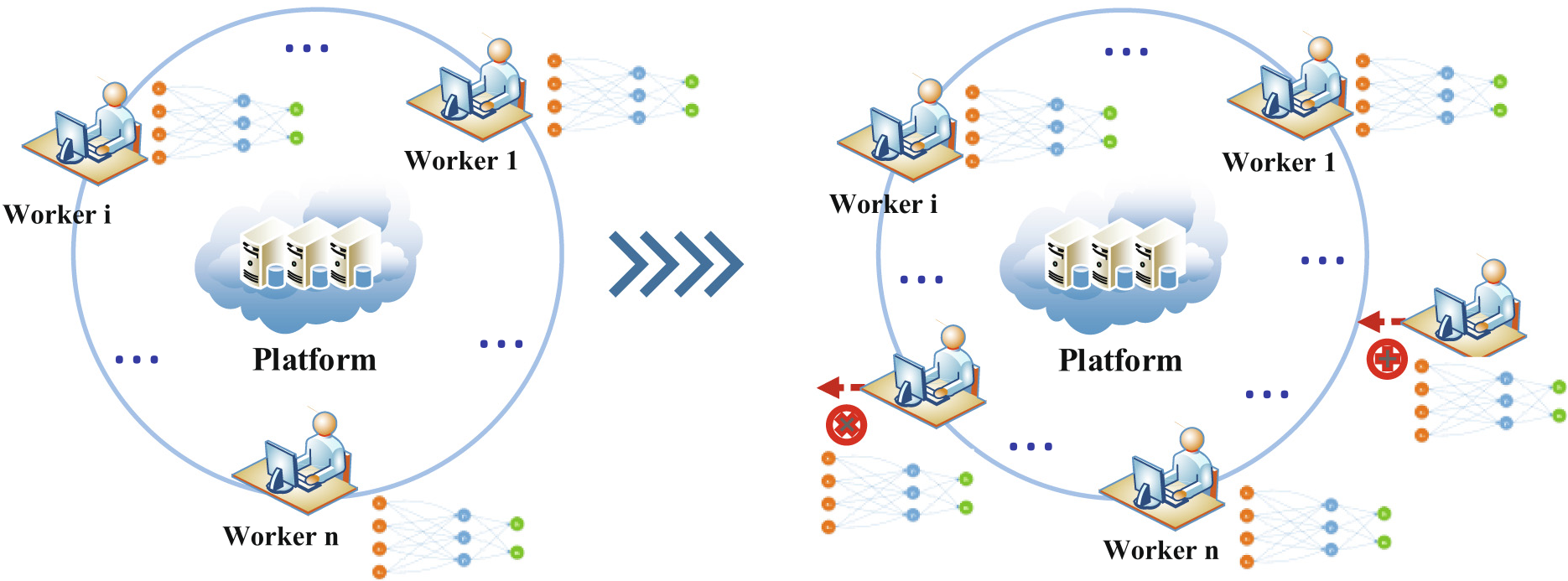 Figure 1: The PVOC system model showing the interaction between the platform and the distributed workers.
3. Verification & Dynamicity
The authors solve the "quality control" problem by introducing Checkpoints. The platform periodically inserts a known image. To verify skills, workers are asked to reveal the specific blinding vector for only that image. This allows the platform to update the worker skill degree () without compromising the privacy of the other "real" tasks.
Experimental Results: SOTA Efficiency
The researchers evaluated the protocol on MNIST and CIFAR datasets. The most striking result is the relationship between worker count and computation time.
 Table 1: Computational breakdown showing that even with 210 workers, key agreement and computation remain under a second.
Key findings include:
- Linear Scalability: Both worker and platform overhead scale linearly, making it suitable for massive groups.
- Low Platform Overhead: Since the platform only performs multiplications, its task is extremely lightweight (~3ms for 50 images across 210 workers).
- Zero Accuracy Loss: Because the masks cancel out perfectly, the classification accuracy is identical to a plaintext MLE system.
Critical Analysis & Future Outlook
Strengths: PVOC excellently addresses the "dynamic group" problem. Most SMC protocols require a full restart if a person leaves; PVOC’s amortized model allows keys to be reused, significantly lowering the "cost of entry" for new workers.
Limitations:
- Honest-but-Curious Assumption: The protocol assumes the platform follows the rules. If the platform is actively malicious and manipulates the checkpoints, it could potentially pressure workers to reveal more than intended.
- Communication Synchronicity: The protocol requires workers to be online at the same time to ensure the products cancel out correctly.
Future Work: The authors suggest exploring Order Preserving Encryption (OPE) to further optimize verification, potentially allowing quality checks without requiring workers to send back blinding factors in a second round. This would move crowdsourcing toward a truly "asynchronous" and private future.
Conclusion
PVOC proves that privacy doesn't have to come at the cost of performance. By shifting the complexity to a one-time key agreement and using simple modular math for aggregation, it provides a high-security, high-efficiency solution for the next generation of expert-driven crowdsourcing.