
PVOC: Balancing Privacy, Dynamics, and Verifiability in Modern Crowdsourcing
Privacy-preserving and verifiable online crowdsourcing with worker updates
The paper introduces PVOC, a Privacy-preserving and Verifiable Online Crowdsourcing protocol designed for multi-class classification tasks. It leverages a lightweight masking mechanism based on the Decisional Diffie-Hellman (DDH) assumption to aggregate worker responses without revealing individual answers, achieving SOTA performance in secure data aggregation specifically for dynamic worker groups.
TL;DR
Online crowdsourcing is shifting from simple labeling to complex, professional classifications. However, workers' answers are their intellectual property and often contain sensitive data. PVOC (Privacy-preserving and Verifiable Online Crowdsourcing) is a novel protocol that allows a platform to aggregate crowd intelligence using encrypted values without ever seeing individual inputs, while simultaneously managing worker "skills" and dynamic group membership.
The Core Conflict: Privacy vs. Quality Control
In crowdsourcing, we face a "trilemma":
- Privacy: Workers don't want the platform or peers to see their specific raw answers.
- Quality Control: The platform needs to know who is a "high-quality" worker to weight their answers correctly (using models like Dawid-Skene).
- Dynamics: In the real world, workers join and leave the task group constantly.
Existing solutions are either too slow (Standard MPC), require a fully trusted aggregator, or break when a single worker goes offline.
Methodology: Peer-to-Peer Masking with "Zero-Decryption"
The mathematical intuition of PVOC is elegant: Pairwise Masking.
For every pair of workers and , they share a secret . When worker submits an answer, they add to their value, while worker subtracts it. When the platform multiplies (or adds) all submissions, these secrets cancel out to (or ), leaving only the aggregated truth.
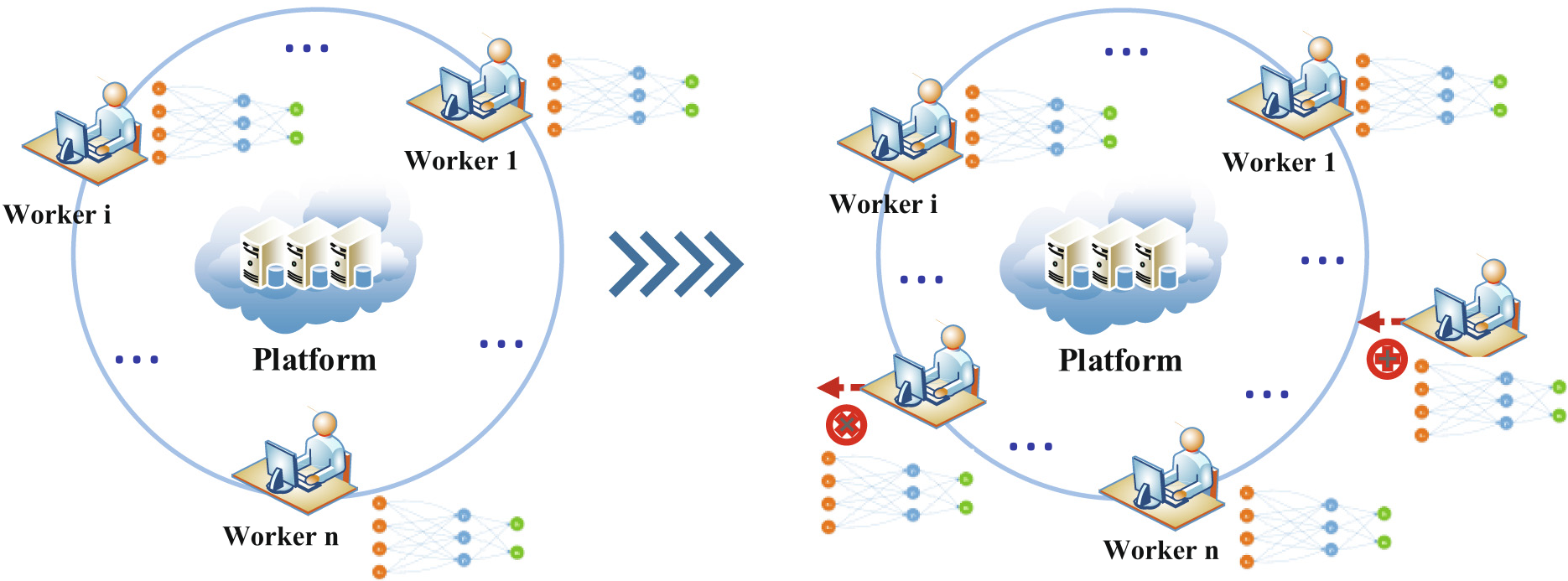 Fig 1: The architecture of PVOC, illustrating the interaction between the platform and a dynamic pool of workers.
The Innovation: Spot-Checking Skills
Since the platform only sees the final result, how can it know if Worker A is a bot or an expert? PVOC introduces a Verification Mechanism. The platform randomly inserts a "check-point" image (with a known label) into a batch. To verify, workers must temporarily reveal specific blinding factors for that image. This allows the platform to update the worker’s skill weight without compromising the privacy of the other "real" images in the batch.
Experimental Results & Performance
The authors tested PVOC against three major benchmarks: MNIST, CIFAR-10, and CIFAR-100.
- No Accuracy Trade-off: Because the masking is mathematically exact, the classification accuracy is identical to plaintext crowdsourcing.
- Scalability: The system scales linearly. While the "Masking Encryption" phase is the most time-consuming (due to generating many pairwise keys), it is an amortized cost. Once keys are agreed upon, they can be used for many iterations.
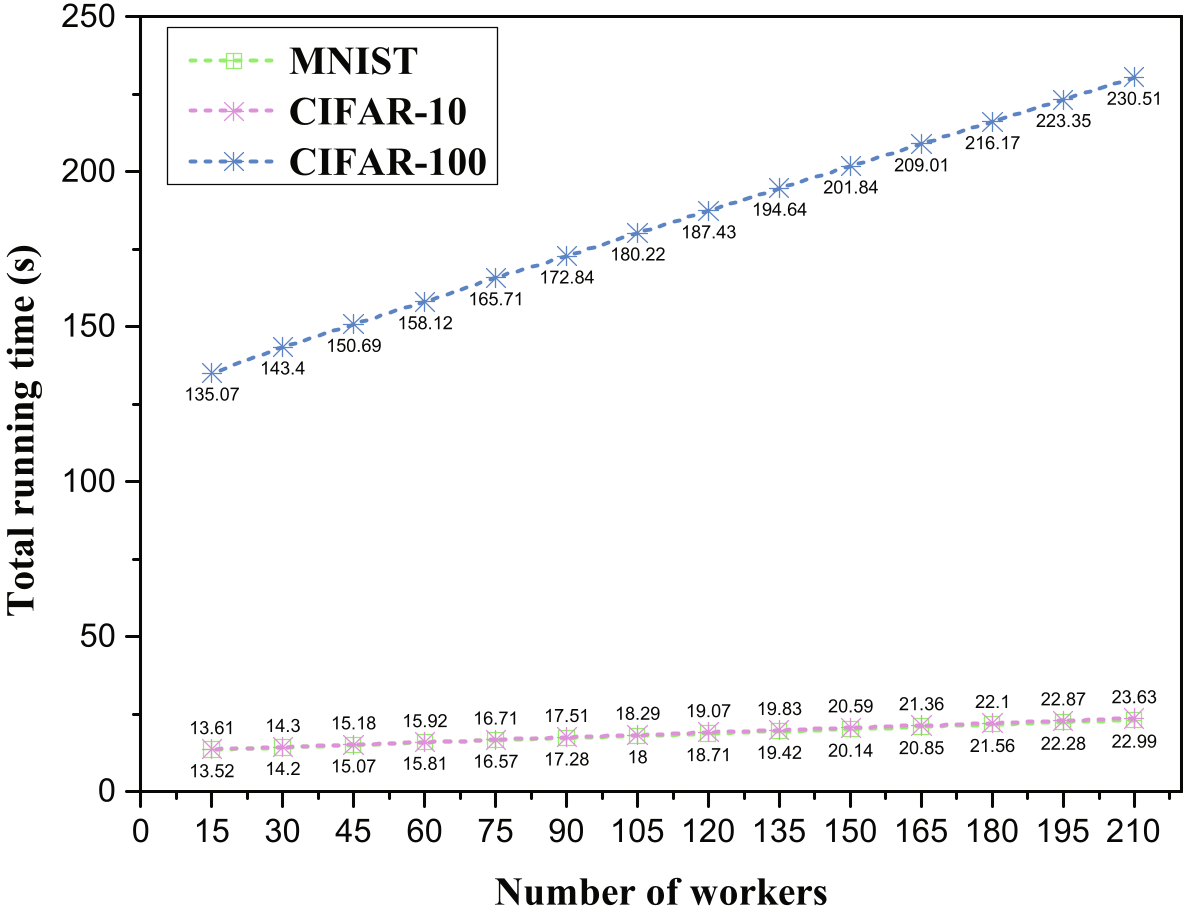 Fig 2: Total running time across different datasets. CIFAR-100 takes longer due to the larger dimension of the classification vector.
Critical Insight & Conclusion
The true value of PVOC lies in its lightweight nature. By avoiding heavy-duty Homomorphic Encryption (HE) and focusing on symmetric blinding with Diffie-Hellman, it makes secure crowdsourcing practical for mobile devices.
Limitations: The threat model assumes "honest-but-curious" participants. While it handles malicious activity via the verification mechanism, a large-scale collusion where workers collaborate with the platform could still technically break an individual's privacy.
Future Outlook: PVOC provides a blueprint for "Self-Governing Privacy." Future platforms might use this to allow researchers to gather High-Value Intellectual Property (like medical diagnoses) from experts without either party needing to trust each other fully.