
PVOC: Balancing Privacy and Verifiability in Dynamic Crowdsourcing
Privacy-preserving and verifiable online crowdsourcing with worker updates
The paper introduces PVOC (Privacy-preserving and Verifiable Online Crowdsourcing), a novel protocol for multi-class data aggregation. It secures worker intellectual property and sensitive answers using a lightweight multiplicative masking approach that avoids heavy decryption, achieving SOTA performance in secure, dynamic crowd-worker environments.
TL;DR
In the era of decentralized AI, worker answers in crowdsourcing are not just data—they are intellectual property. This paper presents PVOC, a protocol that allows a platform to aggregate multi-class labels from workers without ever seeing the individual answers. By utilizing a "masking-and-canceling" trick for products and a clever spot-check system, it achieves SOTA privacy, supports workers joining/leaving on the fly, and maintains 100% accuracy on standard benchmarks.
The Conflict: Privacy vs. Quality Control
The fundamental tension in crowdsourcing is simple:
- Privacy: Workers want to keep their professional insights (e.g., medical diagnoses) private from a curious platform.
- Verifiability: The platform needs to know who is a high-quality expert and who is a "random clicker" to weight the results correctly.
Prior works usually fail at the intersection. Standard encryption makes weight-balancing impossible, while plaintext models expose everything to the aggregator. PVOC addresses this by moving the entire Dawid-Skene model logic into a secure, ciphertext-friendly pipeline.
Methodology: The "Magic" of Self-Canceling Masks
PVOC relies on the physical intuition that if every worker adds/multiplies a bit of "noise" that another worker removes, the final sum or product remains pure, while the intermediate state is gibberish.
1. Architectural Flow
The system involves a Platform (P) and Workers.
- Agreement: Workers use Diffie-Hellman to create shared secrets with every other worker.
- Masking: A worker doesn't send their confidence vector . Instead, they send , where is a product of shared secrets.
- The Wipeout: When the platform multiplies all together, the internal shared secrets cancel out mathematically (), leaving only the true product of .
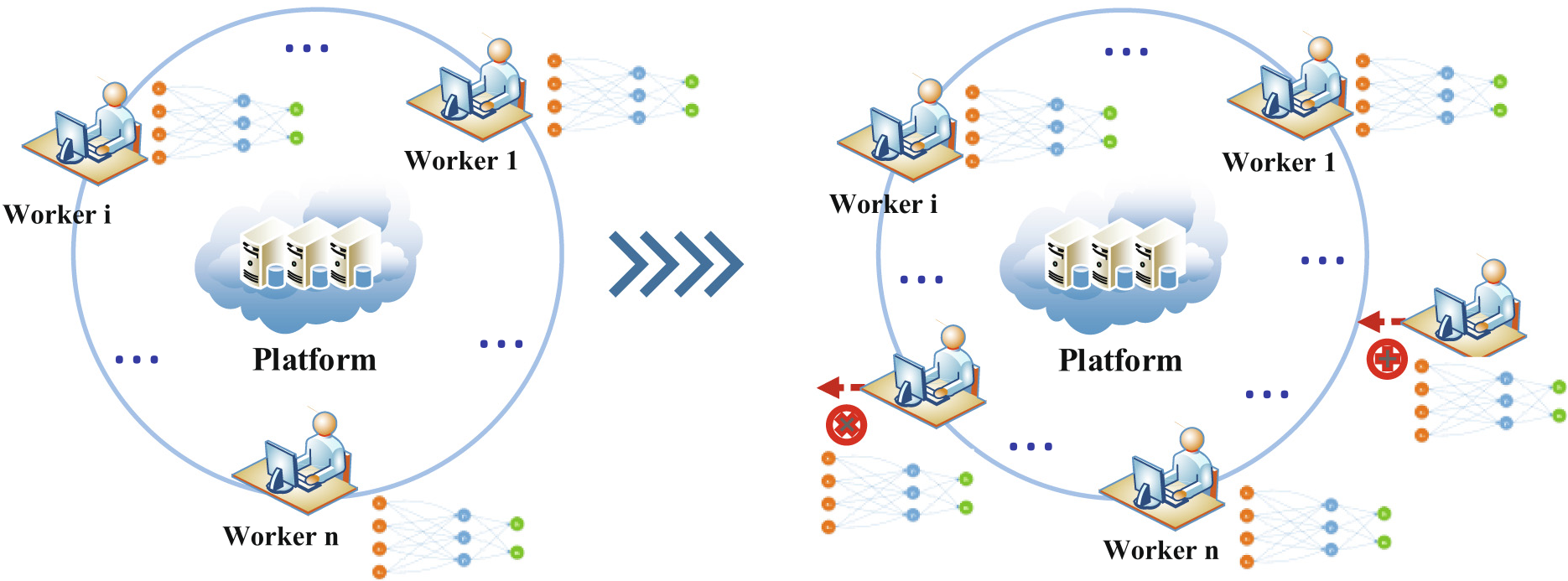 Fig 1: The PVOC system model showcasing the interaction between the Platform and distributed Workers.
2. Solving the Quality Problem (Verify & Update)
How do you update worker skills if you can't see the data? PVOC uses Spot-Checking. The platform injects "Gold Standard" images (check-points) with known labels. For these specific images, workers are required to reveal their masking factors afterward. This allows the platform to verify the accuracy of that specific worker and update their global weight ().
Experimental Results: Efficiency at Scale
The authors tested PVOC on image classification tasks (MNIST, CIFAR). The beauty of the system is its linear scalability.
- Accuracy: Zero loss compared to plaintext crowdsourcing.
- Computation: The "Masking Encryption" phase is the most intensive for workers, but once the key agreement is done, it is amortized.
- Dynamics: When a worker joins or leaves, the platform simply broadcasts the new ID list, and workers update their local blinding factors—avoiding a full system reboot.
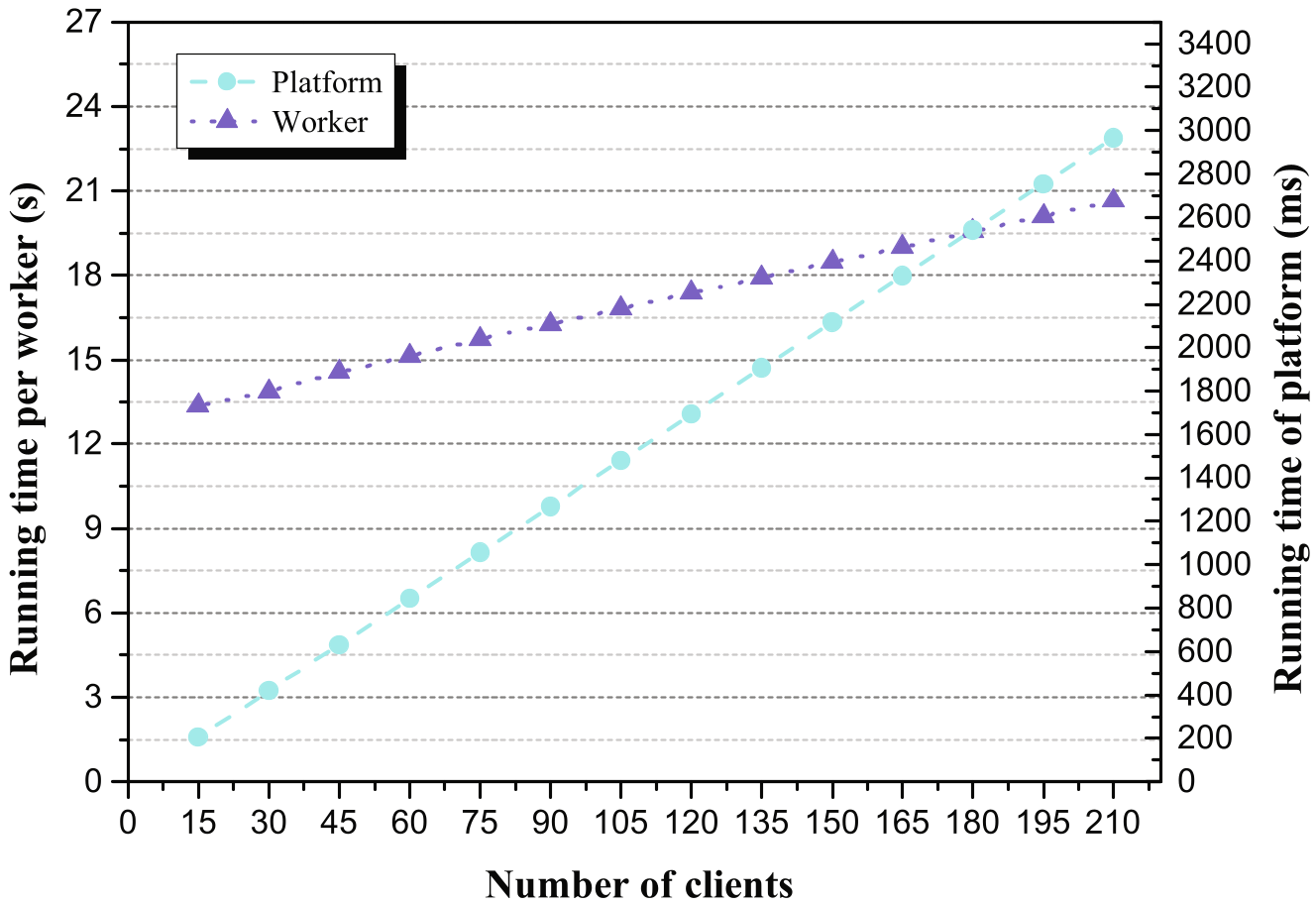 Fig 2: Running time for individual workers and the platform on the MNIST dataset shows sustainable linear growth as the crowd scales.
Critical Insight & Conclusion
PVOC represents a shift toward lightweight MPC. Most academic MPC works focus on complex circuits; PVOC focuses on the specific mathematical operator (multiplication) needed for Maximum Likelihood Estimation (MLE) in crowdsourcing.
Limitatons: The protocol still assumes workers are "honest-but-curious." If workers collude with the platform, individual privacy could be at risk. Future work involving Differential Privacy or Zero-Knowledge Proofs could further harden this against active malicious attacks.
Final Takeaway: If you are building a decentralized data labeling platform, PVOC's masking strategy offers the best trade-off between privacy, expert attribution, and system speed currently available in the literature.