
PVAT: Securing UAV Social Networks through Private Verification and Automated Root-Cause Tracing
Privacy-Preserving Verification and Root-Cause Tracing Towards UAV Social Networks
This paper proposes PVAT, a privacy-preserving self-verification and root-cause tracing framework for UAV social networks. It combines an improved Merkle Hash Tree (MHT) with Datalog-based reasoning to detect flight anomalies and employs learned fault trees to identify fundamental root causes without exposing raw flight data.
TL;DR
Unmanned Aerial Vehicles (UAVs) are increasingly forming "social networks" to complete missions autonomously. However, verifying that a follower drone actually obeyed a leader's order without peeking into its private logs is a major challenge. This paper introduces PVAT, a system that uses improved Merkle Hash Trees for privacy-preserving verification and automated fault-tree learning to pinpoint exactly why a drone failed. It achieves a 4.3% accuracy boost in tracing and moves verification speed from exponential to linear.
Problem & Motivation: The Conflict Between Privacy and Proof
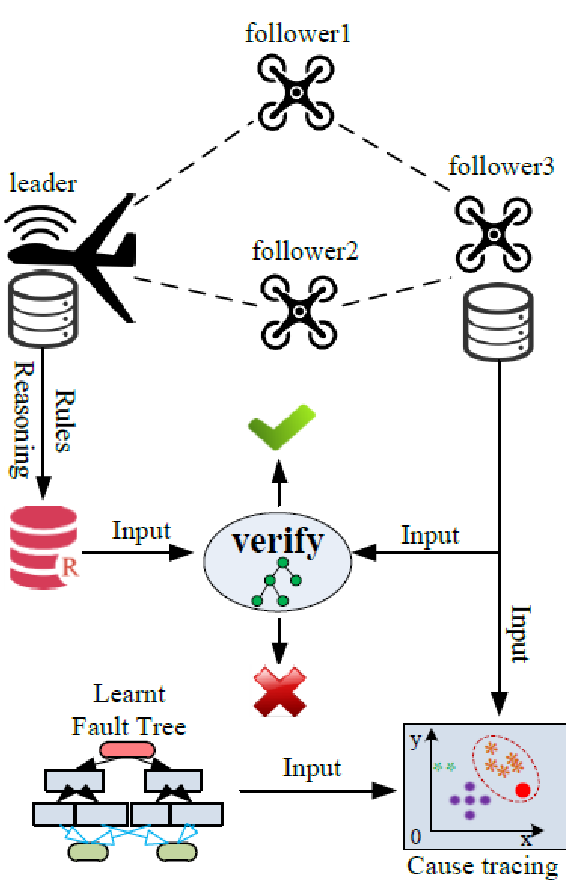
In tactical or industrial UAV missions, drones from different parties often cooperate. A leader drone needs to know: Did my follower actually execute the "Adjust Position" command?
Current solutions face a "catch-22":
- Centralized dependence: Most drones rely on ground stations, but long-range missions are often disconnected (ad-hoc).
- Privacy vs. Verifiability: To verify honesty, you traditionally need to read the follower's "black box" logs. Drones are often reluctant to share raw telemetry or configuration data due to proprietary or security concerns.
- The "What" vs. "Why": Finding an anomaly (e.g., a drift) is easy, but finding the root cause (e.g., GPS jamming vs. motor failure) is hard without human experts.
Methodology: Reasoning, Hashing, and Learning
1. Verification via Deductive Reasoning
The system uses NDlog (a decentralized Datalog variant) to define communication rules. The leader drone doesn't need the follower's data to know what the expected state should be. It uses predefined logic—such as "If I sent a message and received an ACK, the follower MUST have a record of execution"—to deduce the truth.
2. Privacy-Preserving Merkle Hash Trees (MHT)
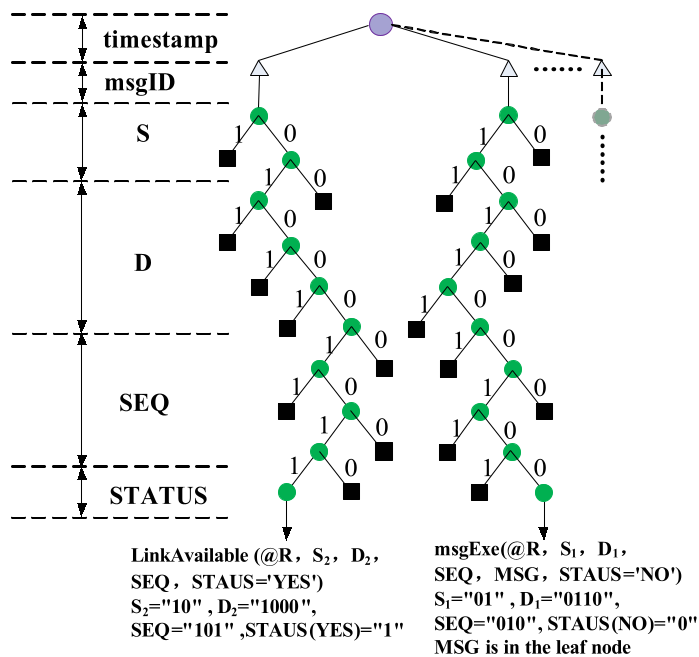
To prove honesty without plaintext, the follower builds an improved MHT. Unlike standard trees, this version integrates Timestamps and Message IDs directly into the structure. This allows the leader to verify specific events by checking hash paths rather than traversing a massive database.
3. Automated Fault Tree Tracing
When an anomaly is detected, PVAT doesn't just raise an alarm. It uses a Fault Tree learned from historical data.
- Construction: Uses Control Flow Graphs (CFG) to determine the sequence of events.
- Anomaly Detection: Uses DBSCAN clustering to find outliers. If a drone's flight parameters (like throttle feedback) fall outside the "normal cluster" radius, it triggers a trace.
- Root Cause: The system follows the branches of the fault tree to see which specific internal event (e.g., AD sampling error) matches the observed anomaly.
Experiments & Results
The authors evaluated PVAT on PixhackDrone hardware, injecting faults like motor damage, GPS loss, and battery depletion.
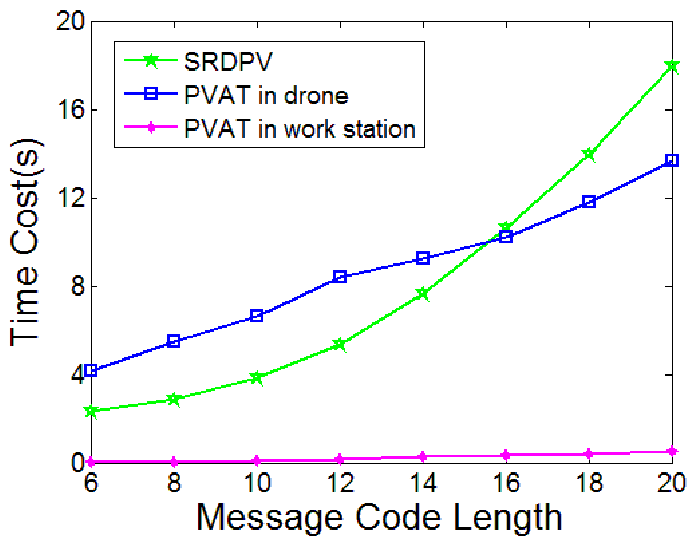
- Efficiency: While previous methods like SRDPV suffered from exponential time growth as log sizes increased, PVAT’s optimized MHT maintains linear growth, making it viable for embedded flight controllers.
- Accuracy: PVAT improved tracing accuracy by 4.3% over the Dlog baseline. It was particularly effective at tracing "Abnormal Throttle Feedback" (A3 in the paper), where the relationship between faults and records is highly distinct.
- Log Reduction: Instead of checking thousands of irrelevant entries, the fault tree allows the drone to ignore nearly 10,000 logs in a 60-minute flight, focusing only on relevant diagnostic sequences.
Critical Insight & Conclusion
The brilliance of PVAT lies in its structural optimization. By adding domain-specific fields (Message IDs/Timestamps) to a standard cryptographic primitive (MHT) and combining it with logic programming (Datalog), the authors solved a multi-disciplinary problem: balancing security, privacy, and diagnostic depth.
Limitations: The system still struggles to distinguish between malicious attacks and environmental factors like heavy wind (weather influence) due to similar telemetry patterns. Future work involving multi-modal sensor fusion could help bridge this gap.
The Takeaway: As drone swarms become more autonomous, the ability to perform "zero-knowledge" diagnostics will be the cornerstone of trust in multi-agent systems.