
Beyond the Hairball: Privacy-Preserving Ontological Network Visualization
Privacy preserving visualization for social network data with ontology information
The paper introduces a novel framework for Privacy Preserving Visualization of Ontological Social Networks. It leverages -anonymity and -diversity models to identify privacy leaks in network visualizations (node-link diagrams and adjacency matrices) and provides interactive graph modification operations like node merging and edge bundling to mitigate these risks.
TL;DR
Researchers from UC Davis have developed a system that brings rigorous privacy models—k-anonymity and l-diversity—into the world of interactive social network visualization. By combining automated leak detection with "semantic-aware" graph modifications like node merging and edge bundling, the system helps researchers share sensitive data without inadvertently "doxing" individuals through their unique network positions.
The "Deductive Disclosure" Problem
Sociologists love social networks, but sharing them is a legal and ethical minefield. Even if you remove names, a network's structure often betrays its members.
If an attacker knows that "Jim" is the only person in a study who works at a specific off-site location, they can find the "Location: Off-Site" node and instantly see Jim’s age, title, and collaborators. This is deductive disclosure. Traditional fixes—like adding "noise" (fake edges) or "hairballing" (making the graph unreadable)—often ruin the scientific value of the visualization.
Methodology: Bringing Relational Models to Graphs
The core insight of this paper is treating an Ontological Network (a network with categories like Age, Job, etc.) as a relational database that can be hardened using two classic privacy pillars:
- k-anonymity: Ensures that any individual is indistinguishable from at least others. In a graph, this means merging rare attribute nodes so that no single "entity" (person) stands out as a unique leaf.
- l-diversity: Ensures that sensitive attributes within a group are diverse enough that you can't guess a specific person's trait.
The Privacy Toolkit
The authors propose three primary "Preservation Operations":
- Node Merging: Combining two nodes of the same type into a "super-node" to satisfy -anonymity.
- Edge Bundling: Curving multiple edges into a single "bundle." This creates visual uncertainty: you know members of Group A talk to Group B, but you can't tell which person in A talks to which person in B.
- Perceptual Masking: Instead of changing the data, you change the layout. By intentionally placing sensitive nodes in high-clutter areas or "shielding" them with overlapping edges, the leak becomes cognitively invisible to a human viewer while the data remains intact.
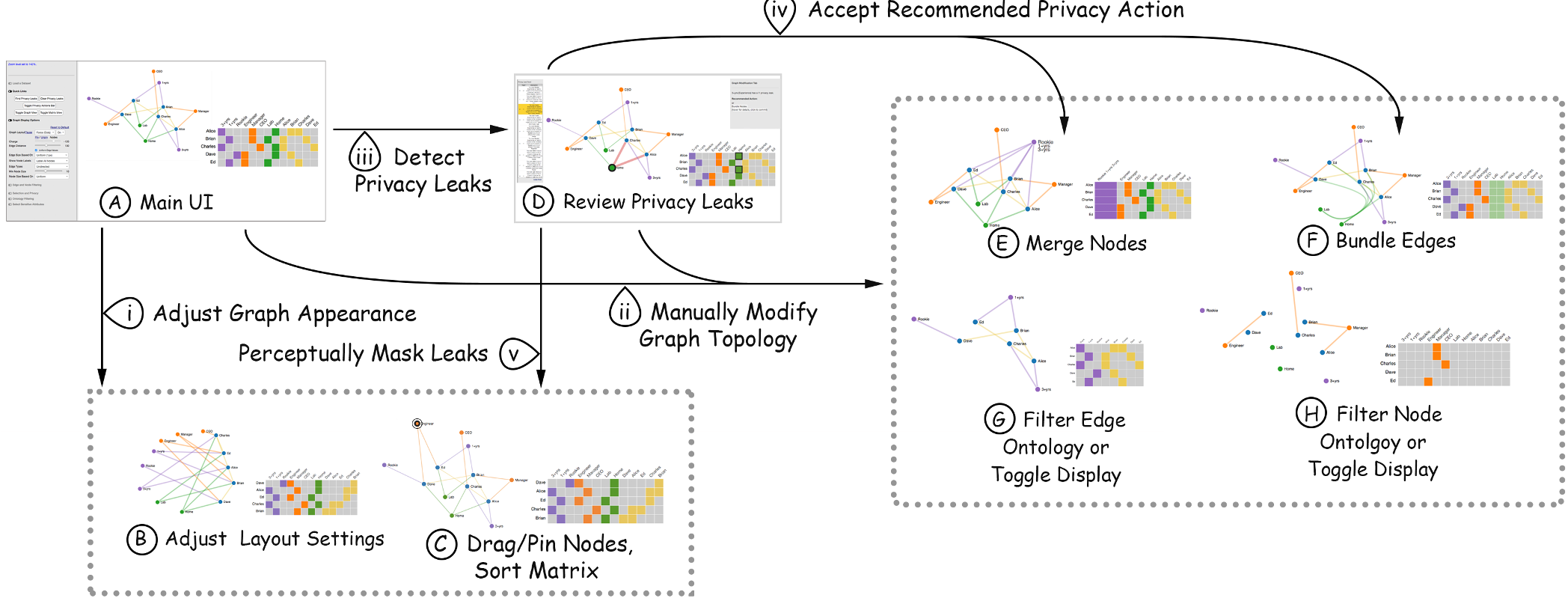 Figure 1: The prototype system workflow: Load data -> Detect leaks -> Apply recommended actions (merging/bundling) -> Refine layout.
Evidence: Case Study on MIT Reality Mining
Using the MIT Reality Mining dataset, the authors showed how an attacker could identify "Senior Grads who live at MIT" and discover they all socialized at a specific place ("Friends").
By applying Edge Bundling, the system effectively "blurred" the connections between the Senior Grads and their hangout spots. The resulting graph still showed the general social trend (high sociability) but protected the specific behavior of individuals.
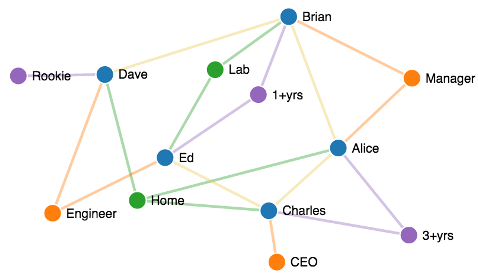 Figure 2: (Left) A leak is clearly visible. (Right) Through node merging and edge bundling, the same data is presented without violating anonymity.
Critical Insight: The "Utility vs. Privacy" Seesaw
The paper's most salient contribution is the Mixed-Initiative Approach. Unlike "black-box" anonymization algorithms, this system treats the human as an editor.
Sociologists interviewed for the study noted that "introducing too much noise can take away the validity of results." By allowing the user to choose how to fix a leak—perhaps by just moving a node to a more crowded area of the screen rather than deleting it—the system preserves the Identity of the Result while protecting the Identity of the Subject.
Limitations and Future Work
While powerful, "Perceptual Masking" is fragile. A malicious actor could use computer vision or script-based scrapers to "de-clutter" the graph and find the hidden nodes. The authors acknowledge that for high-stakes privacy, data-level changes (merging) are safer than layout-level changes (masking). Moving forward, integrating Differential Privacy—the gold standard of privacy—into these node-link diagrams remains the "Holy Grail" for this field.
Summary takeaways: If you're visualizing sensitive human data, don't just hide the names. Look at the ontology. Use k-anonymity to find your "outliers" and bundle your edges to obscure specific sensitive mappings.