
Safeguarding the Connected Cockpit: A Multi-Layered Privacy Framework for Social Cars
Privacy Protection Framework in Social Networked Cars
This paper proposes a comprehensive privacy protection framework for social networked cars. It categorizes security threats and introduces a multi-dimensional defense mechanism combining Bayesian inference, k-anonymity, and cryptographic hashing to secure vehicle-to-everything (V2X) social interactions.
TL;DR
As cars transform into moving social hubs (e.g., "Toyota Friend"), they expose drivers to unprecedented cyber-physical risks. This paper introduces a specialized Privacy Protection Framework designed to thwart identity theft, location tracking, and sophisticated inference attacks through a blend of Bayesian Networks, Adaptive K-Anonymity, and Attack-Defense modeling.
Deep Dive into the Motivation: Why Your Car is Snitching
The transition from simple transportation to "Social Networked Cars" means vehicles now handle high-velocity streams of social data. The authors identify a critical gap: Indirect Privacy Leaks. Even if you don't post your name, an attacker analyzing your "night-time location" can use a reverse directory (Yellow Pages) to identify your home and identity.
Existing security measures often focus on traditional IT threats (DoS, MITM) but ignore the Cyber-Physical overlap—where a digital data leak leads to real-world stalking or kidnapping.
Methodology: The Three Pillars of Defense
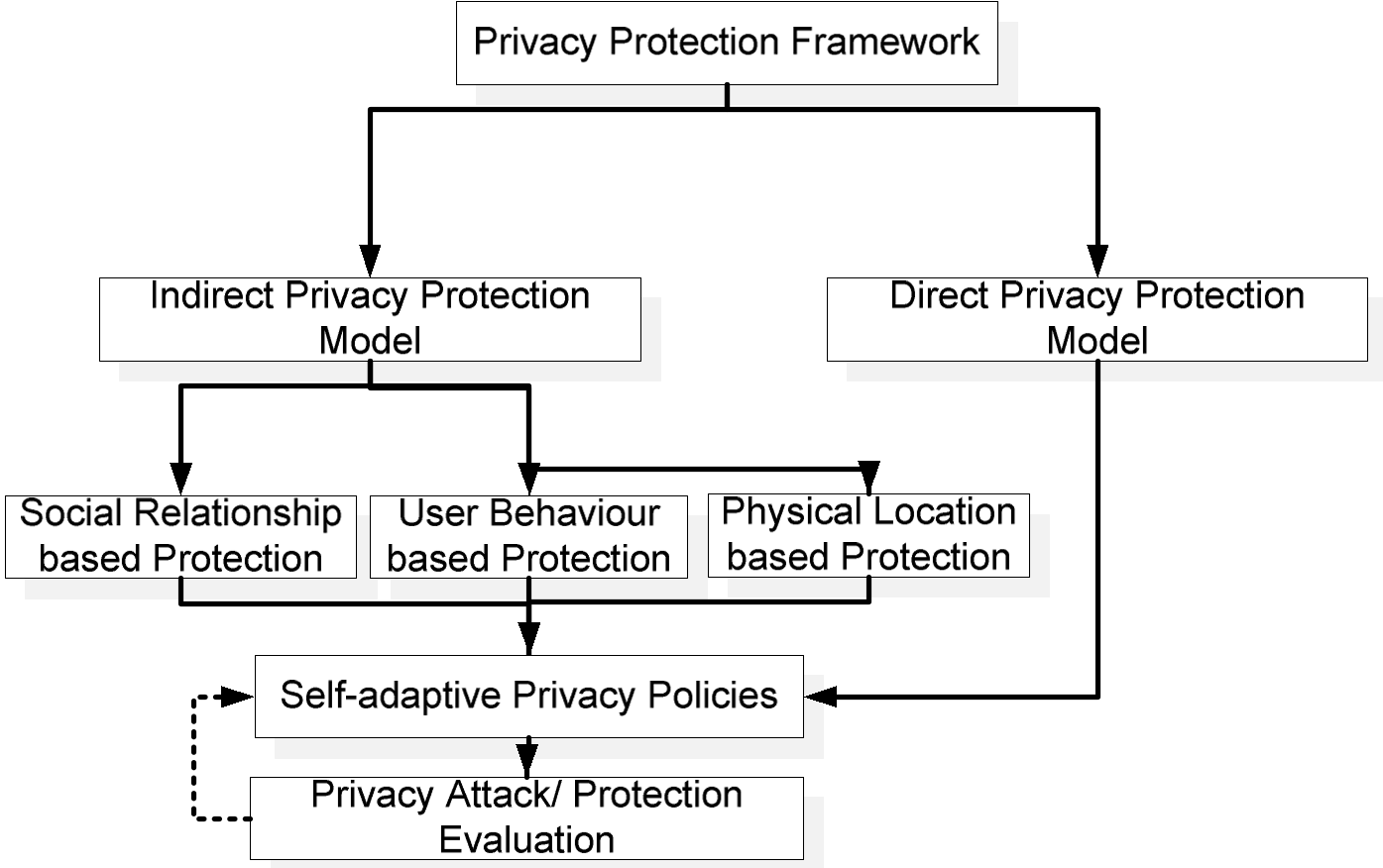
The heart of this research is a modular architecture that addresses privacy from three distinct angles:
1. Social Relationship Protection (Bayesian Insight)
To combat inference attacks, the authors employ a Bayesian Network Classifier. It calculates the "weights" of social relations to determine which attributes (like location A or friend B) pose the highest risk of leaking the driver’s identity.
- Refinement: They treat the k-anonymity problem as a Clustering Task, ensuring that members in an anonymity set are logically grouped to prevent "outlier" identification.
2. User Behavior Protection (Cryptographic Id)
To mask identity during active service use, the framework utilizes a One-Way Hash Function combined with a secret key () and a salt value ().
- Formula:
- This ensures that while the service provider can verify a legitimate user, they cannot easily harvest the original ID for profiling.
3. Physical Location Obfuscation
Instead of sending precise coordinates, the system generates a Cloaked Region (). This spatial masking ensures the LBS (Location Based Service) can function without knowing the driver's exact meter-level position.
The Attack-Defense Experimental Model
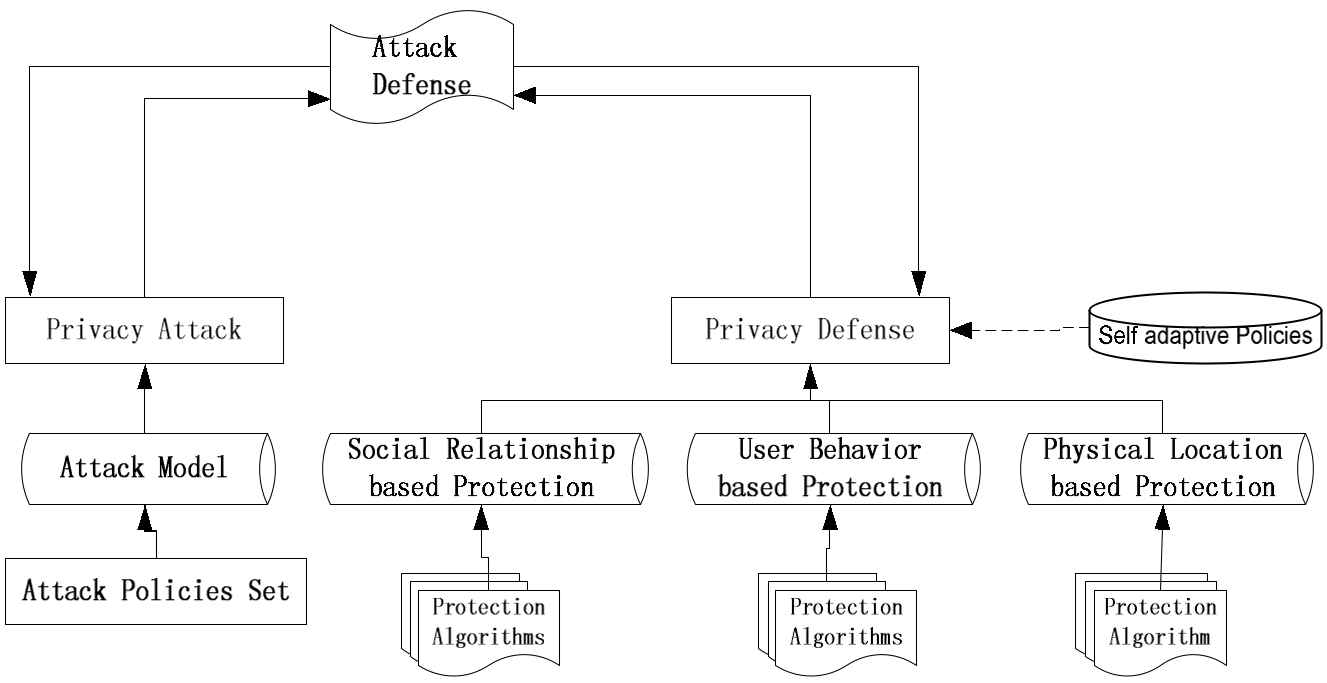
The authors don't just propose a static fix; they model the interaction as a game :
- P (Parties): Attacker () vs. Defender ().
- S (Strategies): A set of evolving attack policies vs. adaptive defense policies.
- U (Utility): A mathematical function determining the "payoff" for each side.
This allows the framework to be Self-Adaptive, choosing the best defense policy dynamically based on the observed attack pattern.
Critical Analysis & Future Outlook
The framework’s strength lies in its Fusion Inference Method—the realization that social, behavioral, and location data are interconnected and must be defended as a single unit.
Limitations:
- Computation Overhead: The paper mentions preliminary success, but the cost of running Bayesian optimization and heavy hashing on vehicle-grade hardware (ECUs) needs more rigorous benchmarking.
- Dynamic Environments: In high-density traffic, maintaining -anonymity is easier than in rural areas where the set of "neighbors" is small.
Final Takeaway: This work represents an essential shift in V2X security—moving from "locking the door" (encryption) to "wearing a mask" (identity and behavior obfuscation). For future car manufacturers, privacy will not just be a feature, but a core safety requirement.