
Balancing Profit and Privacy: A Robust Hybrid Incentive Mechanism for Mobile Crowdsourcing
An incentive mechanism with privacy protection in mobile crowdsourcing systems R
This paper introduces a hybrid incentive mechanism for mobile crowdsourcing that integrates privacy protection, auction theory, and reputation management. The core framework consists of an Improved Two-stage Auction (ITA) algorithm and a Truthful Online Reputation Updating (TORU) algorithm, designed to achieve high social welfare and eliminate free-riding.
TL;DR
Mobile crowdsourcing relies on two pillars: incentives (to keep workers participating) and trust (to ensure data quality). This paper proposes a dual-algorithm framework—ITA for efficient real-time auctioning and TORU for reputation management—wrapped in a privacy-preserving layer to solve the "free-rider" problem and the "unfairness" of traditional online auctions.
Background: The Crowdsourcing Dilemma
In mobile crowdsourcing, platforms face a constant struggle. If the incentive is too low, workers leave. If it's too high, the platform's budget is depleted. Furthermore, selfish participants often engage in free-riding, providing low-quality or fake data to collect rewards. This research addresses these issues by treating the interaction as an asymmetric evolutionary game.
The Privacy Challenge
Workers are hesitant to share their movement profiles or bidding values for fear of being tracked. To solve this, the authors implement a three-stage privacy protocol:
- Uploading Bidding: Using pseudonyms and commitments.
- Uploading Data: Employing platform public keys and blinded signatures.
- Updating Reputation: Securing the feedback loop so only the worker and platform know the adjusted trust score.
Methodology: The Technical Core
1. Improved Two-Stage Auction (ITA)
Traditional two-stage auctions often ignore the first "sample" batch of workers, treating them merely as data points to set a threshold. This creates a "Starvation" problem for early arrivals. ITA solves this by:
- Sampling-Accepting Process: Dynamically calculating a marginal budget () and threshold () for Stage 1.
- Dynamic Competition: In Stage 2, it evaluates the marginal utility of each new worker arriving sequentially, ensuring that the platform accepts contributors based on their "Density" of value-to-cost.
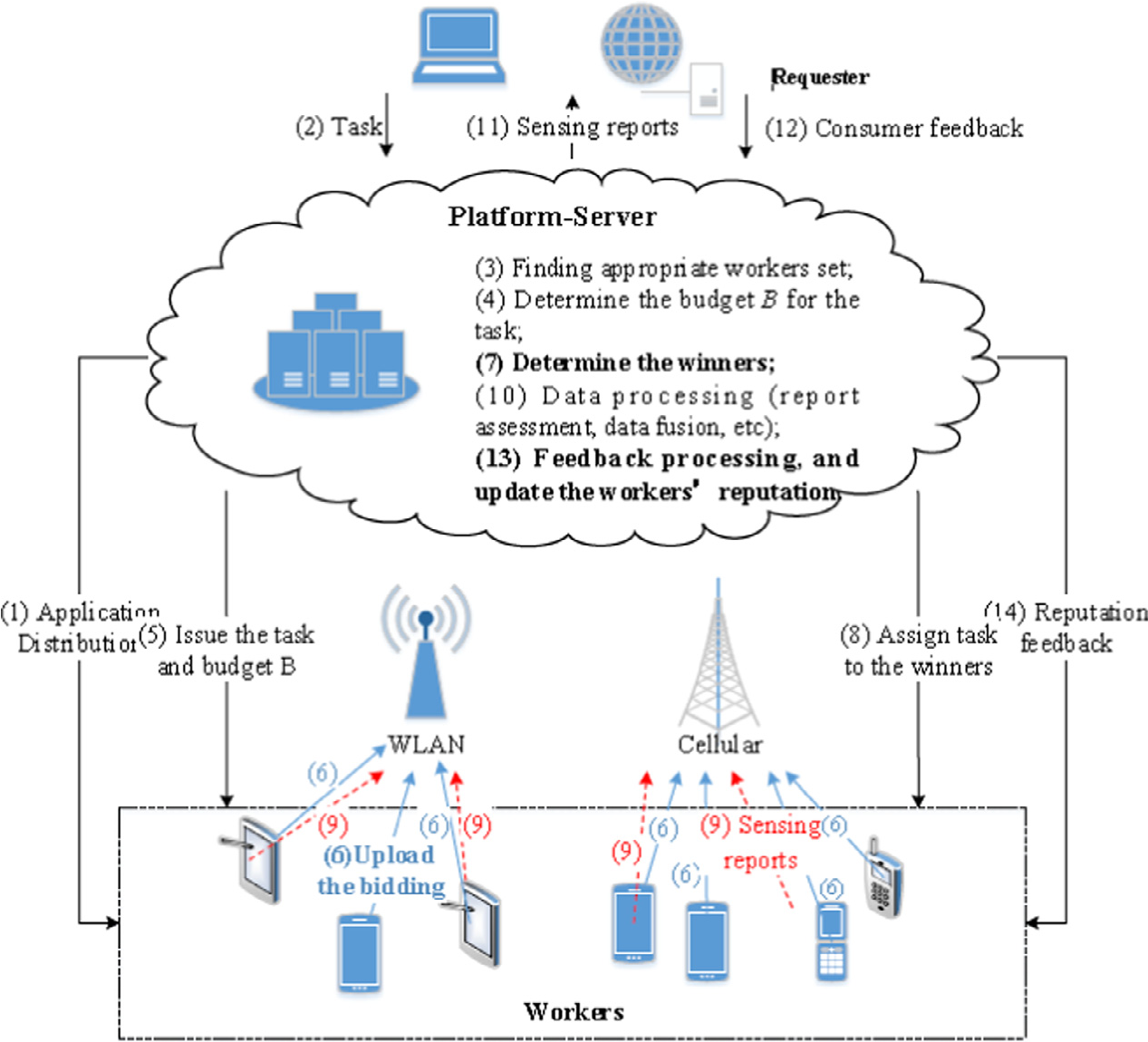 Above: The interaction flow between workers and the platform, highlighting the integration of privacy and auctioning.
2. Truthful Online Reputation Updating (TORU)
Using Evolutionary Game Theory (EGT), the authors prove that without punishment, "Distrust" is the Evolutionarily Stable Strategy (ESS)—meaning everyone eventually cheats. TORU introduces a flexible punishment mechanism:
- Incentive: Trustworthy behavior increases reputation toward .
- Forgiveness: Unlike "Social Norm" models that ban workers forever after one mistake, TORU allows workers to drop to a lower threshold (), giving them a chance to participate in low-stakes tasks and "earn" back their reputation.
Experimental Insights
The researchers tested ITA against general and traditional two-stage auctions under varying budgets ().
- Efficiency: ITA reached the budget limit and completed tasks in fewer rounds than competitors. It effectively utilized early-arriving workers rather than discarding them.
- Stability: As seen below, ITA maintains superior performance regardless of the budget scale, demonstrating its robustness for real-world deployment.
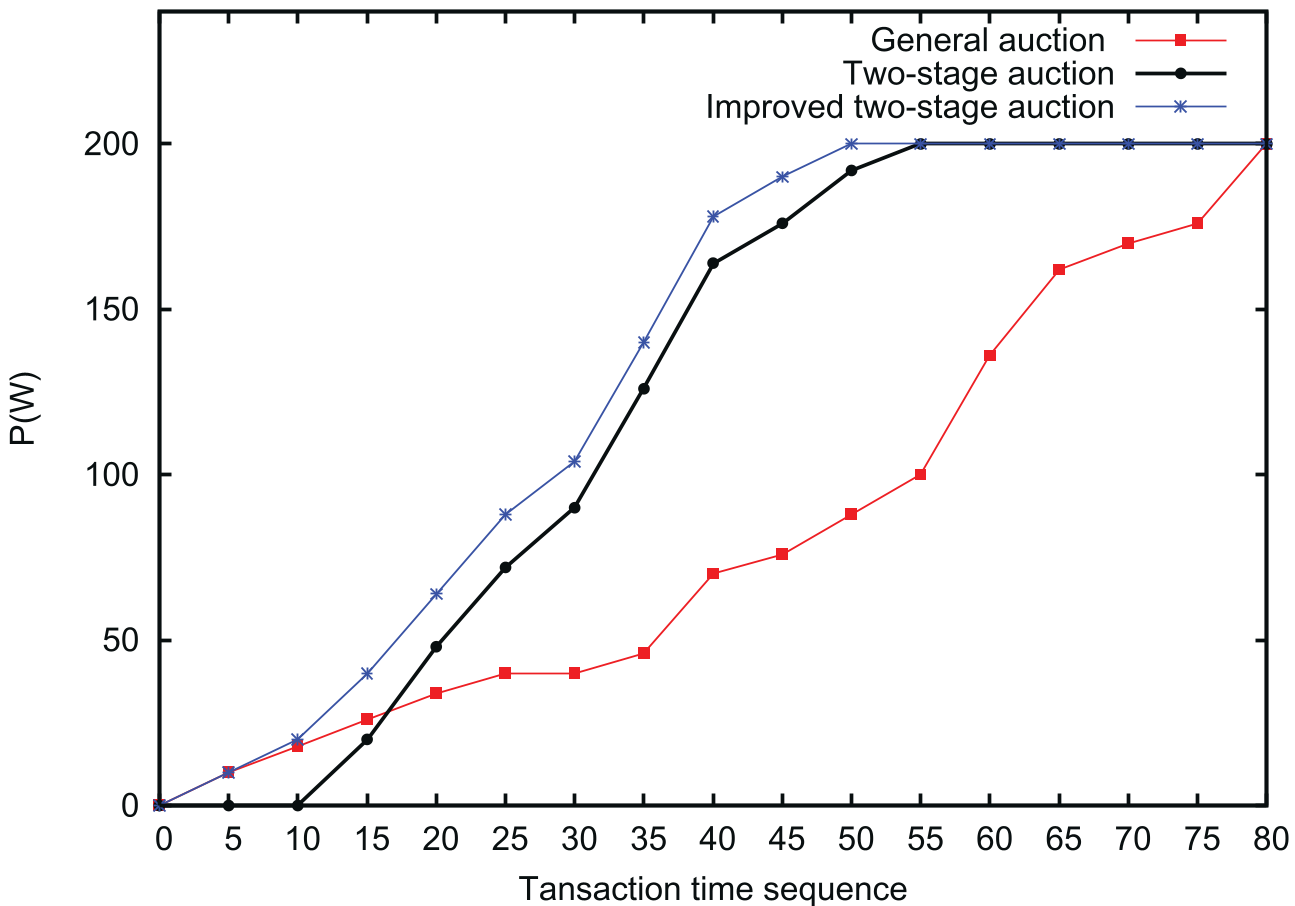 Figure: ITA (solid line) demonstrates a faster convergence rate relative to the sequential arrival of workers.
Critical Analysis & Conclusion
The true strength of this paper lies in its hybridity. By merging offline candidate filtering with online execution, it captures the best of both worlds.
Key Takeaways:
- Fairness matters: Workers who arrive early should have a fair shot at winning, or they will lose interest in the platform.
- Reputation is dynamic: Binary "Trust/Ban" systems are too rigid. A multi-level threshold system encourages honest behavior while maintaining a larger workforce pool.
Limitations: The paper assumes a static platform budget and doesn't fully account for sophisticated "Sybil" attacks where one user creates multiple identities to manipulate the reputation system. Future work in decentralized identity (DID) could further harden this framework.