
PPS: Solving the Triple Privacy Dilemma in Mobile Social Networks
Privacy Protection for Location Sharing Services in Social Networks
The paper introduces PPS (Privacy-preserving Protocol for location Sharing), a novel framework designed for mobile social networks. By decoupling information storage between a Social Network Server (SNS) and a Location Server (LS), it achieves SOTA-level privacy for user identity, location, and social relationships while maintaining millisecond-level processing overhead on mobile devices.
TL;DR
The PPS (Privacy-preserving Protocol for location Sharing) framework introduces a robust dual-server architecture that prevents service providers from linking a user's identity to their physical location or social circle. By employing k-anonymity and cryptographic separation, it delivers comprehensive privacy with a negligible latency of under 300ms on mobile devices.
Background & Positioning
As Location-Based Services (LBS) like Twitter and Weibo become ubiquitous, we are effectively trading our "spatial privacy" for convenience. The fundamental problem in the current academic landscape is that most protocols focus on either location anonymity or identity protection. PPS positions itself as a holistic solution, addressing the often-overlooked Relationship Privacy—ensuring that not even the server knows who your friends are during a "nearby friends" query.
Motivation: The Danger of Centralized Knowledge
In a standard LBS setup, the server is omniscient. It knows Who you are, Where you are, and Who you hang out with. This data allows for intrusive tracking or sensitive inferences (e.g., visits to a hospital). The authors suggest that the only way to fix this is to ensure no single entity holds all the keys to a user's digital life.
Methodology: Divide and Conquer
The core of PPS lies in the split between the Social Network Server (SNS) and the Location Server (LS).
- Identity/Social Management (SNS): Stores IDs and friend lists. It sees your social graph but doesn't know where you are.
- Location Management (LS): Receives encrypted location "spots" and handles the spatial math. However, the LS only sees Fake IDs (FIDs) and receives one real location hidden among fake ones.
The Query Flow
When you look for friends nearby, the SNS generates a Bloom Filter (BF) of your friends and sends it to the LS. The LS uses this filter to find matches in its database without ever knowing the actual names or IDs of the friends it is searching for.
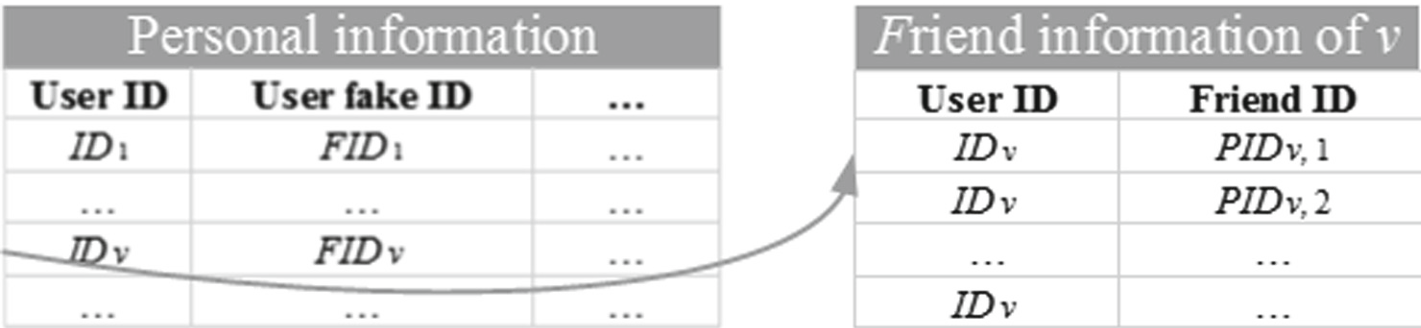
The figure above illustrates the separation of identity info in the SNS versus location data in the LS.
Experiments & Results: Performance on the Go
A common criticism of privacy protocols is their heavy computational "tax." PPS tackles this by using a hybrid of AES (for efficiency) and RSA (for security).
- Scalability: Even with 30 friends in proximity, the AES decryption phase takes ~35ms.
- Stranger Handling: RSA decryption, used to verify those not in the immediate friend list, stays below 300ms.
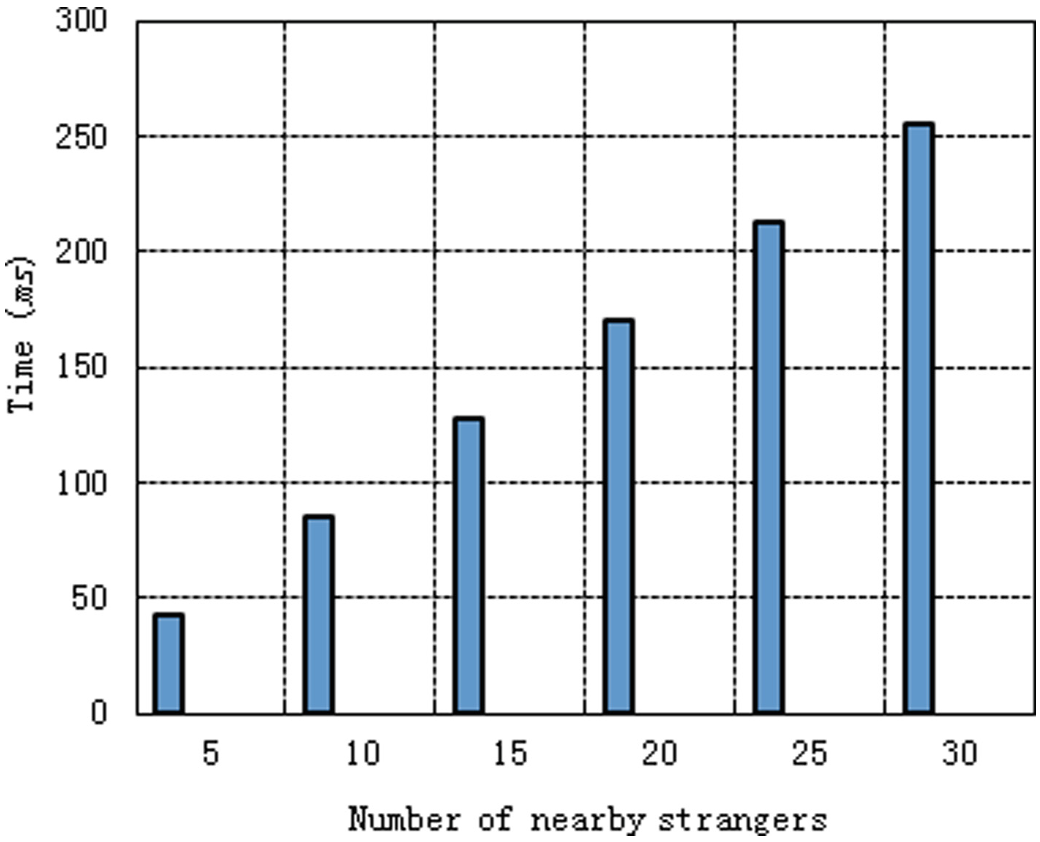
As shown in the decryption benchmarks, the latency scales linearly and remains well within the "real-time" threshold for mobile users.
Critical Insight & Conclusion
The genius of PPS is not just in the encryption, but in the shuffling of identifiers. By changing the Fake ID (FID) with every location update, the protocol prevents the Location Server from performing "long-term trajectory analysis." Even if the LS is compromised, the attacker only sees disconnected spatial points with no link to a permanent identity.
Limitations
- Collusion Risk: The protocol assumes that the SNS and LS do not collude to exchange data. If they harmonize their databases, the privacy benefits evaporate.
- Storage Overhead: The LS must store times more data due to the dummy locations, which might require aggressive pruning policies.
Future Perspective
PPS sets a strong baseline for "perfect privacy" in social LBS. Future iterations could integrate Differential Privacy to add mathematical guarantees against membership inference attacks, potentially making the system even more resilient to sophisticated statistical adversaries.