
Link Privacy Under Siege: Why Edge Randomization Fails in Social Networks
On link privacy in randomizing social networks
This paper investigates the vulnerability of edge-based randomization in social networks. It proposes a link privacy attack method using graph similarity measures (Common Neighbors, Katz, etc.) to reconstruct sensitive links from randomized graphs, achieving high prediction accuracy even under significant perturbation.
TL;DR
Think adding random noise to a social graph protects your secret connections? Think again. This paper demonstrates that topological fingerprints are so resilient that attackers can use simple similarity measures (like how many mutual friends you have) to "unmask" original links in a randomized graph with startling accuracy—often exceeding 80% precision even when the graph is heavily distorted.
The Illusion of Privacy via Randomness
In the world of social network publishing, "Link Privacy" is the holy grail. We want to share data for sociological research or epidemiology without revealing who actually knows whom. The standard defense is Edge Randomization:
- Delete true edges.
- Add fake edges.
Previous researchers assumed that if was large enough, the "noise" would bury the "signal." However, this paper reveals a fatal flaw: Social graphs are not random; they have a distinct geometry. Even after randomizing edges, the underlying "proximity" between nodes stays relatively intact, serving as a beacon for attackers.
Methodology: Weaponizing Proximity
The authors prove that an attacker doesn't need to know the original graph to break it. They just need to look at the Similarity Measures in the released, messy graph.
1. The Core Insight
Nodes that were originally connected tend to share more common neighbors or have shorter paths between them. Randomly adding/deleting edges changes the count of these features but rarely flips the relative ranking of node pairs.
2. The Enhanced Posterior Belief
The paper introduces a formal attack model. Instead of treating all edges as equally suspicious, the attacker calculates: This formula calculates the probability that a link is "real" given that it exists in the noisy graph () AND has a specific similarity score ().
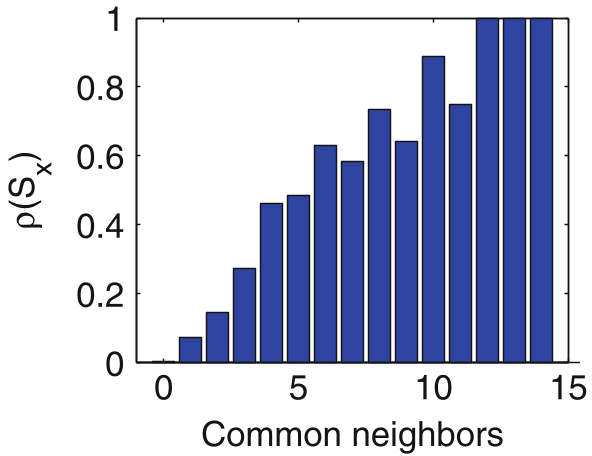 Fig 1: Evidence that link existence (ρ) remains highly correlated with similarity measures (Common Neighbors, Katz, etc.) even after randomization.
Experiments: The Failure of the Defense
The researchers tested this on datasets like the Enron email corpus and US political blogs.
Key Findings:
- High Precision: Even when 30% to 70% of the graph was "noise," the Top-t predicted links were correct more than 80% of the time.
- Measure Superiority: While "Common Neighbors" is the simplest, measures like Adamic/Adar and Katz often provided even more lethal accuracy for attackers.
- Vs. Low-Rank Approximation: Interestingly, this similarity-based attack often performed better than Spectral/SVD-based reconstruction (Low-Rank Approximation), especially because SVD requires picking an optimal rank —a task that is notoriously difficult for attackers.
 Fig 2: Precision-Recall curves showing similarity-based attacks (colored lines) significantly outperforming the baseline "prior belief" (black dashed line).
Critical Analysis & Conclusion
This work is a wake-up call for data privacy officers. It proves that structural information is the true identity in a network.
Limitations
The study focuses on "Link Disclosure" (did A and B talk?) rather than "Identity Disclosure" (who is node X?). Furthermore, the attack assumes the attacker knows the magnitude of perturbation , which is a common but strong assumption.
The Takeaway
If you are releasing social network data, randomization is not a shield. Future defenses must move toward Differential Privacy or Edge Generalization/Clustering, which fundamentally alter the graph's topology rather than just sprinkling random noise over it. The "Physics" of social networks—that we are who we are surrounded by—is simply too strong to be hidden by a few random coin flips.