
The Ghost in the Graph: Unmasking Social Network Users via Degree-Trail Attacks
Privacy Risk in Graph Stream Publishing for Social Network Data
The paper introduces the "Degree-Trail Attack," a novel privacy threat against graph streams in social networks, and proposes "Stable Link Randomization" as a more efficient anonymization method for evolving data. By tracking a target node's degree evolution across multiple published snapshots, an adversary can re-identify individuals with high probability, even when current SOTA defenses like link perturbation or k-anonymity are applied.
TL;DR
Social networks are dynamic, yet privacy research often treats them as static snapshots. This paper reveals a critical vulnerability: an adversary can "tag" a user by interacting with them to influence their node degree, then track this "Degree-Trail" across multiple anonymized releases. Even with randomized link perturbation, the target’s identity eventually leaks through the temporal noise.
Problem: The Static Snapshot Trap
Researchers and data miners love evolving graph data—it helps track how diseases spread or how influence grows. However, current anonymization (like -anonymity or standard link perturbation) is designed for "one-and-done" releases.
The authors point out a fatal flaw: if you randomize each release independently, the graph becomes structurally unstable, ruining data utility. If you randomize once and keep it, or use predictable methods, an active adversary can "sculpt" a target's degree over time. By observing how many friends a target gains or loses in the real world versus the published data, the adversary can filter out "innocent" nodes until only the target remains.
Methodology: Stable Randomization and The Attack
The authors propose Stable Link Randomization. Unlike traditional methods that pick a fixed number of edges to flip, this method uses a constant deletion rate and insertion rate . Once a link is randomized, its state is "remembered" for future versions of the graph, ensuring stability for data miners.
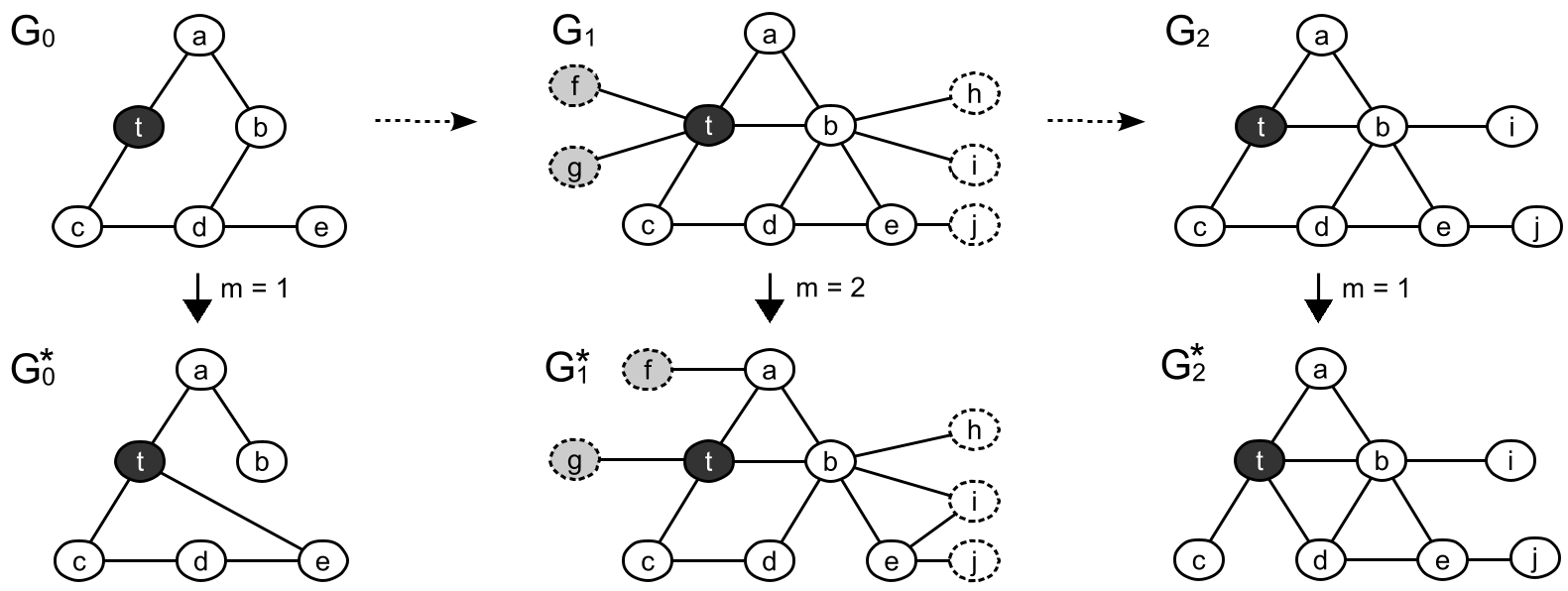
The Degree-Trail Attack follows a simple but deadly logic:
- Observation: Start with a set of candidates in the first publication.
- Active Interaction: The attacker adds/removes friends for the target in the live network.
- Refinement: In each subsequent publication, the attacker calculates which nodes in the previous candidate set still match the target’s known real-world degree (adjusted for known randomization parameters).
- Intersection: . As increases, the size of this set collapses toward 1.
Mathematically Measuring Risk
The paper introduces two ways to quantify this:
- Posterior Probability Model: Asks, "Given I see node with degree , what is the probability it actually has target degree ?"
- Confidence Interval Model: Uses the Chernoff Bound to create a 'goldilocks zone' of degrees. If a node's degree stays within this statistical range across multiple snapshots, it's flagged as the target.
Experiments: Nowhere to Hide
The authors tested this on the URV email network and Newman’s collaboration network.
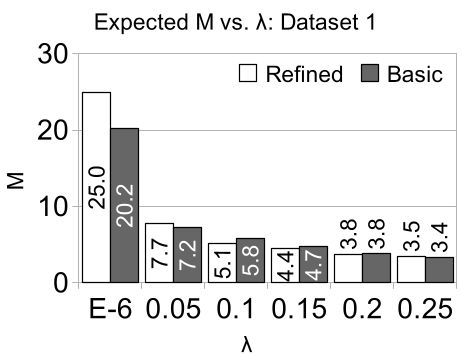
The results were sobering:
- Speed of Convergence: In most cases, the identity of a target was narrowed down to fewer than 5 people (a "success" by privacy standards) within just a few publications.
- Network Activity: In highly active networks (where users add many edges), the attack works better because the target's specific growth pattern stands out more clearly against the "normal" background growth of other nodes.
- Robustness: The attack succeeds even if the adversary doesn't behave like a "bot." They can mimic normal user growth patterns, making them nearly impossible to detect.
Critical Insight & Conclusion
The core takeaway is that temporal consistency is a double-edged sword. Stable randomization is necessary for utility (so data miners can trust the trends), but that same stability allows an adversary to track a "signal" through the "noise."
While this paper focuses on the attack, it sets a high bar for future defenses. Any future "Graph Stream" anonymization must not only protect the current state of the network but also ensure that the history of node metadata does not become a unique, trackable fingerprint.
Future Outlook: We need "Temporal Anonymity"—methods that potentially introduce intentional structural shifts across time to break the trail without destroying the underlying evolution trends.