
p2ReMon: Navigating the Tension Between Social Growth and Privacy Protection
Privacy and Social Capital in Online Social Networks
The paper introduces p2ReMon, a specialized Trust and Reputation Model for Online Social Networks (OSNs) designed to balance the trade-offs between extending Social Capital and maintaining Privacy Preservation. By utilizing behavior-based trust metrics and reputation-linked social capital thresholds, the model optimizes friendship decisions and information accessibility.
TL;DR
In the digital age, we face a fundamental "Privacy Paradox": we want to be connected, but every new connection is a potential vulnerability. This paper introduces p2ReMon, a framework that uses mathematical models of Trust and Reputation to automate privacy settings and friendship decisions. It proves that there is an "optimal threshold" where you can maximize your social influence safely.
The Core Conflict: Bridging vs. Bonding
Social networks thrive on two types of capital:
- Bridging: Creating "weak ties" with strangers to find new opportunities and non-redundant information. This is high-risk.
- Bonding: Strengthening "strong ties" with close, trusted circles. This is high-security but low-growth.
Most current platforms force users into a binary choice: either "Public" or "Private." The authors argue that this is insufficient because it doesn't account for the dynamic behavior of actors in a network.
Methodology: The p2ReMon Framework
The system operates on a feedback loop where interactions (Feeding and Feedback) inform Trust, which aggregates into Reputation, which finally determines Social Capital.
1. Peer-to-Peer Trust Modeling
Trust is not a static score. In p2ReMon, it is calculated based on three dimensions:
- Feeding: Quality and frequency of posts.
- Feedback: Positive interactions like 'likes' or comments.
- Common Friends: Similarity based on network structure.
2. Tiered Access Rights
Unlike the simple "block/unblock" mechanisms, this paper proposes a hierarchy of rights based on trust thresholds:
- View (Lowest Trust Required)
- Comment
- Share
- Propagate (Highest Trust Required)
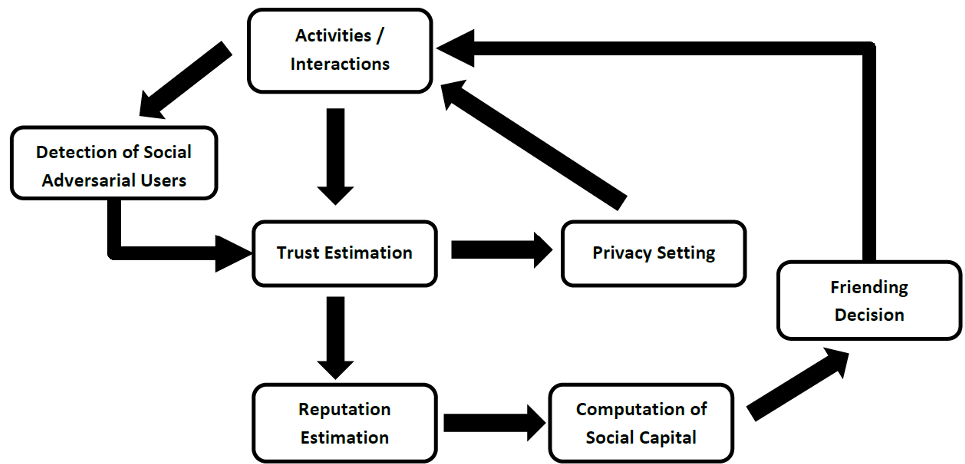 Fig 1: The cyclic relationship between Trust, Reputation, Privacy, and Social Capital.
Experiments: Finding the "Sweet Spot"
Using an ego-Facebook dataset, the researchers simulated realistic social interactions under various "hostility" levels (attack densities).
Key Observations:
- The Failure of the Middle Ground: Interestingly, medium privacy thresholds () often performed the worst. They allowed enough access for attackers to modify information but not enough visibility for the system to detect and evict them quickly.
- Optimal Settings: The study identifies (a high but not extreme threshold) as the champion setting, providing the best balance of message diffusion and leak prevention.
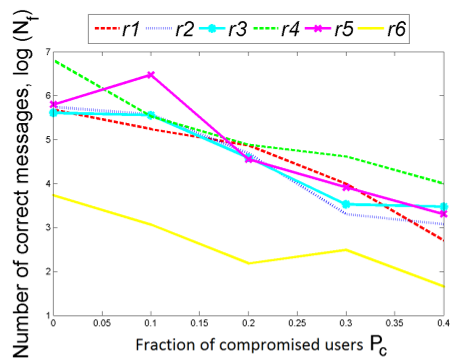 Fig 2: Impact of social capital thresholds () on Information Diffusion () and Privacy Leak-out ().
Critical Insight: Risk Appetite
The most profound takeaway is that privacy is not "one size fits all." The thresholds ( and ) act as a "risk appetite" slider. A marketing professional might tolerate a lower threshold to maximize bridging capital, while a private individual might crank the threshold up to prioritize bonding and security.
Conclusion & Future Outlook
p2ReMon moves social network security away from "bolted-on" encryption toward "behavior-aware" access control. While the current study uses a static Facebook snapshot, the future of this research lies in dynamic network evolution—modelling how trust decays over time when friends stop interacting.
Limitations: The model assumes that "likes" and "shares" are reliable indicators of trust, which can be gamed by sophisticated "sybil" attacks (coordinated groups of fake accounts). Future iterations will need more robust countermeasures against collective adversarial behavior.