
The Myth of Concern: Why What Users Say About Privacy Doesn't Match What They Do
Privacy and Social Networks: Is Concern a Valid Indicator of Intention and Behaviour?
This study investigates the "Privacy Paradox" in Social Network Systems (SNS) by comparing users' stated privacy concerns with their reported intentions and actual profile visibility. Using the Westin Index and direct observation of Facebook profiles, the author evaluates whether general concern serves as a valid predictor of protective behavior.
TL;DR
Is "being concerned" about privacy enough to make us act safely online? This study deconstructs the Privacy Paradox—the glaring gap between our stated worries and our public digital footprints. By auditing Facebook profiles against survey responses, the research reveals that general concern is a statistically invalid indicator of how people actually manage their data. Most users exist in a state of "unintentional transparency," blinded by default settings and short-term social gains.
Background: The Privacy Paradox
In the academic world of Human-Computer Interaction (HCI), the "Privacy Paradox" is a persistent headache. We know users say they value privacy, yet they continue to broadcast personal data to "Everyone" on networks like Facebook.
The author, Thomas Hughes-Roberts, argues that the field has been too reliant on an unproven assumption: that high concern leads to high protection. This paper sets out to prove that privacy is too contextually fluid and complex to be captured by simple "Are you concerned?" survey questions.
Methodology: Perception vs. Reality
To crack this, the researcher used a two-pronged approach:
- The Westin Index: A classic scale that buckets users into Fundamentalists (privacy hawks), Pragmatists (the middle ground), and the Unconcerned.
- The P-Score: A custom metric quantifying information visibility.
- Reported P-Score: What settings the user thinks they have.
- Observed P-Score: What their profile actually looks like to the public.
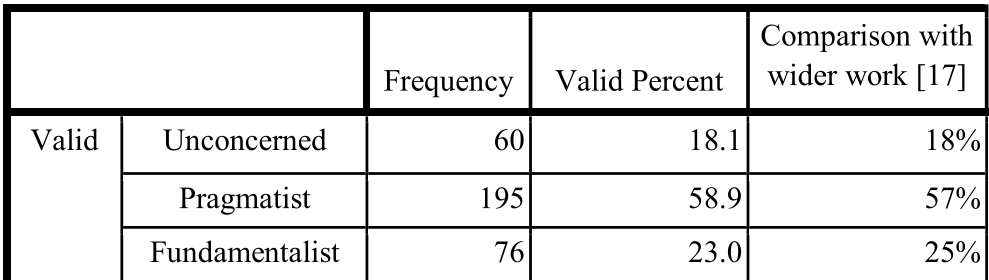 The sample distribution (23% Fundamentalists) closely mirrored broader global privacy trends.
The Disconnect: Findings
The results were striking. While 62.6% of participants claimed to be "concerned," their behavior told a different story.
1. The Perceptual Gap
There was a massive statistical difference between where users thought their privacy stood and where it actually was (P < .0001). Most participants believed their settings were "Friends Only," but their Observed P-Scores were significantly higher. Many were stuck on Facebook's default settings, a phenomenon the author attributes to a lack of technical skill or the "persuasive" nature of the UI.
2. Concern is Not a Compass
Perhaps the most damning finding is illustrated in the figures below. Whether you categorized a user as a privacy "Fundamentalist" or "Unconcerned," their actual profile visibility (P-Score) remained roughly the same.
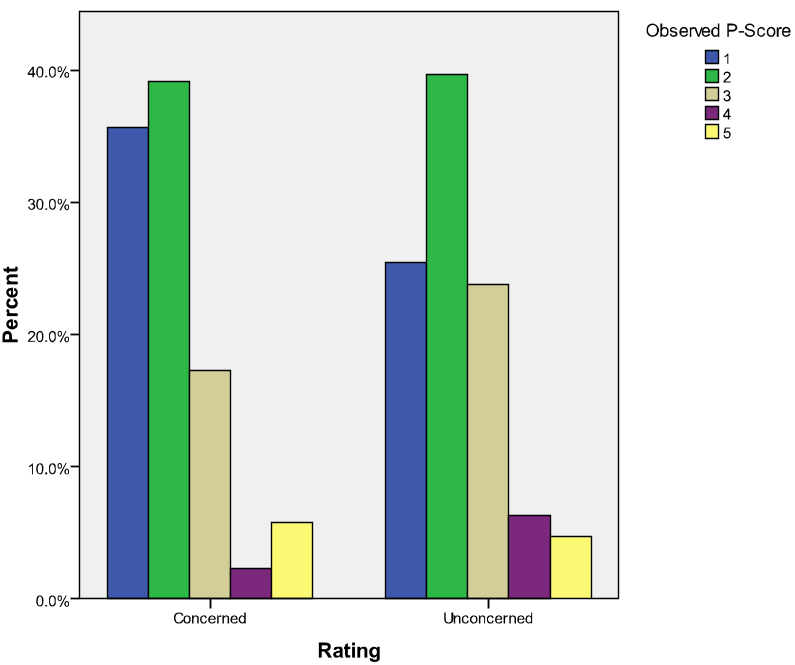 Note the flat distribution: Worrying more does not correlate with better settings.
Why is the Paradox So Persistent?
The paper points to several psychological and systemic factors:
- Hyperbolic Discounting: We prefer the immediate reward of a "Like" or a social connection over the vague, long-term risk of a data breach.
- Prospect Theory: When interacting with a system, we focus on what we can gain (social capital) rather than what we might lose (privacy).
- The Default Bias: Users rarely change the factory settings. If Facebook sets it to public, it usually stays public.
Critical Insight & Conclusion
The study concludes that surveys are failing us. Asking a user if they are concerned is like asking them if they want to be healthy—the answer is almost always "yes," but it doesn't predict if they'll eat the salad or the burger.
Takeaway for Tech Professionals: If you are building privacy features, don't just ask users for their preferences. You must address the stimulus-response level of the UI. Privacy protection shouldn't be a menu hidden in settings; it must be a salient, active part of the user experience.
Limitations: The sample was heavily weighted toward female nursing students, which may introduce demographic bias. Furthermore, the study focused on Facebook, a platform with specific "nudges" that might differ from more modern platforms like TikTok or Signal.
Future Outlook: To truly solve the privacy paradox, we must look beyond "concern" and toward "empowerment"—developing tools that make the consequences of disclosure visible in real-time at the moment of posting.