
Sight: Quantifying Privacy Risk in the Social Graph through Active Learning
Privacy in Social Networks: How Risky is Your Social Graph?
The paper proposes a novel risk estimation framework for Online Social Networks (OSNs) called "Sight," which quantifies the privacy risk of interacting with "strangers" (second-hop connections). It utilizes an active learning approach to learn a user's subjective risk attitude, achieving an 83.36% prediction accuracy on real-world Facebook data.
TL;DR
Researchers at the University of Insubria have developed a conceptual model and a Facebook application named Sight that estimates the privacy risk of interacting with strangers. By balancing the "Benefits" of new connections against "Similarity" (Homophily) and using an Active Learning framework, the system predicts risk with over 83% accuracy while requiring minimal user input.
Problem & Motivation: The Blind Spot of Social Connections
Most social network users treat a "Friend" as a binary relationship: they are either in or out. However, modern OSNs are filled with "virtual friendships"—people we have never met but who gain access to our private lives via default "Friends of Friends" settings.
The authors argue that current privacy tools are failing because they are static. They don't account for the fact that:
- Risk is Subjective: One user might find sharing photos with a stranger highly risky, while another might see it as an opportunity for social growth.
- The Graph is Massive: Manually setting privacy levels for 16,000+ second-degree contacts is impossible for a human.
- Information Flow is Uncontrolled: You cannot control what a friend's friend might infer or re-share from your profile.
Methodology: Risk as a Trade-off
The paper introduces a risk measure built on two pillars of social theory:
- Homophily (Similarity): We tend to trust those similar to us. The system measures both Network Similarity (mutual friend density) and Profile Similarity (demographics).
- Heterophily (Benefits): We interact with different people to gain information. Risk is evaluated against the benefit () of what the stranger reveals to us.
The Active Learning Pipeline
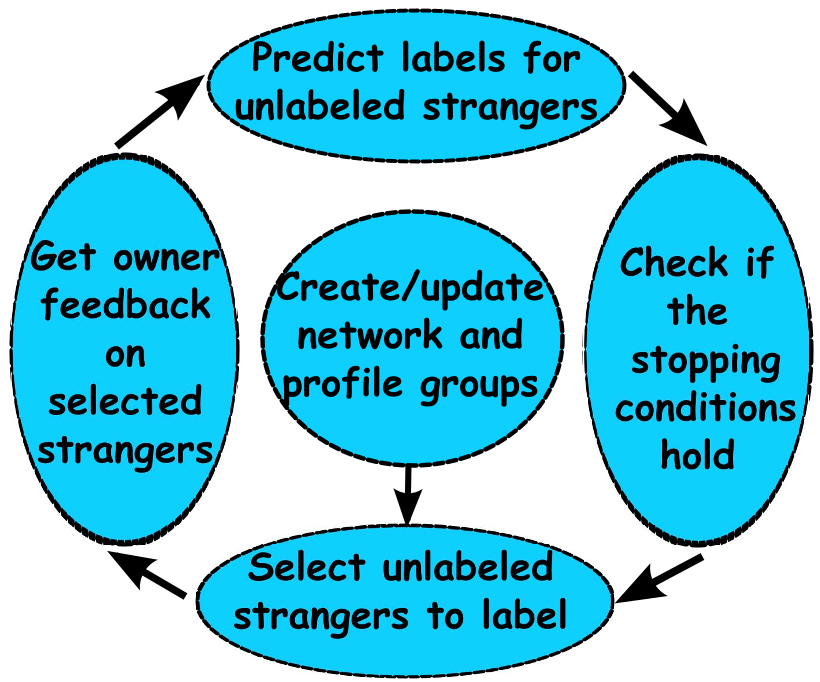
To solve the scale problem, the authors use Active Learning. Instead of labeling everyone, the user labels a few "informative" strangers.
- Clustering (Squeezer): The system groups strangers into pools based on similarity.
- Active Querying: The user is asked: "This stranger is X% similar and provides Y% benefits. Is it risky to connect?"
- Label Propagation: Using a graph-based classifier (Zhu et al.), the system propagates these subjective labels to thousands of unlabeled strangers in the social graph.
Experiments & Results: 83% Accuracy with Small Effort
The researchers tested Sight on 47 Facebook users. The key findings were:
- Accuracy: The system achieved 83.36% exact match accuracy on risk labels.
- Efficiency: Owners only needed to label an average of 86 strangers out of 3,661 to achieve stable results.
- Human Insights:
- Gender was the most influential factor in risk perception for 34 out of 47 users.
- Photos were rated as the most important "benefit" item, yet home walls were perceived as less valuable to both intruders and owners.
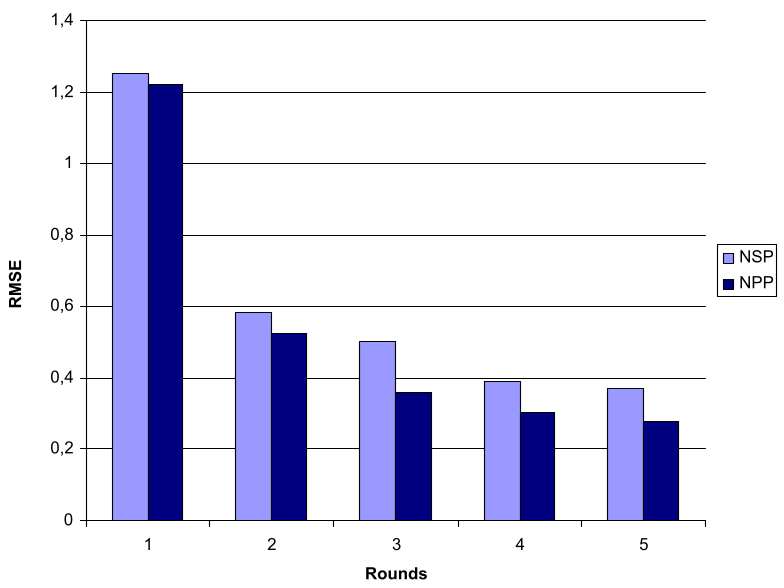 Figure: The "Network and Profile based Pools" (NPP) approach consistently showed lower RMSE (error) than basic network similarity (NSP).
Critical Analysis & Conclusion
This work shifts the privacy conversation from Access Control Lists (ACLs) to Risk Management. By quantifying the "risk" of a social graph, it allows for future applications like "Risk-aware Friend Suggestions" or automated privacy firewall adjustments.
Limitations:
- The study relies on Facebook's 2011-era API; modern "walled gardens" make gathering such graph data significantly harder for third-party apps.
- The "Benefit" model assumes all visibility is a positive utility, which may not hold in adversarial scenarios (e.g., stalking).
Future Outlook: As we move toward AI-driven social agents, models like Sight could serve as the "Privacy Engine" that helps users navigate complex digital interactions without being overwhelmed by technical settings.
Takeaway: Your social graph isn't just a network; it's a measurable landscape of privacy exposure.