
Sound vs. Silence: Decoding Privacy in the Age of Acoustic Social Networks
Privacy in Sound-Based Social Networks
The paper explores privacy dynamics in Online Sound-Based Social Networks (OSBSNs) using a custom research tool called Hurly-Burly. It proposes a novel approach of sharing high-level contextual sound classifications (music, speech, environment) rather than raw audio to mitigate user privacy concerns while maintaining social utility.
TL;DR
Is the background noise of your life the next frontier for social media? This paper introduces Online Sound-Based Social Networks (OSBSN) and addresses the "privacy elephant" in the room. By using a tool called Hurly-Burly, the authors demonstrate that we can share the "vibe" of our environment (music vs. talking) without actually broadcasting private conversations, achieving an 87% classification accuracy while respecting user boundaries.
Contextual Cues: The Missing Link in Social Media
Current social networks are dominated by text and photos, but these are "active" disclosures. We choose to take a photo. In contrast, Soundscapes—the sonic environment of a place—offer a "passive" and continuous stream of context.
The authors argue that knowing whether a friend is in a quiet library, a bustling cafe, or a loud concert adds a rich layer of social presence. However, the motivation for this study stems from a critical friction: Audio is inherently leaky. A background recording can capture private passwords, intimate conversations, or embarrassing sounds.
Methodology: The Hurly-Burly System
To test how users feel about sharing their "sonic profile," the authors built Hurly-Burly for iOS. The system architecture is designed to avoid the "Privacy Trap" through abstraction.
1. The Sensing Cycle
Instead of a continuous stream, the app records a ~2.8-second snippet every 3 minutes.
2. Machine Audition (Edge Processing)
Crucially, the audio never leaves the device. The Soundscape Sensing Module (built with Pure Data and LibPD) classifies the audio into:
- Music (Entertainment context)
- Speech (Social context)
- Environmental Sound (General context)
3. Abstract Visualization
Instead of "playing" the sound for friends, the app displays animated waveforms. The amplitude and shape change based on the classification, providing a visual metaphor for the soundscape.
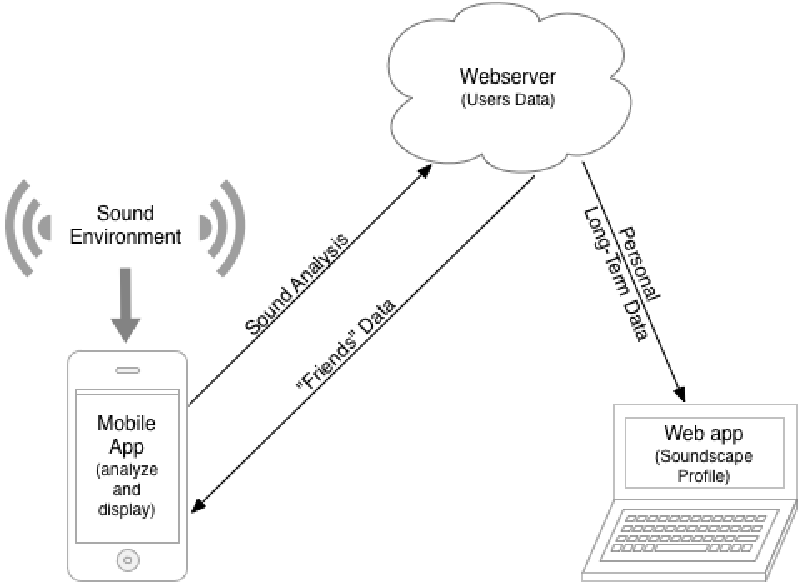 Figure 1: Typical Client-Server configuration for the Hurly-Burly system.
Experimental Insights
The researchers deployed the app across three distinct groups (students, researchers, and designers) in Macau and Portugal.
The "Audio Uncanny Valley"
The study found a fascinating psychological threshold. When users were asked if they would share actual audio clips:
- 17% said "Never."
- 39% said "Only in controlled situations."
- Only 13% were comfortable with it.
This confirms the existence of an "Uncanny Valley" for audio—as the representation becomes too realistic (raw audio), the discomfort spikes. However, when the sound was abstracted into "Waves" and "Classifications," the resistance dropped significantly.
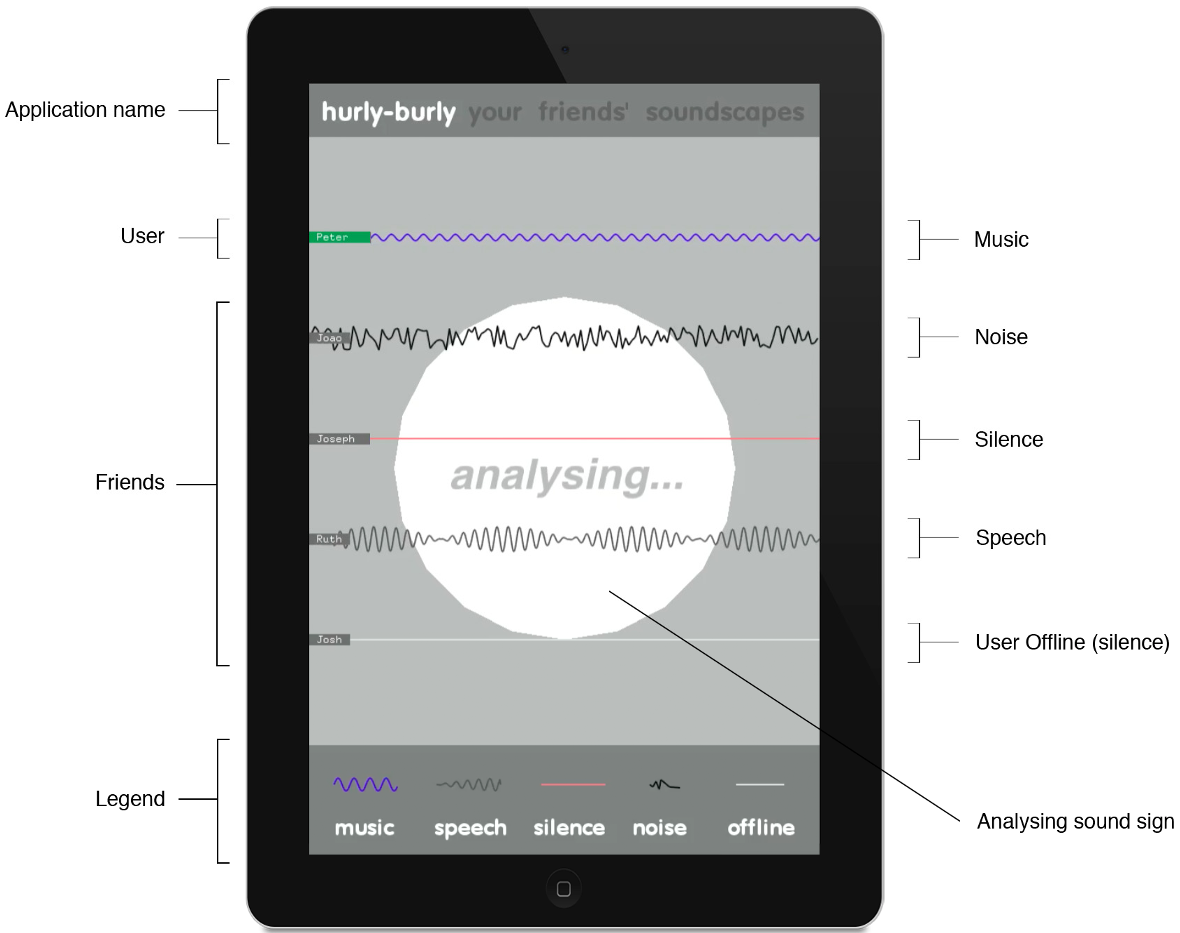 Figure 2: The GUI representing friends as categorized waveforms.
Why This Matters: Privacy vs. Utility
The correlation analysis revealed a key trend: people who recognized the social value of soundscapes were much more willing to share data. Yet, the biggest "killer" of the app wasn't actually privacy—it was battery life (72%). This suggests that for mobile sensing to succeed, optimization is as critical as encryption.
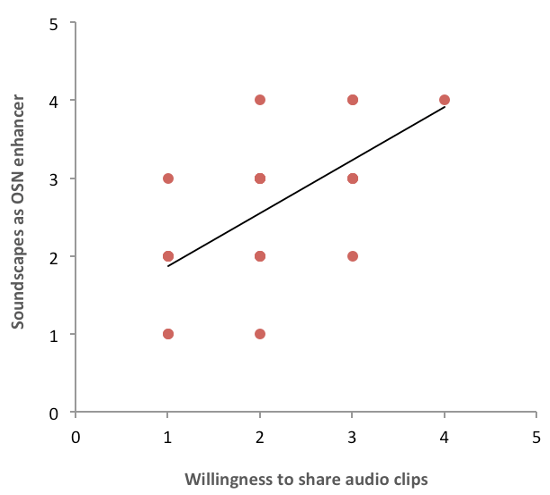 Figure 3: Correlation between usage habits and willingness to share audio.
Conclusion: Toward Symbolic Privacy
The genius of the Hurly-Burly approach is the move from Data Collection to Insight Sharing. By sharing "Meaning" (the category) instead of "Data" (the waveform), the authors provide a roadmap for future IoT and Social Network integrations.
Future Outlook: As wearable devices (like smart glasses) become more common, the lesson here is clear: to keep users engaged, we must design systems that "hear" without "listening" and "see" without "watching."
Limitations
- The sample size was relatively small (23 participants) and skewed toward academic environments.
- The "Movement Detection" cross-check (phone in a bag vs. real environment) is a vital heuristic that needs further refinement to avoid false context reporting.