
Harmonizing Privacy and Availability: A Temporal Approach to Decentralized Social Networks
Privacy and Temporal Aware Allocation of Data in Decentralized Online Social Networks
This paper introduces a privacy-aware and temporal-aware data allocation strategy for Decentralized Online Social Networks (DOSNs). It utilizes a linear predictor to model user availability patterns and ensures that data replicas are stored only on trusted nodes authorized by privacy policies, achieving high availability without traditional encryption overhead.
Executive Summary
TL;DR: This research tackles the "Availability-Privacy Dilemma" in Decentralized Online Social Networks (DOSNs). By predicting when users will be online using a linear predictor and only replicating data on peers authorized by privacy policies, the authors achieve 95% data availability and a 30% improvement over traditional session-length baselines without relying on resource-heavy encryption.
Context: This work sits at the intersection of Distributed Systems and Privacy-Preserving Social Computing. It moves away from "blind" replication (storing data anywhere and encrypting it) toward "informed" replication (storing data only where it is legally allowed and likely to be accessible).
The Problem: The High Cost of Decentralization
In a centralized world (Facebook/X), your data is always online because a server farm hosts it. In a DOSN, your data lives on your friends' devices. If you and your friends all go to sleep and turn off your apps, your profile disappears.
Current solutions fail in two ways:
- Random Replication: Spreads data to any peer, requiring heavy encryption to prevent unauthorized access, which drains mobile battery and CPU.
- Naive Availability: Replicates to peers with the longest "average session length," often overloading a few "super-peers" while ignoring the specific time of day when data is actually needed.
Methodology: Trust Meets Predictability
The authors propose a dual-layered selection mechanism for content replicas. Instead of asking "Who has space?", the system asks:
- "Who is allowed to see this?" (Privacy Constraint)
- "Who is likely to be online right now?" (Temporal Constraint)
1. Privacy-Aware Filtering
The system models a user profile as a tree structure. Each leaf (a post or image) has a specific policy (e.g., "Only friends with >1 common friend"). Before replication, the system filters out any peer that doesn't meet these criteria.
2. The Linear Predictor
To solve the timing issue, the authors implement a linear predictor. It looks at the past time intervals (trained on 12 days of history) to predict the status of a peer:
This allows the system to identify peers who are "Night Owls" or "Early Birds," ensuring that for any given hour, at least one of the replicas is hosted by someone likely to be awake.
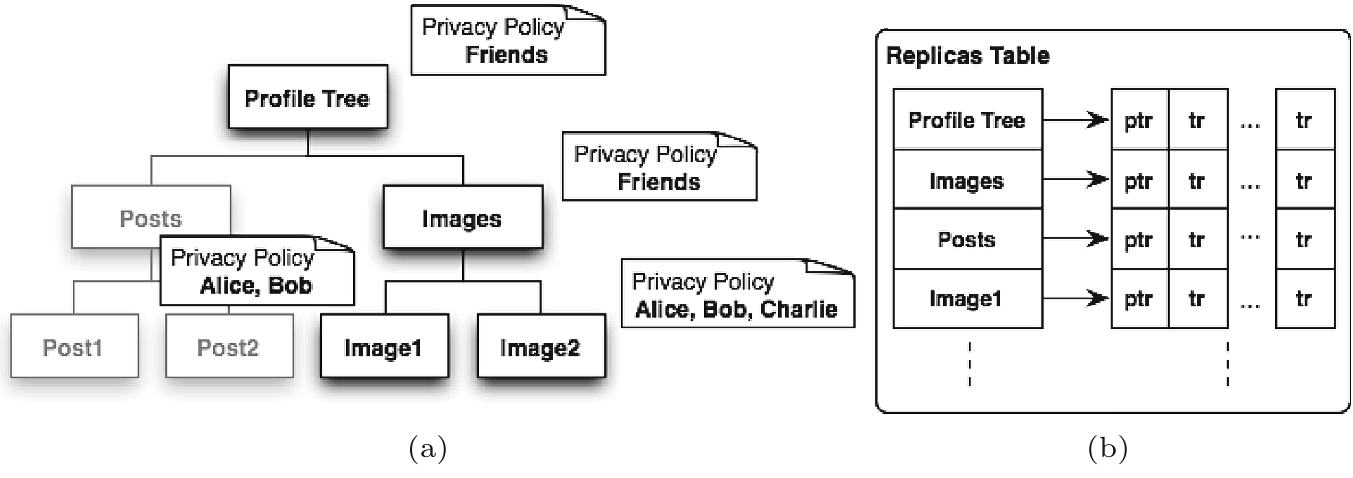 The architecture utilizes a DHT (Distributed Hash Table) to track where these smart replicas are stored.
Experimental Insights
The study used real-world traces from 23,428 Facebook users over 32 days.
Key Findings:
- Nighttime Superiority: During the night, when overall network activity drops, the Linear Predictor (LP) strategy maintained 30% higher availability than the Session Length (SL) strategy.
- Load Balancing: Unlike the SL strategy, which hammers the most active users with all the data, the LP approach distributes the load across different users based on their specific time-slots.
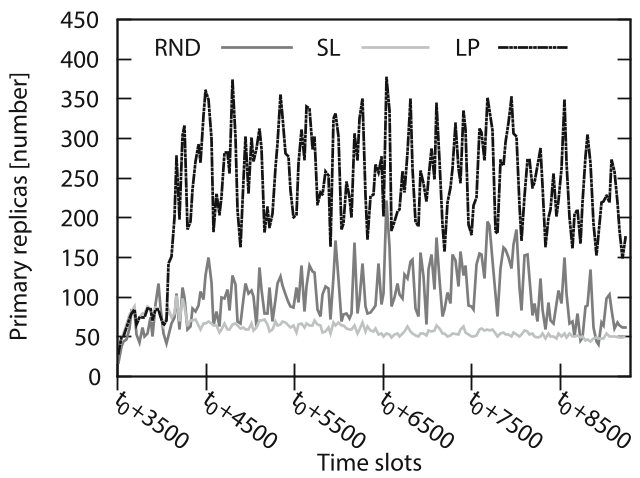 Comparison of LP (Linear Predictor) vs SL (Session Length) and RND (Random) strategies.
Critical Analysis & Conclusion
Takeaway
The genius of this paper lies in its Inductive Bias: user behavior in social networks is periodic, not random. By baking this periodicity into the replication logic, the authors eliminate the need for the "encrypt everything" brute-force approach.
Limitations
- Cold Start: The model requires 12 days of "training" data for a user before it can accurately predict their availability.
- Dynamic Policies: If a user changes their privacy settings, the system must trigger a massive re-allocation of replicas, which could cause a temporary spike in network traffic.
Future Work
The next logical step is moving beyond linear predictors to Recurrent Neural Networks (RNNs) or Transformers to capture more complex, non-linear social habits, and implementing automated load balancing to prevent certain "popular" friends from being overwhelmed with storage requests.