
De-masking the Graph: Why Deleting Names Isn't Enough for Social Network Privacy
Privacy Threat Analysis of Social Network Data
This paper provides a comprehensive threat analysis of privacy disclosure in social network data publishing. It identifies a taxonomy of privacy breaches—identity, link, and attribute disclosure—and analyzes how structural background knowledge (degree, neighborhood, sub-graphs) can be leveraged by adversaries to de-anonymize "naively" anonymized graphs.
TL;DR
Simply wiping Names or Social Security Numbers from a social network dataset is a "naive" approach that fails to protect user privacy. This paper demonstrates that the structure of your relationships—who you know and how they know each other—acts as a unique fingerprint. By leveraging structural queries (like degree and local neighborhood patterns), an adversary can re-identify "anonymized" users with alarming precision.
The "Anonymization" Illusion
In the era of Big Data, service providers often share "anonymized" social network data with researchers or advertisers for "public good." However, the authors argue that the complex dependencies in social networks make traditional privacy methods obsolete.
The core problem is Background Knowledge. An attacker doesn't need to know your ID; they just need to know that "Gary has 4 friends, and three of those friends know each other." That unique structural fragment is often enough to find "Gary" in a sea of millions.
Methodology: How Adversaries Map the Network
The paper breaks down how an attacker translates a social network into a searchable map using Structural Queries:
1. Vertex Refinement ( Queries)
This is an iterative "zoom-out" approach.
- Level 0: Who are you? (Attributes)
- Level 1: How many friends do you have? (Degree)
- Level 2: How many friends do your friends have? As the attacker moves higher in the iterations, the uniqueness of the signature increases exponentially.
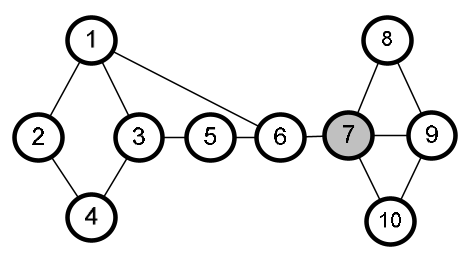 Figure 1: Contrast between a real social network and its "naively" anonymized graph where vertices are replaced by meaningless IDs.
2. Sub-graph and Active Attacks
An adversary can be "passive" (knowing existing patterns) or "active." In an Active Attack, an attacker creates "dummy profiles" with a very specific, weird connection pattern and links them to a victim. When the data is released, the attacker simply looks for that specific "weird pattern" to locate the victim.
3. Hub Fingerprints
Famous people or "hubs" (nodes with high centrality) are the easiest to find. Because they are outliers, their connection to a target serves as a "GPS coordinate" for that target.
The Taxonomy of Privacy Breaches
The authors categorize the resulting damage into three tiers:
- Identity Disclosure: Successfully mapping a real person to a node (The "Master Key").
- Sensitive Link Disclosure: Revealing relationships people want to hide (e.g., membership in a secret political group).
- Sensitive Attribute Disclosure: Predicting a person's private traits (e.g., a medical condition) based on the "company they keep" (homophily).
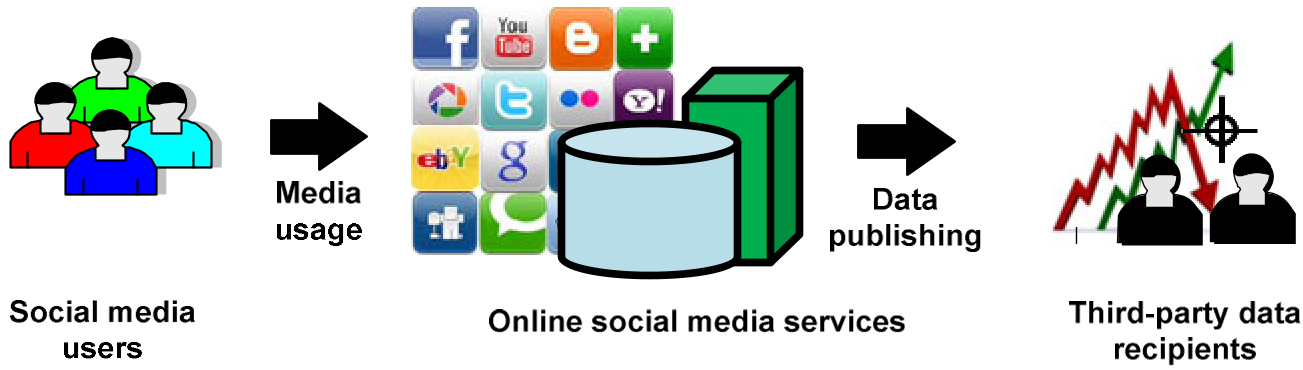 Figure 2: The standard data flow from users to service providers to third-party recipients, highlighting where the "sanitization" must occur.
Critical Insight: The "Small World" Vulnerability
The paper implicitly relies on the "Small World" phenomenon. Because most social networks have a low diameter and high clustering, individuals' local neighborhoods are surprisingly unique. This "Inductive Bias" of human social behavior is ironically what makes our digital shadows so hard to hide.
Conclusion & Future Look
The paper serves as a wake-up call for Data Protection Authorities. It proves that privacy is not a static attribute but a structural property.
Takeaway for Researchers: We must move beyond "sanitizing" nodes and start looking at "Graph Perturbation"—adding fake edges or nodes (Noise) to break the structural signatures without destroying the statistical utility of the data.
Takeaway for Users: "Consent" is often given without understanding. Even if a platform promises to hide your name, your "social footprint" remains a highly identifiable trail.