
The Geography of Privacy: Navigating Vulnerabilities in GeoSocial Networks
2592_A survey of privacy vulnerabilities and defenses in geosocial networks.
This paper provides a comprehensive survey of security and privacy vulnerabilities in GeoSocial Networks (GSNs). It categorizes attack vectors like Sybil accounts and location spoofing while evaluating defense frameworks—such as VeriPlace and Shy Mayor—against a unified set of privacy and functionality requirements.
TL;DR
GeoSocial Networks (GSNs) like Foursquare and Yelp have revolutionized how we interact with physical spaces, but they have also created a "gold mine" for privacy adversaries. This paper surveys the landscape of GSN vulnerabilities—ranging from Sybil attacks to location cheating—and evaluates current defense mechanisms. The core tension lies in maintaining high-utility GSN features (like badges and recommendations) without surrendering precise user trajectories to untrusted providers.
Background: The Price of a "Check-In"
In GSNs, the "friend" concept from traditional social networks is extended with spatial-temporal data. While this enables venue rewards and proximity alerts, the privacy stakes are significantly higher. Research shows that just two weeks of GPS traces can uniquely identify a user's home and work locations. The GSN ecosystem involves two primary threats: the Adversarial Provider (who might sell data) and the External Malicious User (who uses automated tools to harvest information).
The Anatomy of GSN Attacks
The paper identifies three primary vectors that attackers use to gain an "equal footing" with providers:
- Sybil Attacks: Leveraging automated tools and 10-minute emails to create thousands of fake identities. These identities can bypass rate limits and infiltrate real users' social circles.
- Location Cheating: Tools like
LocationSpooferorGPSCheatallow users (or attackers) to report being at a venue they never visited, undermining the integrity of reward systems (badges). - Large-Scale Crawling: Exploiting permissive default privacy settings to scrape public profiles and map user movements across different cities.
Methodology: Benchmarking the Defenses
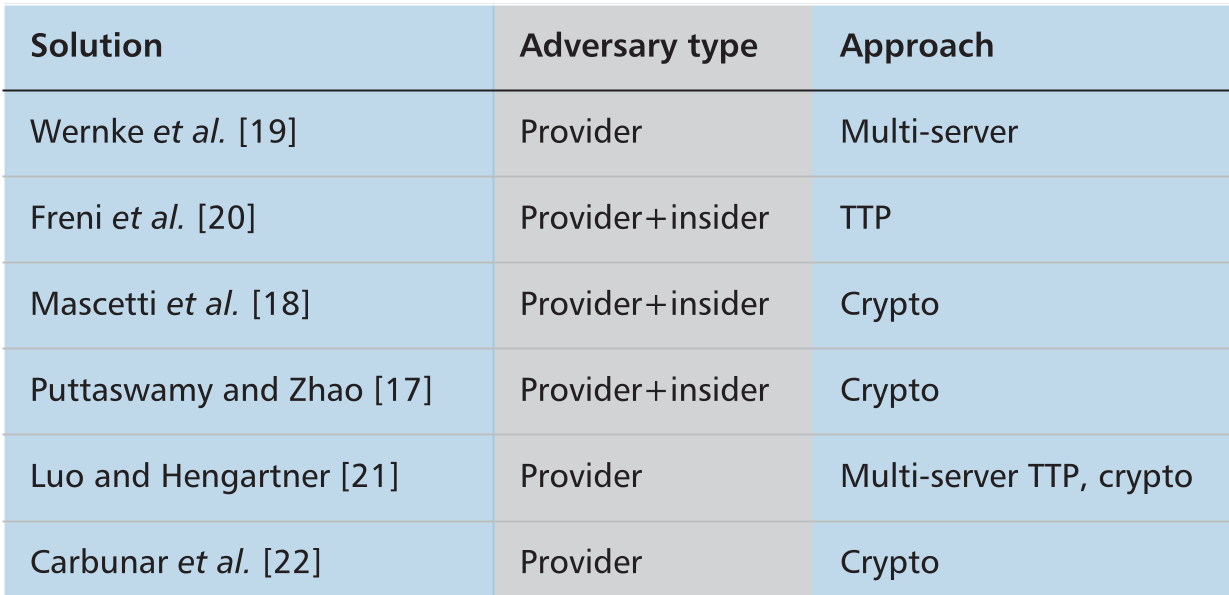
The author evaluates existing SOTA solutions against five "Crystallized Properties." Here is how they stack up:
The Core Defense Mechanisms:
- Cryptographic Constructs: Solutions like Shy Mayor use Zero-Knowledge Proofs (ZKP) and Quadratic Residues. Users can prove they have earned enough "check-in tokens" for a badge without revealing exactly which venues they visited.
- Multi-Server/TTP Systems: VeriPlace and PShare split location data into shares. A single compromised server yields no useful information, requiring collusions to breach privacy.
- Behavioral Analysis: Detecting Sybils by analyzing "clickstreams"—the patterns of how users navigate the app—which are significantly different for bots versus humans.
Experimental Analysis: The Trade-off Matrix
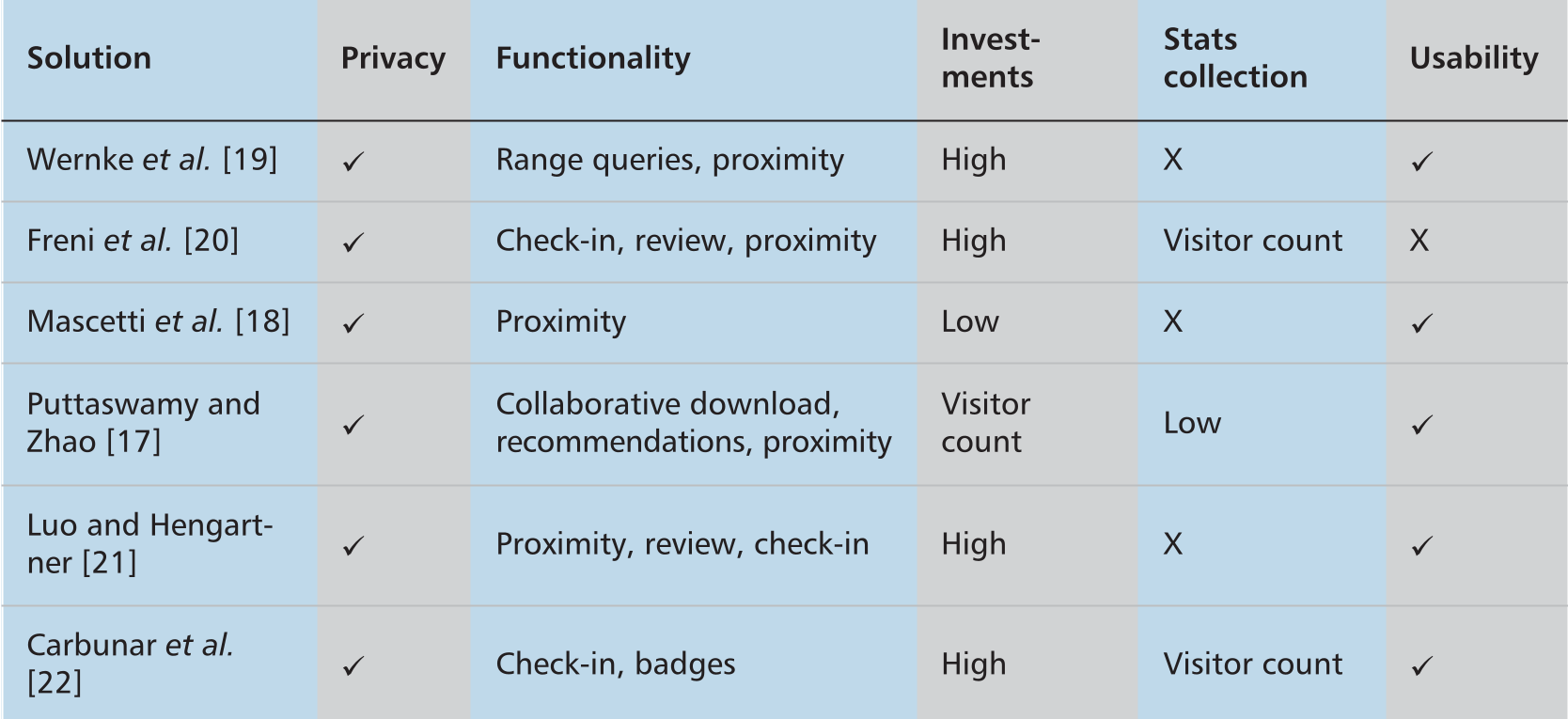
The survey provides a critical comparison of how different solutions impact the GSN ecosystem.
Key Insights from the Results:
- Functionality vs. Privacy: Most solutions focus on "Proximity Notification," but very few (like Puttaswamy and Zhao) successfully address complex requirements like Collaborative Recommendations while maintaining privacy.
- Investment Barriers: High-security architectures (e.g., VeriPlace) require significant investment from venue owners (installing local verification hardware like NFC/WiFi), which hinders adoption.
- The Statistics Gap: Almost all current privacy-centric solutions fail to provide rich statistics to GSN providers (e.g., demographic distribution of visitors), which is the primary revenue driver for these platforms.
Critical Insight & Conclusion
The "Holy Grail" of GSN research remains Private Personalized Recommendations. Currently, users must choose between receiving relevant tips (by surrendering their location history) or staying private (and losing functionality).
The author concludes that the next generation of GSNs must move beyond simple encryption. We need systems that support Computation on Encrypted Data—enabling providers to compute "similarity" between users without ever seeing their actual check-in coordinates. Until then, GSNs remain a high-stakes trade-off between social convenience and personal safety.