
Why Your "Anonymous" Location Data Isn't Private: A Deep Dive into Mobility Trace Vulnerabilities
Privacy Vulnerability of Published Anonymous Mobility Traces
This paper investigates the privacy vulnerabilities of published anonymous mobility traces, demonstrating that anonymization through ID replacement and spatial/temporal cloaking is insufficient. It proposes optimal inference strategies, primarily the Maximum Likelihood Estimator (MLE) and Minimum Square (MSQ), achieving 30%-50% identification accuracy with only 10 pieces of noisy side information.
TL;DR
Even if your name is replaced with a random ID and your GPS coordinates are blurred, your movement is a "fingerprint." This paper proves that an adversary with just a few random sightings of a person can deanonymize their entire history in a public dataset with up to 50% accuracy. The study introduces a rigorous mathematical framework to quantify this "privacy loss" using real-world taxi and bus data.
The "Anonymity" Illusion: Problem & Motivation
Data portals like CRAWDAD publish mobility traces to help researchers design better urban networks and sensing systems. To protect users, they use Anonymization (swapping names for IDs) and Cloaking (reducing spatial/temporal resolution).
However, the authors point out a fatal flaw: Side Information. In the real world, someone might see you at a coffee shop (direct observation) or you might tweet your location (indirect disclosure). If an attacker gets their hands on a few of these "snapshots," can they find your "needle" in the "haystack" of millions of anonymous data points? The answer is a resounding yes.
Methodology: The Math of the Stalker
The paper treats the adversary as a "sophisticated" agent performing Bayesian Inference.
1. The Passive Adversary (Problem A)
Imagine an attacker with a static database and a few noisy snapshots () of a victim. They use a Maximum Likelihood Estimator (MLE) to find the trace that maximizes the probability: The authors tested four approaches:
- MLE: Assumes a specific noise distribution (e.g., Gaussian).
- MSQ (Minimum Square): Minimizes the distance between side info and the trace.
- BAS/EXP: Heuristic methods using radii or exponential weights.
2. The Active Adversary (Problem B)
Here, the attacker is a physical entity—perhaps a "malicious node" in the network—trying to meet people. They use a greedy algorithm to visit "popular cells" to maximize encounters, stripping away the -anonymity of participants through the process of elimination.
 The core mathematical model for noise perturbation in side information.
Experiments: Real-World Evidence
The authors tested their theories on three massive datasets:
- San Francisco Cabs (High entropy, random movement).
- Shanghai Buses (Low entropy, periodic/fixed routes).
- Shanghai Cabs (Sparse distribution over a large area).
Key Insight: The Robustness of MSQ
One of the most striking findings is that the Minimum Square (MSQ) approach is the "MVP" for attackers. While MLE performs perfectly if the noise assumption is correct, it fails miserably if the noise distribution is misinterpreted. MSQ, however, requires no prior knowledge of the noise and matches the best-case performance of MLE.
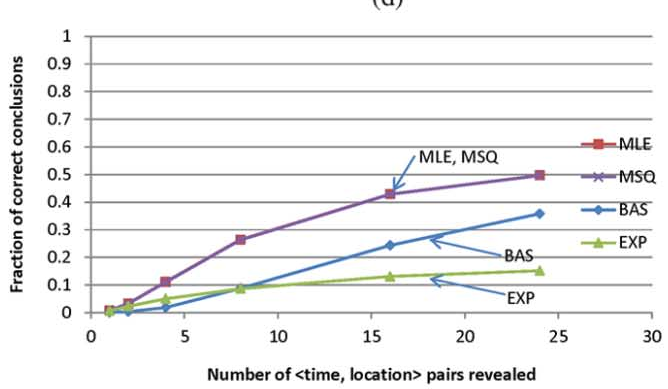 Figure 6: As the number of side information pairs increases, the fraction of correct conclusions (unique identification) shoots up significantly.
Why Cloaking Fails
The paper uncovers a "competitive effect" in spatial cloaking (blurring GPS data). While larger grid cells make traces more similar (helping privacy), they also mask errors in the attacker's side information. This means that increasing the blur can sometimes help an attacker by filtering out the "noise" in their own observations!
Critical Analysis & Takeaways
- The Fragility of Mobility Privacy: The high "entropy rate" of human movement means we rarely follow the same path twice in an identical way. This uniqueness is our privacy undoing.
- Limitations: The study primarily uses a Markovian assumption for movement. While robust, more complex non-Markovian patterns (like long-term intent) could potentially offer even more side-channel leaks.
- Conclusion: Current "anonymization" practices are insufficient for high-stakes privacy. The authors argue that while Differential Privacy (DP) offers a stronger theoretical guarantee, it ruins the "utility" of individual traces for simulation. We are left with a stark trade-off: Utility or Privacy—pick one.
Future research must focus on generating Synthetic Traces that mimic real-world interactions without leaking the "fingerprints" of the original participants.