
PrivacyTag: Reclaiming Subject Consent in the Era of "Post-First" Social Media
PrivacyTag: A Community-Based Method for Protecting Privacy of Photographed Subjects in Online Social Networks
PrivacyTag is a community-based privacy protection framework that utilizes physical wearable tags and a dedicated "Photo Privacy Realizer" (PPR) app. It adaptively blurs the faces of subjects in photos based on privacy policies embedded in the tags and the viewer's community membership.
TL;DR
PrivacyTag is a novel system that uses wearable physical tags to communicate privacy preferences directly to cameras. By embedding community-specific policies into a custom-designed bit pattern, it allows for adaptive face blurring without requiring users to register biometrics. It extends reliable privacy signaling to the "social distance" (up to 4.5m), far exceeding the capabilities of standard QR codes.
Background: The Invisible Victim of OSNs
In current Online Social Networks (OSNs) like Facebook or Instagram, the "poster" holds all the power. While you can control who sees your post, the people in your photos — the subjects — often have no say in how their image is displayed. Current solutions are flawed:
- Face Recognition: Requires subjects to upload their faces to a database (a privacy irony).
- QR Codes: Hard to scan from a distance or when the subject is moving.
- Subjective Judgment: Relying on the photographer to "be nice" rarely works in the heat of a social moment.
The "Why" behind PrivacyTag's Design
The authors recognized that privacy is contextual. You might be fine with your face showing in a "Yoga Class" community photo, but not in a public post. PrivacyTag solves this by embedding SACL (Social Access Control List) logic into a wearable accessory.
Methodology: Engineering for the "Social Distance"
The core innovation lies in the physical tag design and the Photo Privacy Realizer (PPR) app.
1. The Tag Architecture
The team moved away from complex QR codes to a high-contrast bit pattern.
- The Frame: A 3mm+ line width ensures the app can find the tag even at a distance of 12 meters.
- Bit Pattern: It includes a header for orientation (so the tag can be worn upside down) and a Reed-Solomon coded payload for the Community ID and Policy.
- Adaptive Policies:
- Private: Always blur.
- Within Community: Show face only to members.
- Public: No blurring.
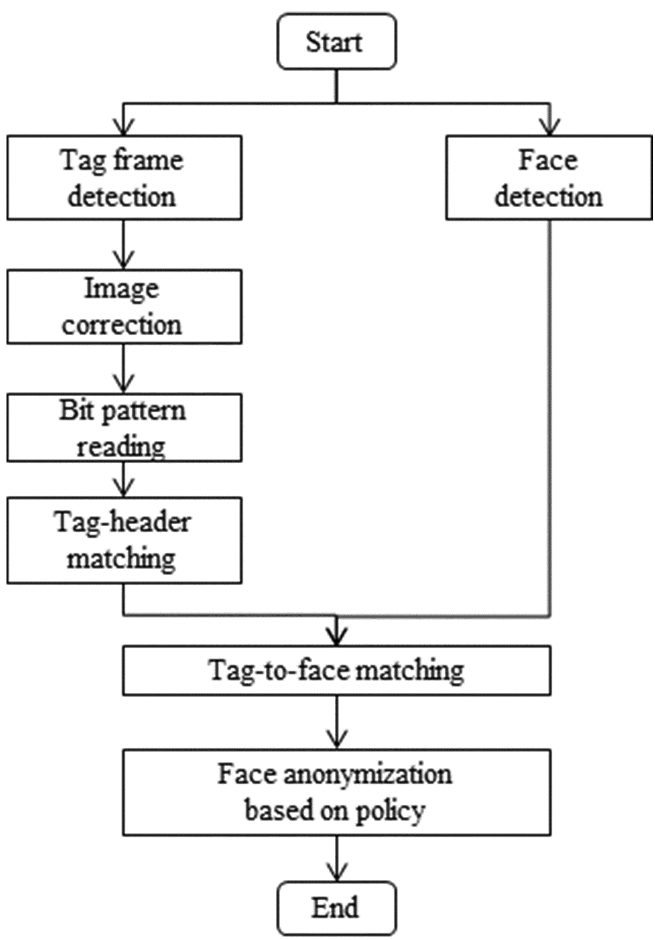 Figure: The dual-track process of simultaneous face detection and tag analysis.
2. Physical Layout vs. Digital Logic
The PPR app executes a parallel workflow: it finds faces using the Viola-Jones algorithm and simultaneously scans for tags in a "search zone" (3x width, 4x height) below the detected face. This spatial association links the policy to the person.
Experimental Results: Outperforming the Baseline
The researchers compared their tag against a standard Version-1 QR code. In social settings, most photos are taken at a "Social Distance" (1.2m to 3.5m).
- The 3cm Challenge: At a 3.5m distance, a 3cm QR code becomes a blurred mess, failing detection. The PrivacyTag, however, remains readable, effectively extending the safety net for subjects in group shots.
- Validation: For 5x5 cm tags, PrivacyTag achieved successful analysis up to 4.5m, whereas QR codes failed after 3.5m.
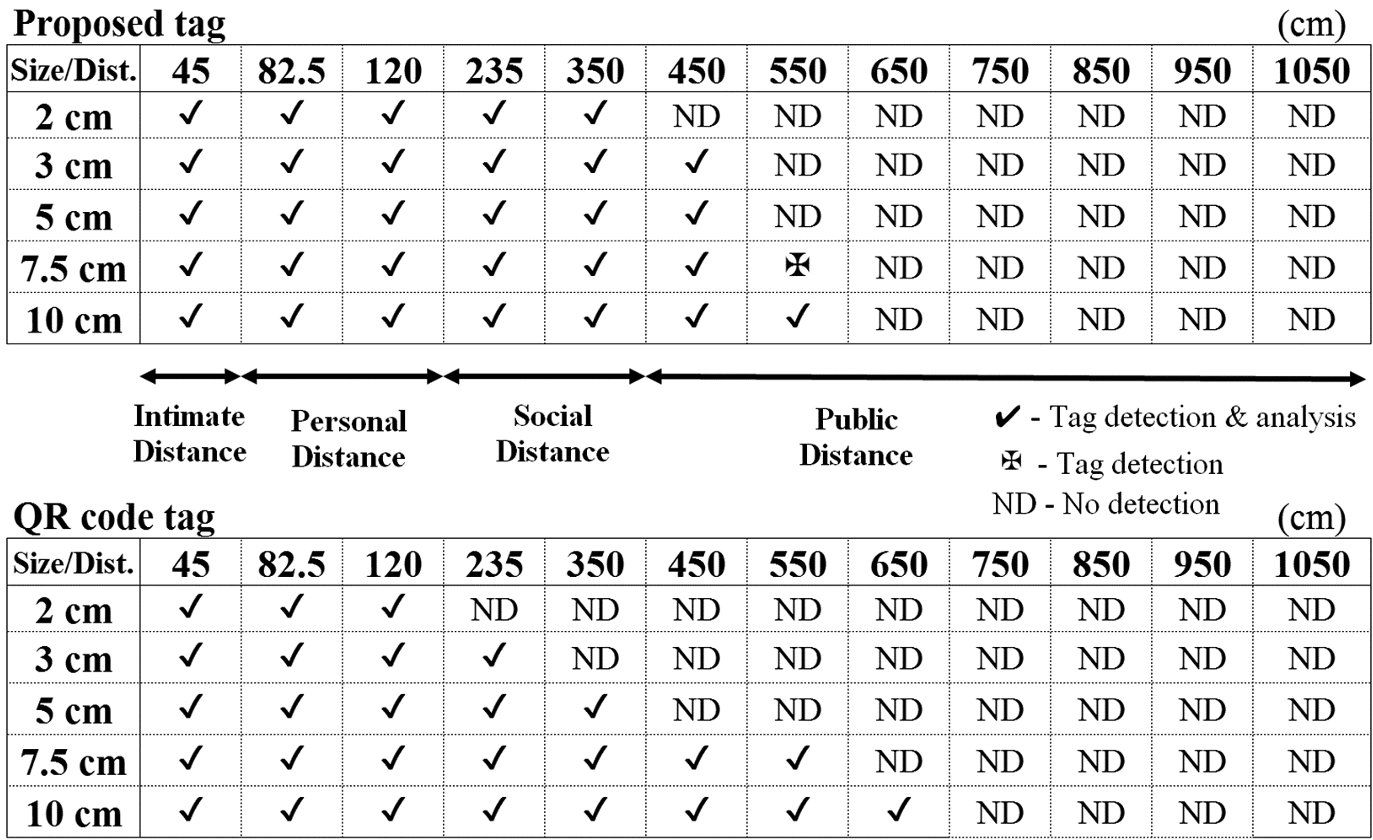 Table: Success rates of Tag Detection (✓) vs. QR Codes across distances.
Implementation: The Facebook Prototype
The authors didn't just stop at theory; they built a Facebook-integrated PPR. The app handles the "Heavy Lifting":
- Community Mapping: Bridges the physical tag ID to a digital Facebook Friend List.
- Auto-Anonymization: Before the "Post" button is even active, the app scans the photo, checks the viewer's list, and applies the blur.

Critical Insight & Future Outlook
While PrivacyTag is a significant step forward, it faces a classic "Chicken and Egg" problem: it requires both the photographer to use the PPR app and the subject to wear a tag.
The Takeaway: The real value here is the "Privacy Wall" concept — a proposed server-side OSN function that would automatically detect these tags upon upload, regardless of the app used. This would shift the burden of privacy from the user's hardware to the platform provider, creating a universal "Do Not Track" for the physical world.
Limitations:
- Recognition from clothes/context (the "Non-Facial Identification" problem).
- Aesthetic adoption (will people wear tags as fashion?).
PrivacyTag proves that by rethinking the physical-to-digital interface, we can build a more consensual social media ecosystem.