
Private Badges: Reconciling Privacy and Rewards in Geosocial Networks
Private Badges for Geosocial Networks
This paper introduces a privacy-preserving framework for Geosocial Networks (GSNs) that enables users to acquire "badges" (special statuses) without revealing their specific check-in locations or times to the service provider. The authors propose a suite of protocols—GeoBadge, FreqBadge, e-Badge, and MPBadge—leveraging zero-knowledge proofs and threshold secret sharing to balance user anonymity with the provider's need for verification correctness.
TL;DR
Geosocial Networks (GSNs) thrive on user check-ins and "badges," but at a massive cost to location privacy. This paper proposes a cryptographic framework that allows users to earn Foursquare-style rewards (like Mayorships or Expertise badges) while remaining completely anonymous to the service provider. By using Zero-Knowledge Proofs (ZKP) and Threshold Secret Sharing, the system ensures that a provider can verify a user's achievement without ever knowing where or when they were.
The Tension: Privacy vs. Correctness
In GSNs, data is currency. Providers use your location history to serve targeted ads, while you trade your privacy for digital badges and real-world discounts. Existing solutions like "location cloaking" (adding noise to coordinates) often fail because consecutive reports can be linked to reconstruct a user's path.
The authors identify a fundamental conflict:
- Users want their data to be "untraceable" and "unlinkable."
- Providers need to ensure users aren't "location spoofing" to cheat their way into rewards.
Methodology: Cryptography at the Edge
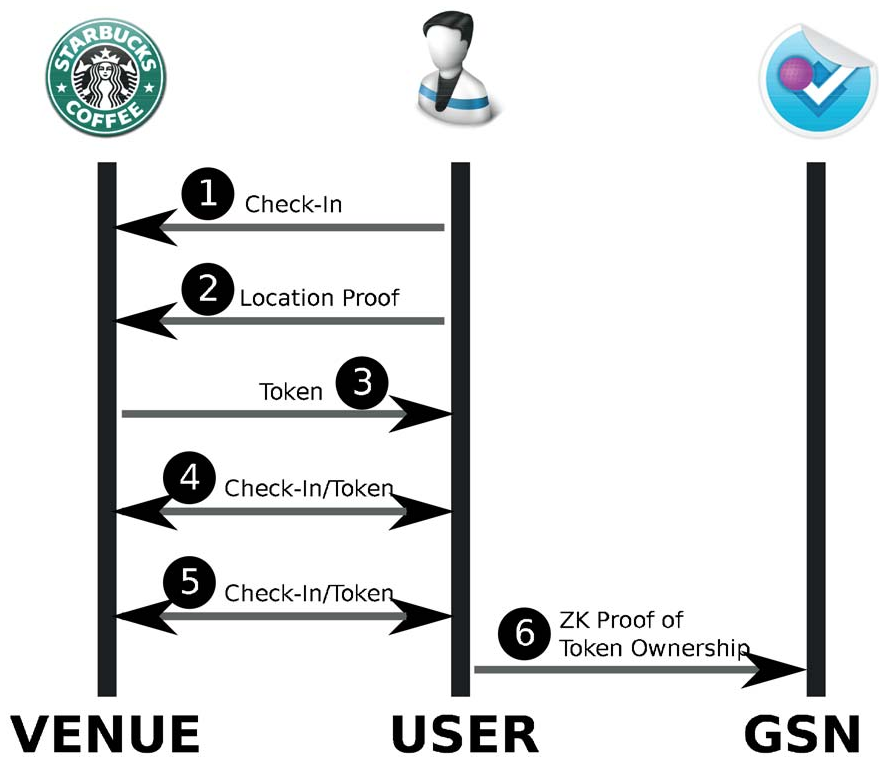
The solution shifts the paradigm from "Server-Managed" to "User-Managed" data. Instead of the server keeping a log of your check-ins, the server issues a blindly signed share of a secret whenever you prove your location locally.
1. GeoBadge & T-Badge (Location Counts)
The server defines a secret for a venue and splits it using a threshold secret sharing scheme. When you check in, you get one share. Once you have shares (meaning visits), you can reconstruct and claim the badge.
2. FreqBadge (The Shy Mayor)
Mayorships are harder because they are competitive and time-sensitive (e.g., most check-ins in the last 60 days). The authors use a Quadratic Residuosity (QR) Assumption. The server publishes squares () each epoch, and the user must prove they know the square roots () for at least elements in a sliding window, using a ZK proof that doesn't reveal which specific days they visited.
3. MPBadge (Multi-Player Interaction)
To earn a "crowd" badge, users must prove they were at the same place at the same time as others. This protocol prevents Sybil Attacks (one person using multiple devices) by requiring a blind signature generation step that limits users to one token per epoch.
Experimental Results: Is It Practical?
One of the major critiques of ZK-heavy systems is that they are too slow for mobile devices. This paper proves otherwise through rigorous testing on then-standard hardware (Google Nexus One).
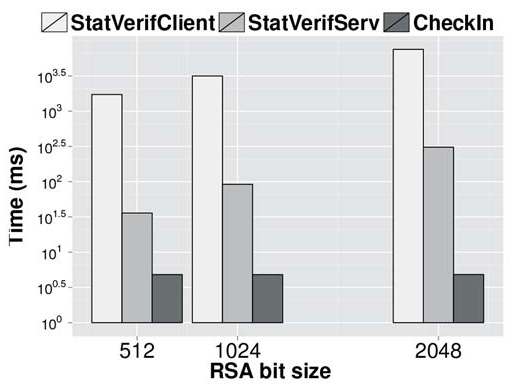
- Server Scalability: The provider can support over 4,000 CheckIn or StatVerify runs per second for GeoBadges. For FreqBadges (Mayorships), the server can handle 13,000 check-ins per second.
- Client Performance: While a 2048-bit ZK proof for a complex badge can take up to 21 seconds, these operations happen in the background only when a user achieves a status. Daily check-ins are near-instant ().
Critical Insight: The "Zero-Knowledge" Advantage
The core genius here is the StatVerify-Indistinguishability (SV-IND) property. Most systems lose privacy at the moment of reward redemption. In this framework, even when you "show off" your badge, the server cannot link that badge to the specific check-in sessions that earned it.
Limitations
- Network Anonymity: The system relies on "Mix" networks like Tor to hide IP addresses during the check-in process. Without a robust anonymizer, the physical layer (IP/Metadata) would leak the very privacy the cryptography tries to protect.
- Trust in Location Proofs: The system assumes the existence of a secure local infrastructure (like WiFi APs) to verify immediate physical presence, which is a separate but necessary dependency.
Conclusion
This paper serves as a blueprint for "Privacy-Preserving Gamification." It proves that we don't have to choose between digital status and personal safety. By making the user the custodian of their own "shares" and using the server only as an oblivious verifier, we can build social networks that are both rewarding and respectful of privacy.