
PBS: Rethinking Spatial Privacy in Social Networks via Encrypted Dual-Indexing
Private Buddy Search: Enabling Private Spatial Queries in Social Networks
This paper introduces Private Buddy Search (PBS), a framework designed for private spatial queries (Range and k-Nearest Neighbor) within social networks. It utilizes a combination of server-side encrypted index structures and client-side query processing to enable "buddy" tracking without revealing sensitive location or profile data to an untrusted central server.
TL;DR
The "killer app" of the mobile era is arguably the intersection of social networking and location-based services (LBS). However, disclosing your precise coordinates to a central server—or even your "buddies"—presents a massive privacy risk. In this paper, Ali Khoshgozaran and Cyrus Shahabi present Private Buddy Search (PBS), a system that allows you to find your friends on a map without the server ever knowing where anyone is or how many friends are in a specific area. By shifting the "intelligence" of the query to the user's device and using clever, fixed-size encrypted indexes, they achieve SOTA privacy with sub-60ms latency.
The Motivation: Why Current LBS Privacy is Broken
Most existing solutions fall into two categories, both flawed:
- The Trusted Anonymizer (e.g., Casper): These rely on a "middleman" to blur your location into a region with other people. If the middleman is hacked, your data is exposed. Furthermore, the "blurring" degrades the quality of service.
- P2P Approaches: These avoid servers but require massive communication overhead (broadcasting to everyone) and can't answer global queries like "Which of my friends are in New York right now?"
The core challenge is that encryption usually kills search efficiency. If a server can't see the data, it doesn't know which records to send you, often forcing a "download the whole database" scenario.
Methodology: The Dual-Index Breakthrough
PBS solves this by using a Space-Driven Indexing strategy (Fixed Grids) instead of Data-Driven trees (like R-trees).
The technical "secret sauce" is the separation of data into two plain, encrypted indexes that look like "noise" to the server:
- Aggregate Cell Index (ACI): Stores the number of buddies from a specific group in a grid cell. It only tells the client: "There are 3 of your friends in Cell A."
- Isolated Object Index (IOI): Stores the actual encrypted location and profile of each user.
Architecture Overview

When a user performs a Range Query, the process is a two-step "conversation":
- Step 1: The client identifies which grid cells overlap their search area and asks the ACI for the counts in those cells.
- Step 2: If Cell A has 2 buddies, the client requests exactly 2 records from the IOI for that cell. Since the IOI records are indexed by a "rank" (e.g., "Buddy 1 in Cell A", "Buddy 2 in Cell A"), the server doesn't know who those people are, only that the client is authorized to see them.
Experiments: Real-World Latency
The researchers tested PBS using simulated movement data from Oldenburg, Germany, and Hennepin County, Minnesota. The goal was to prove that privacy doesn't have to be slow.
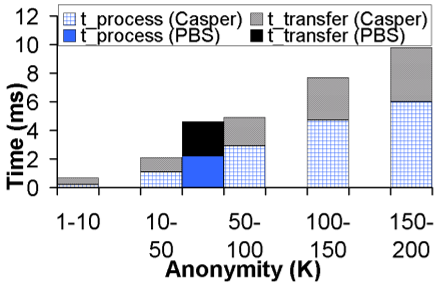
Key Findings:
- Efficiency: A standard Range or k-NN query finishes in under 60ms. This is fast enough for real-time mobile use.
- Scalability: Even with 50,000 active users, the workload is distributed. The server just does simple lookups; the client does the decryption and logic.
- The "Privacy vs. Performance" Tradeoff: Unlike Casper (the previous benchmark), PBS doesn't sacrifice accuracy for privacy. You get the exact location of your friends, and the server gets zero information, regardless of the value.
Critical Analysis & Conclusion
The genius of PBS lies in its "Plain Structure". By ensuring every encrypted record in the server is the same size and using timestamps to prevent the server from seeing count changes, the authors effectively neutralize traffic analysis attacks.
Limitations
While PBS effectively blocks the server, it still relies on Group Trust. If a "buddy" in your group is a malicious actor or shares the group key with an outsider, your location is compromised. This "social boundary" issue remains one of the hardest problems in digital privacy.
Final Takeaway
PBS is a masterclass in Privacy-Preserving Systems Design. It proves that by carefully choosing your data structures (Grids over Trees) and shifting the computation to the edge (Client-side), you can build social features that are both fast and truly private. For developers of modern social apps, the "Dual-Index" approach is a blueprint for building trust with users.