
Reclaiming Quality: How Private Crowdsourcing and Collaborative Filtering Mastered Big Data Annotation
Deployment of Private Crowdsourcing System with Quality Control Methods
The paper introduces a Private Crowdsourcing System (PCSS) developed for intranet environments, specifically designed to address quality control in high-volume microtask processing. By implementing a multi-stage worker filtering pipeline including collaborative filtering, the system achieved a 32.4% increase in accuracy for complex NLP vocabulary data collection.
TL;DR
To solve the persistent issue of "garbage in, garbage out" in crowdsourcing, researchers at Toshiba developed a Private Crowdsourcing System (PCSS). By moving away from public platforms like AMT and implementing a sophisticated four-stage filtering pipeline—including an innovative "Guess-Processing" method using collaborative filtering—they achieved accuracy boosts of over 30%, enabling the collection of 138,000 high-quality vocabulary entries for NLP research.
Contextualizing the Problem: The Knowledge Gap in Quality Control
Microtask crowdsourcing is often a double-edged sword. While it provides a low-cost solution for massive data analysis, the quality is notoriously volatile. Existing methods typically place the burden of quality control on the requester. Requesters are expected to be experts in task design, gold-standard creation, and worker management.
The authors argue that this is a fundamental flaw. In a corporate or specialized environment, the system itself—the server side—should handle the heavy lifting of quality assurance. The challenge is: how do you filter out bad workers and match good workers to specific tasks when you don't even know the correct answers to the tasks yet?
Methodology: The Four Pillars of Filtering
The core contribution of this work is a hierarchical worker selection pipeline. Instead of a single filter, PCSS uses a funnel-like approach to ensure only the most capable hands touch the data.
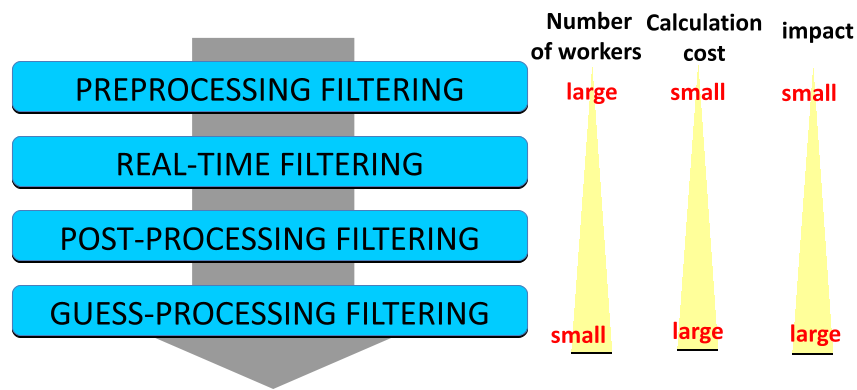
- Preprocessing Filtering: A demographic gatekeeper. Before entering the system, workers are screened via questionnaires for ICT experience and educational background.
- Real-Time Filtering: The "Game Mechanics" layer. The system tracks an accuracy rate () and "Experience Points" (). If a worker's accuracy dips below 70%, they are locked out.
- Post-Processing Filtering: A domain-specialization layer. The system analyzes historical results to label workers with specific "Skills" (e.g., "Worker who can write accent data").
- Guess-Processing Filtering: The system's predictive engine. Leveraging Pearson correlation coefficients, PCSS identifies similarities between workers. If Worker A and Worker B are similar, and Worker A excels at grammar, the system "guesses" Worker B will also excel at grammar, proactively allocating tasks to them.
This mathematical approach allows the system to predict potential accuracy for task categories a worker has never even attempted.
Real-World Impact: Building a 12.5 Billion Sentence Corpus
The authors put PCSS to the ultimate test: cleaning and annotating vocabulary data for Japanese voice recognition and text-to-speech. This involved processing 12.5 billion sentences crawled from the web to extract proper nouns and unknown words.
Performance Gains
The results were striking. By applying the filtering pipeline, the accuracy of complex tasks like "Accent Data Addition" skyrocketed from a mediocre 54.1% to an elite 98.7%.
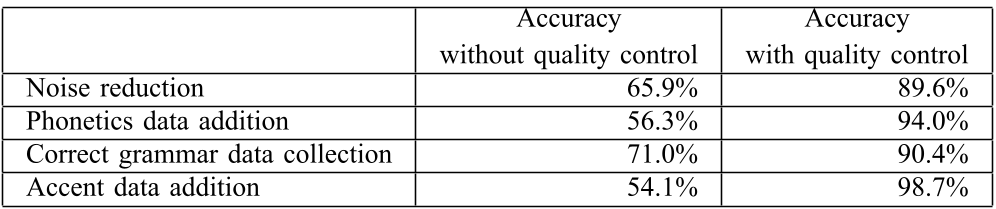
The "Guess-processing" module proved to be highly reliable, with only a 3-4% margin between predicted "guessed" accuracy and the actual performance of the workers.
Deep Insight: Beyond Spam Detection
The most profound conclusion of the paper is the distinction between malicious spam workers and low-quality workers.
- Spam Workers are malicious and need to be excluded.
- Low-Quality Workers are often simply unaware of their own strengths and weaknesses.
The PCSS approach doesn't just "punish" bad workers; it uses data to find the specific "niche" where a low-performing worker might actually become a high-performing contributor. This "right person for the right job" philosophy is what ultimately drives the 32%+ accuracy improvement.
Critical Analysis & Future Outlook
Strengths: The paper provides a rare, long-term (3-year) longitudinal view of a production-grade private crowdsourcing system. The use of collaborative filtering for worker allocation is a brilliant application of recommendation system theory to labor management.
Limitations: The system relies heavily on "majority vote" as the ground truth for real-time accuracy calculations. In highly subjective or extremely difficult tasks where the majority might be wrong, this mechanism could fail or reinforce biases.
The Future: As AI models require increasingly specialized "Human-in-the-loop" feedback (like RLHF), the PCSS model of internal, highly-filtered crowdsourcing will likely become the industry standard for tech giants moving away from noisy public platforms.