
Private Flirts, Public Friends: The Jealousy Logic of Digital Exclusivity
Private flirts, public friends: Understanding romantic jealousy responses to an ambiguous social network site message as a function of message access exclusivity
This study investigates the impact of "masspersonal communication" on romantic jealousy by examining how message access exclusivity (private vs. public) influences perceptions, emotions, and behaviors. Through a randomized experiment using Facebook scenarios, the research identifies message exclusivity as a critical contextual cue that intensifies negative emotional responses and sparks confrontational behavior in romantic relationships.
TL;DR
Is a cryptic "Hey you ;)" message more threatening when posted on a Facebook wall or sent in a private DM? This study reveals that message access exclusivity acts as a powerful psychological trigger. Private messages provoke significantly higher negative emotions and confrontational behaviors, even when the content itself is identical, because the "secret" context signals hidden intimacy.
The "Masspersonal" Motivation
Traditional communication research distinguishes between mass communication (one-to-many) and interpersonal communication (one-to-one). However, SNS platforms like Facebook collapse these boundaries. The authors argue that ambiguity on SNS—combined with the ability to "stalk" or surveil—creates a fertile ground for jealousy. They hypothesize that when message content is ambiguous, users look for contextual cues—specifically how exclusive the message access is—to judge relative threat levels.
Methodology: The Anatomy of a Digital Rivalry
The researchers conducted a randomized experiment where participants imagined their partner left Facebook open, revealing a message to an ex-partner.
- High Exclusivity Group: The message was in a private Inbox.
- Low Exclusivity Group: The message was on a public Wall.
The study utilized Path Analysis to model the flow from the technological context (Exclusivity) to the internal state (Emotion/Cognition) and finally to the Action (Confrontation).
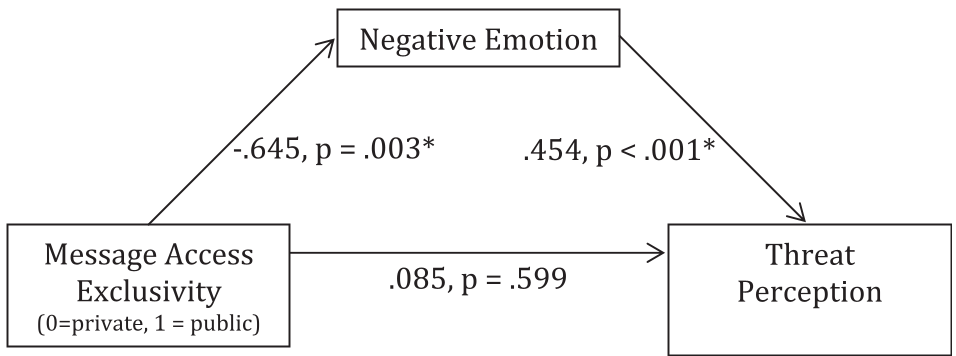 Figure 1: Path model illustrating the indirect effects of message exclusivity on threat perception and behavior.
Key Insights: Why "Secret" Means "Dangerous"
- Emotion Drives Cognition: Interestingly, the study found no direct link between a private message and the thought that it was a threat. Instead, the private nature of the message first triggered negative emotions (anger, worry, resentment), which then "flavored" the participant's interpretation, leading them to perceive a threat.
- The "Behind Closed Doors" Effect: Participants felt more threatened by private messages because they implied the partner was communicating with a rival away from the public eye. A public post, by contrast, implies there is nothing to hide.
- Behavioral Urgency: High exclusivity was a direct predictor of confrontation. If it's private, users feel a greater need to intervene and address the behavior immediately.
Experimental Results & Comparison
The data supported the idea that private interactions are viewed as more intimate and thus more damaging when directed toward a rival.
Note: Private messages (M=4.24) elicited significantly higher negative emotion compared to public messages (M=3.60).
Critical Analysis & Conclusion
This research provides a bridge between Media Equation theories and relationship psychology. It demonstrates that the medium and its privacy settings are just as important as the message in the ecology of romantic relationships.
Limitations
- Sample Bias: The use of "digital native" college students may skew results, as their norms for SNS behavior differ from older demographics.
- Hypothetical Bias: While the results showed "psychological realism," the responses were based on imagined scenarios rather than real-time relationship conflicts.
Future Outlook
As communication shifts further into encrypted or ephemeral spaces (like Snapchat or Telegram), the perception of "exclusivity" will likely become an even more potent variable in interpersonal conflict. Future research should integrate Message Personalization to see if a generic public post can be more or less balance-breaking than a highly tailored private message.