
ProfilR: Solving the Privacy-Demographic Deadlock in GeoSocial Networks
Private location centric profiles for GeoSocial networks
The paper introduces ProfilR, a framework for constructing Location Centric Profiles (LCPs) in GeoSocial Networks (GSNs). It leverages Benaloh's homomorphic cryptosystem and Zero-Knowledge Proofs to aggregate user data (like age or gender) at specific venues without compromising individual privacy or allowing location fraud.
TL;DR
GeoSocial Networks (GSNs) like Foursquare and Yelp thrive on data, but users are increasingly wary of privacy leaks. ProfilR introduces "Location Centric Profiles" (LCPs)—aggregated, anonymized statistics (e.g., "30% of visitors are aged 20-25")—that allow venues to target ads without ever knowing who specifically is visiting. By combining homomorphic encryption with zero-knowledge proofs, it ensures users are physically present and honest without sacrificing their anonymity.
Background: The Conflict of Interest
In the GSN ecosystem, there are three main players with conflicting goals:
- Users: Want rewards (badges, discounts) but demand privacy for their location traces.
- Venues: Need demographic insights to provide incentives but suffer from "fake check-ins" via GPS spoofing apps.
- Providers: Want to monetize data but face legal and reputational risks from data breaches.
Current solutions often rely on "trusted" central servers, which remain a single point of failure for privacy. ProfilR shifts the focus to the Venue, creating a decentralized trust model.
Methodology: How ProfilR Works
The core innovation lies in its ability to update a counter (like "Male" or "Female") while the counter is encrypted. The venue cannot see the values or which specific category a user belongs to.
1. Physical Presence Verification (Spoter)
Before a user can contribute to a profile, they must prove they are actually inside the store. ProfilR uses a low-latency challenge-response protocol. Because it happens locally (over Wi-Fi/Bluetooth), it is much harder to spoof than GPS.
2. Oblivious Aggregation
ProfilR utilizes the Benaloh Cryptosystem, which is additively homomorphic. This means if you have an encryption of , you can mathematically transform it into an encryption of without knowing .
3. ZK-CTR: The "Honesty" Proof
A major challenge in private systems is the "cheating user." Under the veil of privacy, a malicious user might try to increment all counters or bias the results. ProfilR introduces the ZK-CTR (Zero-Knowledge Counter) protocol.

The user provides a proof that:
- They incremented exactly one counter.
- They kept the others identical (just re-encrypted to hide their identity).
- They didn't alter the "index" that defines the categories.
Experimental Results
The authors tested ProfilR on 2012-era hardware (Android Gingerbread), proving that even on legacy mobile devices, the cryptographic overhead is manageable.
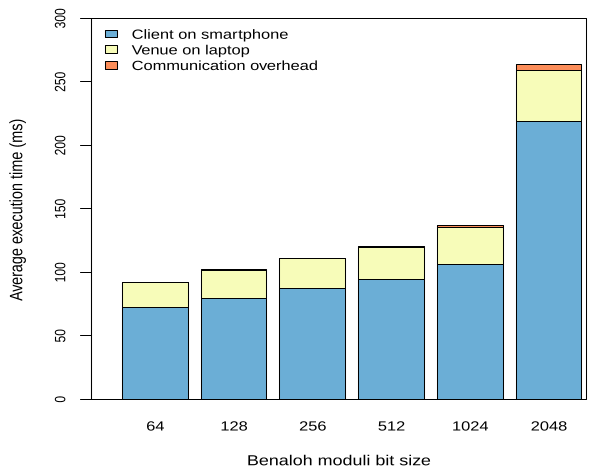 Figure: ZK-CTR execution time scales linearly with the Benaloh modulus size. At 1024 bits, it completes in milliseconds.
- Latency: A full check-in with high security (30 rounds of ZK-CTR) takes ~3.6 seconds.
- Scalability: The communication cost is minimal (under 20KB per dimension), making it suitable for congested retail environments.
Critical Insight: Breaking the Deadlock
The beauty of ProfilR is that the GSN provider only acts as a "Trustee" for keys, while data stays at the venue in aggregate form. Even if the venue's local device is hacked, the attacker only sees total counts for a "cycle" (e.g., every 10 users), never individual profiles.
Limitations & Future Work
- Offline Requirement: While the venue doesn't need constant internet, the user needs to contact the Provider () via a "Mix-net" to get key shares, which might be slow in areas with poor cellular reception.
- Fixed Cycles: Statistics are only released after users check in. If a venue is slow (e.g., an boutique with 2 customers a day), the data remains locked for a long time.
Conclusion
ProfilR represents a sophisticated bridge between the theoretical world of homomorphic encryption and the practical world of mobile apps. It proves that we don't have to choose between "useful data" and "personal privacy"—with the right cryptographic protocols, we can have both.