
PID: Using the Web as a Shield Against Social Media Privacy Leaks
A Private Information Detector for Controlling Circulation of Private Information through Social Networks
This paper introduces a "Private Information Detector (PID)" designed to prevent the accidental disclosure of sensitive data in social network posts. Using a novel "reachability" algorithm that leverages real-time Internet search results, the system detects both direct mentions and indirect clues (e.g., abbreviations, locations, or related topics) that could allow an attacker to deduce a user's private information.
TL;DR
Researchers have developed a Private Information Detector (PID) that acts as a real-time guardian for social media posts. Unlike standard filters, it doesn't just look for "bad words"; it simulates how an attacker would use Google to "connect the dots" between innocent-looking phrases to uncover your secrets.
Background: The "Innocent" Post Problem
We’ve all seen it: a user posts about a "great lunch near the West-6 building." To a human, it’s a harmless update. To a privacy-aware algorithm (or a stalker), the combination of "West-6" and "Chofu" immediately identifies the user as a member of the University of Electro-Communications.
Current SNS privacy settings are static—they protect your profile but do nothing for the thousands of sentences you write every year. Static blacklists fail because they can't keep up with abbreviations, synonyms, or the sheer variety of ways we describe our lives.
Methodology: Simulating the Attacker's Mindset
The core innovation of this paper is the Indirect Detection Algorithm. Instead of relying on a massive, pre-built dictionary of synonyms (which is expensive and quickly outdated), the authors use the Internet as a live knowledge base.
How the Reachability Judgment Works:
- Keyword Extraction: The system takes a sentence and strips away "filler" words (articles, prepositions).
- Permutation: it creates combinations of the remaining keywords (e.g., "West-6" + "lunch").
- Search Simulation: It sends these combinations to a search engine (like Yahoo or Google).
- Risk Scoring (TRS): If the search results frequently mention the user's "Sensitive Phrase" (the info they want to hide), the system flags the sentence as a high-risk leak.
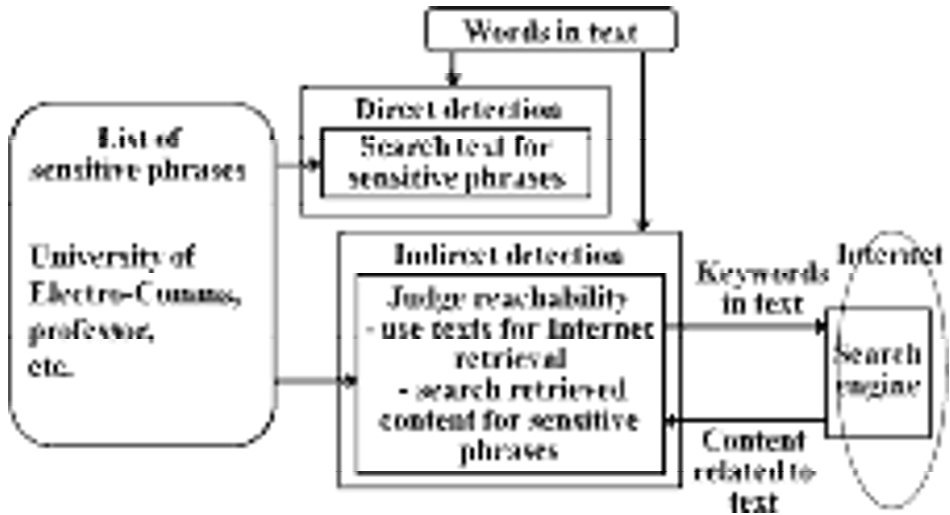 Figure 1: The PID checks words against a list of sensitive phrases using both direct matching and indirect reachability logic.
The "Reachability" is calculated using a mathematical approach to ensure that even subtle clues are caught:
Where is the number of keyword combinations and is the frequency of the sensitive phrase appearing in top search results.
Experiments: Real-World Testing
The authors tested the PID on 7,462 blog sentences from a university professor. The goal was to hide two specific facts: his university and his occupation.
Key Findings:
- High Sensitivity: The system caught 91% of the sentences that could reveal the university name, even when using abbreviations like "UEC" or location clues like "Chofu."
- The "Professor" Challenge: Detecting the occupation "professor" was harder (69% success) because words like "research," "paper," and "students" are common in many contexts, leading to more false positives.
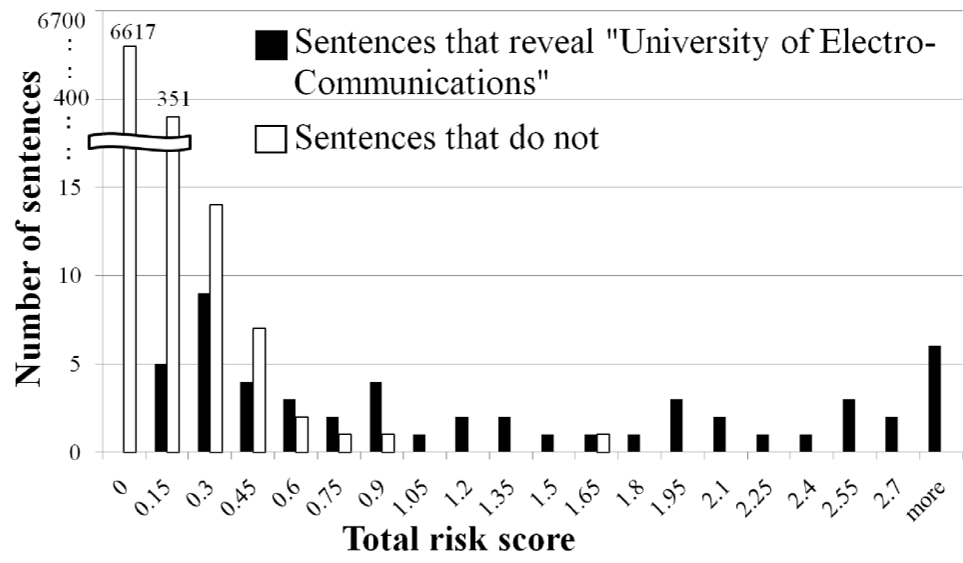 Figure 2: Distribution of Total Risk Scores (TRS) for university detection, showing clear separation between revealing (black) and non-revealing (white) sentences.
Critical Insight: Why This Matters
The brilliance of this work lies in its simplicity and scalability. By treating the search engine as a "black box" of human knowledge, the PID effectively "knows" what an attacker knows. It realizes that "West-6" is a building at a specific university because the rest of the web says so.
Limitations & Future Work
- False Alarms: The 56% false detection rate for "professor" suggests that the system can be "overly cautious." However, the authors suggest a "passive UI" (like a grammar checker) to minimize user annoyance.
- Context Scope: Currently, the system looks at sentences individually. In reality, a leak often happens across multiple posts over several days.
- Automated Sanitization: The next step is a system that doesn't just warn you, but automatically suggests "safer" ways to phrase your posts (e.g., using broader terms from an ontology).
Conclusion
This PID approach represents a shift from content filtering to contextual awareness. In an era where "big data" makes de-anonymization easier than ever, using that same data to protect ourselves is a clever and necessary evolution in digital privacy.