
Digital Footprints: Why We Forgive Job Seekers but Not Politicians
When private and professional lives meet: The impact of digital footprints on employees and political candidates
This paper presents a comparative survey study (n=459) titled "When private and professional lives meet," examining how digital footprints influence the public's perception of job candidates versus political candidates. The study utilizes factor analysis and non-parametric statistical testing to reveal that political candidates are held to significantly higher privacy and conduct standards than ordinary employees.
TL;DR
As our private lives are increasingly archived online, your digital footprint acts as a permanent resume. This study by Mohamed et al. proves that the public is far more "forgiving" of average employees than political candidates. While we value privacy for ourselves and our peers, we demand a nearly impossible standard of historical purity from those seeking public office, even for posts made a decade ago.
The Collision of Personal and Professional Spheres
In the digital age, humans have lost the "virtue of forgetting." Every controversial post, late-night rant, or youthful indiscretion is indexed and searchable. The authors identify a critical tension: information systems are designed to remember forever, while human growth requires the ability to move past a former self.
The motivation for this research stems from a simple observation: Is a racist tweet from 10 years ago a disqualifier for a junior accountant? What about for a Member of Parliament? The authors sought to quantify this "standard of accountability."
Methodology: The Parallel Survey Approach
To isolate the variable of "position type," the researchers utilized a between-subjects design. Two groups answered identical questions, but one group evaluated a Job Candidate while the other evaluated a Political Candidate.
Factor Analysis: The Seven Dimensions of Judgment
The researchers grouped behavior into seven critical factors to see where the "tolerance gap" was widest:
- Content Investigation: Should we even be looking?
- Reputation: Does this damage the entity (Company vs. Country)?
- Offending Employers/Parties: Is loyalty a requirement?
- Controversial Content: Can they have personal opinions?
- Discriminatory Content: Is there a zero-tolerance policy?
- Time Span: Does the "statute of limitations" on bad posts exist?
- Consequences: Should this actually cost them the role?
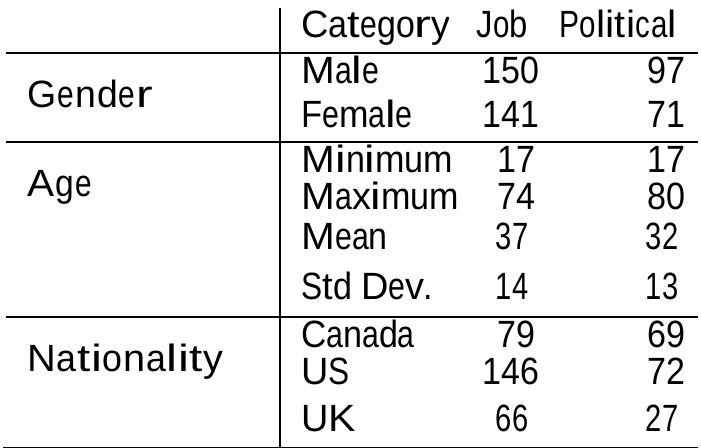 Table 1: The study focused on participants from Canada, the US, and the UK, ensuring a relatively similar democratic context.
Key Findings: The "Double Standard" is Real
The results from the Mann-Whitney U tests were striking. Political candidates were held to a higher standard in almost every category.
- The Time Factor: Respondents were significantly more likely to penalize a politician for content posted 10 years ago compared to an employee.
- Controversial vs. Offending: Interestingly, while people were harsh on politicians for "Controversial Content" (Factor 4), they were actually more likely to support firing an employee for offending an employer (Factor 3) than removing a politician for offending a party. This suggests that "corporate loyalty" is valued differently than "party loyalty."
- The Empathy Gap: The authors speculate that since most respondents will never run for office but will search for jobs, they are more sympathetic to the job seeker. They recognize their own "questionable social media content" and want a second chance for themselves.
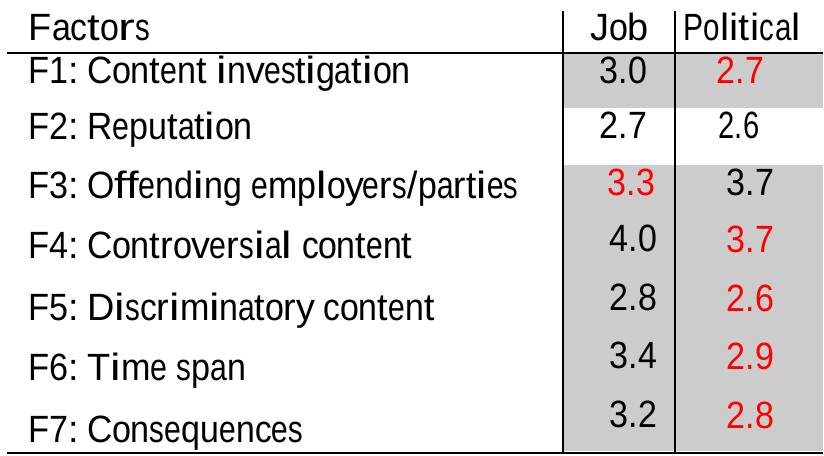 Table 2: Comparison of Means (Lower = Less Tolerant). Note the significant differences in F6 (Time Span) and F7 (Consequences).
Demographic Influence: Age and Nationality
Does your background change how you judge others?
- Age: Older participants were generally less tolerant of controversial content from politicians.
- Nationality: Canadians were found to be the least tolerant of employees and politicians posting controversial content, a finding possibly influenced by the 2015 Canadian federal election occurring just before data collection.
Critical Analysis & The Future of Privacy
This research highlights a looming societal crisis: we are entering an era where no candidate is "pure."
The Paradox
As "digital natives" (who have lived their entire lives online) reach the age of political eligibility, we will face a choice:
- Lower the Standard: Accept that everyone has a "messy" digital past.
- Technological Scrubbing: Increase the use of tools that automatically delete data or enforce the "Right to be Forgotten."
- The Purge: Suffer a lack of qualified candidates as the "scrutiny tax" becomes too high for anyone with a normal social life to pay.
Limitations
The study relies on self-reported data and hypothetical scenarios. As the authors admit, in a real election, a voter might ignore their own "values" to vote for a candidate they like, a phenomenon we have seen increasingly in global politics since 2017.
Conclusion
The study concludes that our digital footprints are not just data—they are character assessments. While we afford our fellow workers the grace of "growing up," we treat the digital history of a politician as a permanent, unchanging transcript of their soul. As technology makes the past more accessible, the "right to be forgotten" becomes less of a legal debate and more of a societal necessity.