
Beyond Visibility: Protecting the Hidden Threads of Social Networks
Private Relationships in Social Networks
The paper introduces a comprehensive privacy framework for social networks that focuses on relationship protection. It proposes a decentralized mechanism using dynamic cryptographic techniques and distribution rules to ensure that sensitive relationship data is only shared with authorized participants based on relationship type, depth, and trust.
TL;DR
While most social network privacy research focuses on content (who can see your photos), this paper by Carminati et al. tackles the metadata: Who can see who you know? The authors propose a decentralized, cryptographic framework where relationship certificates are encrypted and distributed only to users who meet specific criteria (type, depth, and trust), preventing both malicious users and central servers from mapping out sensitive social connections.
The "Relationship Leak" Problem
Traditional Access Control List (ACL) models in social networks are too blunt. If Alice wants to share a document with "Consultants of Company X," she must reveal her "Company X" relationship to anyone requesting the file.
The authors identify two fatal flaws in the status quo:
- Public Certificates: Proving you are a friend of Bob shouldn't require disclosing your entire social circle to a central server.
- Rule Leakage: Just seeing an access rule (e.g., "Must be a patient of Clinic Y") reveals private information about the owner's status, even if you are denied access.
Methodology: Cryptographic Selective Dissemination
The core of the solution lies in two distinct layers of protection: Certificates and Access Rules.
1. Granular Distribution Rules
When a relationship is formed, the parties create a Relationship Certificate (RC). Unlike standard models, this RC is encrypted with a symmetric key (). Whether a third party gets this key depends on Distribution Rules.
As the certificate key travels through the network, the "Depth" parameter is decremented—a clever mechanism that ensures a "friend of a friend" (Depth 2) can see the certificate, but a stranger (Depth 3) cannot.
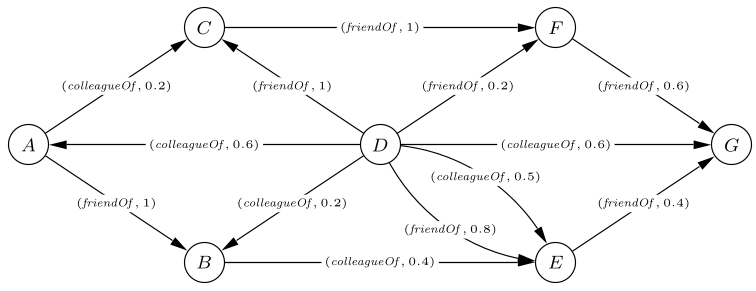 Figure 1: Sample social network graph with Relationship Types and Trust Levels.
2. Encrypted Access Conditions
To solve the "Rule Leakage" problem, the authors assign a Relationship Key () to specific relationship types (e.g., a key for "Colleagues"). Access rules are encrypted with these keys. If you aren't part of the "Colleagues" community, you can't even read the requirements to access a resource, let alone satisfy them.
Experiments & Security Analysis
The paper details how the network handles "Community Merging." When two separate groups of "Friends" finally connect via a new edge, their respective cryptographic keys must be reconciled or exchanged to allow seamless access across the newly merged graph.
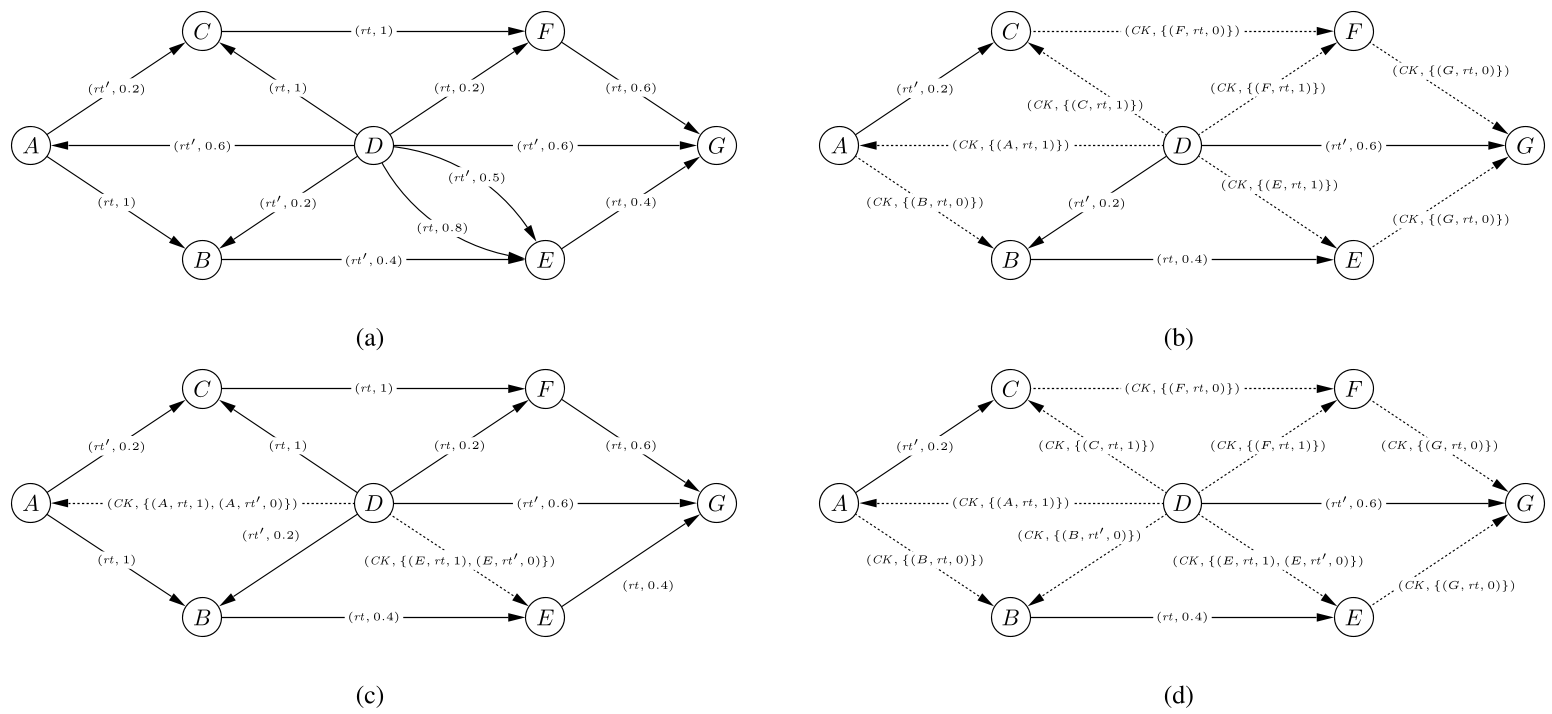 Figure 2: The process of Certificate Key Distribution across multiple hops.
The researchers highlight a critical trade-off: Trust Computation. In a private network, the Central Node cannot see all paths (since they are encrypted). Therefore, the "Trust Level" is computed based on the specific certificate chains the requestor is authorized to see, rather than the global absolute truth. This "subjective" trust is the price paid for absolute privacy.
Critical Analysis & Conclusion
Takeaway
The shift from central validation to client-side proof (leveraging encrypted certificates) is a precursor to modern self-sovereign identity (SSI) and decentralized social media. By making the Central Node a mere "dumb repository" for encrypted data, the model significantly reduces the risk of mass data harvests by platform owners.
Limitations
- Revocation Lag: As the authors admit, notifying the entire network of a revoked certificate is slow. A user might retain a relationship key () long after they've been "unfriended."
- Complexity: The manual negotiation of distribution rules for every relationship might overwhelm the average user.
Future Outlook
This work lays the groundwork for Privacy-Preserving Graph Analysis. As we move toward Web3 and decentralized social protocols, the techniques of decremental depth and community-keyed encryption will be essential for balancing social utility with individual anonymity.