
Secure Social Recommendations: Trust Your Friends, Not Your Data Leaks
A Private and Reliable Recommendation System for Social Networks
The paper introduces a private and reliable recommendation system for social networks based on a weighted average of ratings protocol. It leverages threshold homomorphic encryption (specifically Paillier) to aggregate ratings while ensuring that neither the querier nor the system can learn individual user preferences, achieving state-of-the-art privacy within a decentralized social network framework.
TL;DR
Researchers from the University of Notre Dame have developed a recommendation system that allows you to query your social circle for product ratings without anyone—not even your friends or the service provider—knowing your specific answer. By combining social network topology with threshold homomorphic encryption, the system computes a trustworthy weighted average while keeping individual ratings mathematically invisible.
Background & Motivation: The Privacy-Trust Dilemma
In the digital age, we rely on two types of recommendations:
- Anonymous Systems: Think Amazon or Yelp reviews. They provide broad coverage but are prone to "shilling attacks" (fake reviews) and lack personal relevance.
- Social Recommendations: Asking friends what they think. This is highly trustworthy but requires a total sacrifice of privacy. If you rate a sensitive book or a controversial product, your social circle knows.
Current social platforms like Facebook act as a "trusted" middleman, but users lose control once data hits the server. The authors ask: Can we get the trustworthiness of a social network recommendation without the privacy cost?
Methodology: The Cryptographic Engine
The core of the solution is Threshold Paillier Encryption. Unlike standard encryption, Paillier is additively homomorphic, meaning .
1. Hierarchical Propagation
A user (the Root) sends a query to depth-2 (friends of friends). Each node computes their rating and passes back an encrypted value.
2. The Weighting Problem (Secure Division)
The big technical hurdle is that a recommendation is a weighted average: . Performing division on encrypted numbers is notoriously difficult. The authors developed a custom multi-party division protocol that breaks numbers into bits, performs secure comparisons, and identifies the quotient without ever decrypting the underlying values.
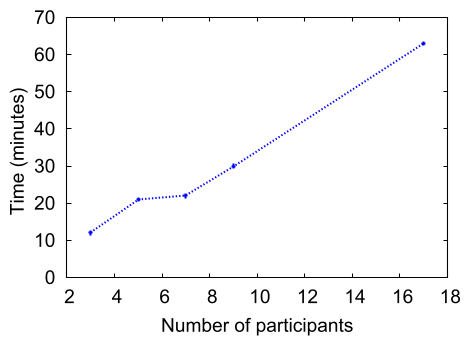 Fig 1: The system first performs a distributed key generation where no single party holds the full decryption key.
Experiments and Results
To prove the system works in the "real world," the authors built a Java-based desktop application integrated with the Facebook API.
- Multiplication: For a 7-party setup with 1024-bit keys, a secure multiplication takes about 1.3 seconds.
- Bit Decomposition: This is the "heavy lifting" part of the protocol. Converting an encrypted value into its bitwise representation (needed for division) takes roughly 15-20 seconds for 32-bit integers.
- Division: The final division protocol takes about 25-30 seconds.
While 30 seconds sounds slow compared to a search engine, the authors argue that in a social context—where waiting for friends to reply often takes hours or days—this cryptographic overhead is negligible.
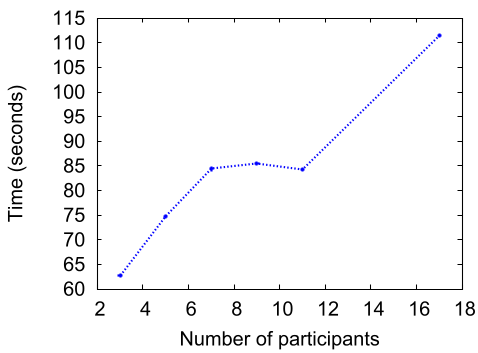 Fig 2: Performance of the LessOrEqual protocol, a crucial building block for secure division.
Critical Insight: Why This Matters
The brilliance of this work lies in how it handles "Zero Weights." In a social network, many friends won't have rated the item you're asking about. The authors implemented a "Non-Zero Test" that effectively masks those who haven't rated an item, ensuring that the final average isn't skewed by "zeros" while protecting the fact that a user didn't rate the item at all.
Limitations
- Semi-Honest Model: The protocol assumes participants follow the rules but will try to learn info if they can. While suitable for social circles, it may require "Zero-Knowledge Proofs" (ZKP) to be robust against truly malicious hackers.
- Scalability: While depth-2 covers thousands of users, the number of rounds in the bit-decomposition protocol grows with the bit-length of the ratings.
Conclusion
Hoens, Blanton, and Chawla have bridged the gap between social utility and mathematical privacy. Their work shows that we don't need a centralized, data-hungry giant to tell us which movie to watch; we just need a bit of clever math and the friends we already trust.