
PrivGeoCrowd: Balancing Utility and Location Privacy in Spatial Crowdsourcing
PrivGeoCrowd: A toolbox for studying private spatial Crowdsourcing
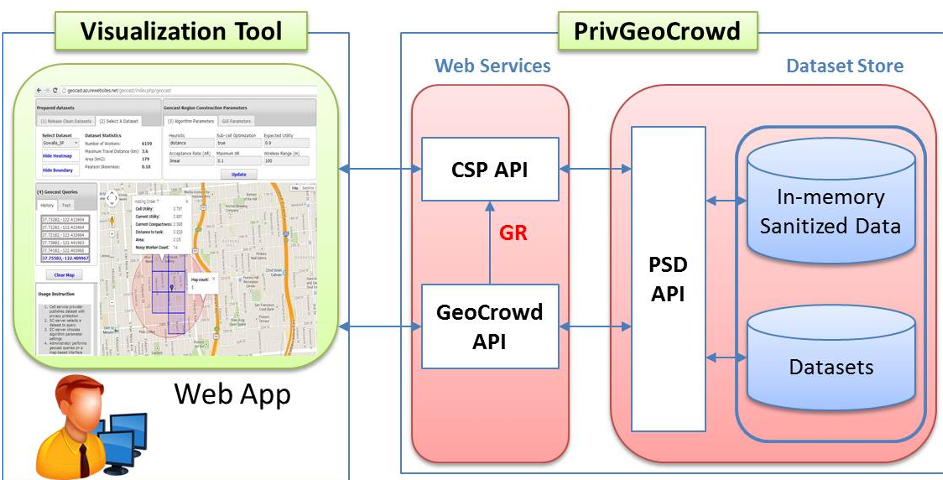
PrivGeoCrowd is an interactive toolbox designed for studying and tuning private spatial crowdsourcing (SC) systems. It utilizes a differentially-private framework based on Private Spatial Decompositions (PSDs) and Geocasting to protect worker location privacy while maintaining effective task assignment.
TL;DR
PrivGeoCrowd is a comprehensive toolbox designed to solve the inherent conflict between Spatial Crowdsourcing (SC) efficiency and Location Privacy. By integrating Differential Privacy (DP) with Adaptive Grid spatial indexing and Geocasting, it provides a playground for system administrators to tune parameters that protect worker identities while ensuring tasks are completed by the right people at the right time.
The Localization Paradox in Crowdsourcing
Spatial Crowdsourcing (e.g., TaskRabbit, Uber, or environmental sensing apps) thrives on precision. To assign a task efficiently, the server needs to know exactly where the workers are. However, this "exactness" is a privacy nightmare. An untrusted server or an adversary can use movement patterns to infer a worker's health status, religious beliefs, or home address.
Traditional anonymization often fails against sophisticated correlation attacks. While Differential Privacy (DP) offers a mathematical guarantee of privacy, it introduces two massive hurdles:
- Noisy Data: The server only sees "blurred" counts of workers in specific areas, making task matching imprecise.
- The Dummy Problem: DP requires adding "fake" worker entries. If a server tries to contact a worker directly and fails, it knows that entry was fake, immediately breaking the privacy guard.
Methodology: The Privacy-Preserving Pipeline
PrivGeoCrowd implements a robust framework to navigate these challenges using a multi-step pipeline:
1. Private Spatial Decomposition (PSD)
Instead of raw coordinates, the Cellular Service Provider (CSP) generates an Adaptive Grid (AG). This is a two-level spatial index where each cell contains a "noisy count" of workers. The grid adapts its granularity based on density—dense areas get finer grids, while sparse areas stay coarse.
2. Geocasting: Indirect Communication
To solve the "Dummy Problem," the system uses Geocasting. The server doesn't message Worker A; it broadcasts a task to a Geocast Region (GR). This ensures the server never learns whether any specific worker in that region exists or is merely "noise" added by the DP algorithm.
3. Geocast Region (GR) Construction
The "secret sauce" lies in how the GR is built. The server must find a region large enough to contain at least one willing worker (utility) but small enough to minimize battery drain and network congestion (overhead).
Visualizing Efficiency: Key Experiments
The PrivGeoCrowd toolbox allows users to toggle several heuristics for constructing these regions:
- ASR-centric: Focuses solely on the probability of task success.
- Distance-based: Minimizes the travel distance for the eventual worker.
- Compactness-based: Creates balanced, circular-like shapes that are easier for network protocols to handle.
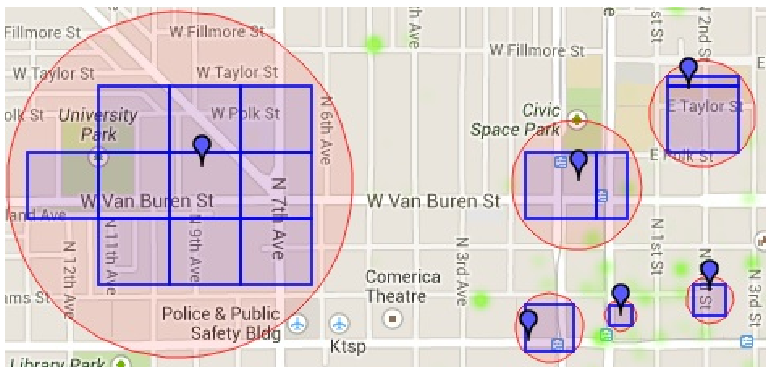
As shown in the experimental results within the toolbox, worker density is a critical factor. In a sparse suburb (left), the GR must be vast to find a worker, whereas in a dense city center (right), the GR can be tight and highly efficient.
Critical Analysis & Insights
PrivGeoCrowd moves the needle by proving that Differential Privacy isn't a "set and forget" solution. The quality of a private system depends on the "Privacy Budget" (epsilon) allocation. If you spend too much budget on the top-level grid, the bottom-level grid becomes too noisy to be useful.
Limitations:
- Static vs. Dynamic: While the tool has a "Mobility Panel," the paper focuses heavily on snapshots. Real-world SC involves high-velocity movement which might degrade the PSD accuracy rapidly.
- Geocast Overhead: Though it solves privacy, broadcasting to a region is inherently more "expensive" in terms of network bandwidth than point-to-point messaging.
Conclusion
PrivGeoCrowd is more than a visualization tool; it is a diagnostic instrument for the future of private location-based services. It demonstrates that by carefully tuning spatial decomposition and leveraging regional communication (Geocasting), we can build crowdsourcing platforms that respect user's boundaries without sacrificing operational utility.