
PrivInferVis: Unmasking the Hidden Risks of Attribute Inference in Social Networks
PrivInferVis: Towards Enhancing Transparency over Attribute Inference in Online Social Networks
PrivInferVis is a transparency-enhancing framework designed to quantify and visualize attribute inference risks in Online Social Networks (OSNs). It utilizes a weighted Bayesian model combined with ego graph aggregation to outperform traditional baselines in predicting sensitive user attributes.
TL;DR
PrivInferVis is a novel framework that helps users understand how much of their "hidden" personal information (like sexual orientation or relationship status) can be guessed by adversaries using public social data. By aggregating data across multiple social platforms and using a sophisticated weighted Bayesian model, it provides a highly accurate "Privacy Score" and intuitive visualizations to help users reclaim their digital sovereignty.
Background: The Illusion of "Private" Data
In the era of the European GDPR, transparency is a legal right. However, most users remain unaware that even if they hide their gender or location on Facebook, an adversary can infer these attributes by looking at their friends' list and public interactions—a phenomenon known as Attribute Inference.
Previous research often failed because it assumed "Naive" independence (treating each friend as a random, unrelated data point). PrivInferVis challenges this by leveraging the Homophily Principle: the idea that "birds of a feather flock together."
Methodology: Beyond Naive Bayes
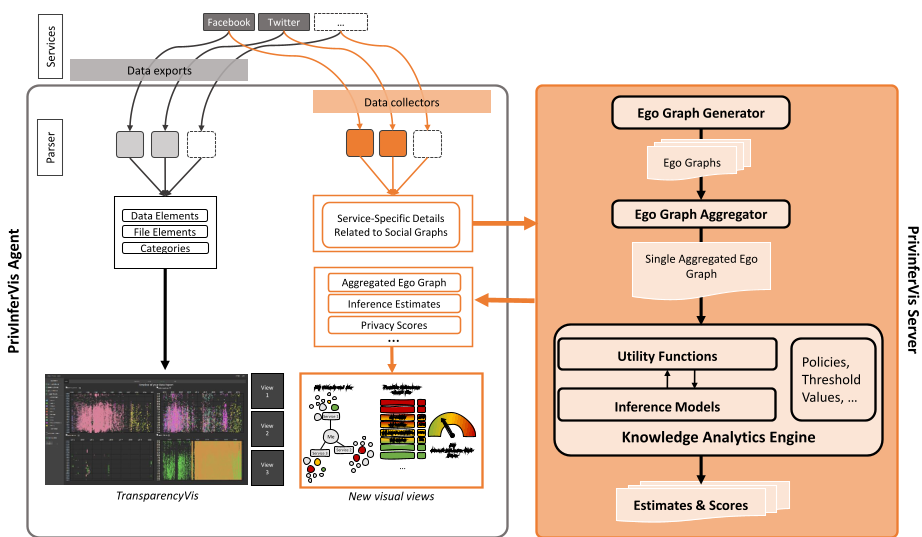
The core of PrivInferVis lies in its two-stage pipeline: Aggregated Ego Graphs and Weighted Bayesian Inference.
1. Cross-Domain Ego Graph Aggregation
Users often have fragmented identities across LinkedIn, Facebook, and X (Twitter). PrivInferVis uses Percolation Graph Matching and Graph Embeddings to stitch these fragments together. This creates a high-fidelity "Ego Graph" that captures the full topological footprint of a user.
2. Weighted Bayesian Inference
Instead of assuming all contacts are equal, the authors introduce a weighted model. They calculate weights based on five dimensions:
- Alter Importance: How central is the friend in your network?
- Attribute Popularity: Is this attribute common in your social circle?
- Value Importance: How strongly does a specific value (e.g., a specific location) correlate between you and your contacts?
Experimental Results: Proving the Risk
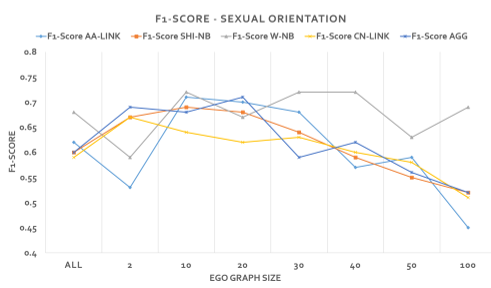
The researchers tested the framework on nearly 30,000 Facebook ego graphs. The results were definitive: by accounting for the weights and dependencies of social connections, PrivInferVis achieved significantly higher F1-scores than traditional models.
As the ego graph grows (i.e., the more friends you have or the more data is public), the accuracy of the inference increases, making this tool vital for "power users" of social media.
Deep Insight: Why Visualization Matters
PrivInferVis isn't just an algorithm; it's an interface. By extending TransparencyVis, the system allows non-technical users to see "Why was my sexual orientation inferred?" It breaks down the influence of specific friends and platforms, transforming abstract privacy risks into actionable insights.
Conclusion & Future Outlook
PrivInferVis represents a leap forward in user-centric privacy tools. While the preliminary results are strong, the authors are already looking toward Trusted Execution Environments (TEEs) to ensure that the server performing these calculations doesn't itself become a privacy threat. For the future of OSNs, transparency must move from "listing collected data" to "visualizing derived intelligence."
Key Limitation: The current model relies on the availability of public ego-network data, which platforms are increasingly restricting via API changes.