
[NVIDIA] ProRL Agent: Scaling Multi-Turn LLM Agents via Rollout-as-a-Service (RaaS)
ProRL Agent: Rollout-as-a-Service for RL Training of Multi-Turn LLM Agents
ProRL Agent is a scalable infrastructure designed for RL training of multi-turn LLM agents, introducing the "Rollout-as-a-Service" (RaaS) paradigm. It decouples the entire agentic rollout lifecycle—including environment initialization, multi-turn execution, and evaluation—from the GPU-intensive training loop via a unified HTTP interface.
TL;DR
Reinforcement Learning (RL) has become the gold standard for refining LLM reasoning, but for multi-turn agents (think software engineers or web browsers), valid data generation is an infrastructure nightmare. ProRL Agent breaks this bottleneck by introducing Rollout-as-a-Service (RaaS)—decoupling the messy, I/O-heavy environment interactions from the high-speed GPU training loop. It provides rootless sandboxes for HPC clusters and eliminates "re-tokenization drift," leading to massive gains on benchmarks like SWE-Bench and MATH.
Problem: The Architectural "Tangled Knot"
In current SOTA frameworks like SkyRL or Agent Lightning, the logic for spinning up a code sandbox, executing a bash command, and collecting the trajectory is often embedded directly inside the RL trainer. This creates a "perfect storm" of system inefficiency:
- Resource Contention: Rollouts are I/O-intensive (creating containers, waiting for network calls), while training is GPU-intensive. Mixing them causes both to stall.
- Maintenance Hell: If you want to switch from a vLLM backend to a NeMo backend, you have to re-write your entire agent execution pipeline.
- Privilege Barriers: Most agent environments rely on Docker, which requires
rootaccess—a luxury rarely granted on shared High-Performance Computing (HPC) clusters like Slurm.
Methodology: The Rollout assembly Line
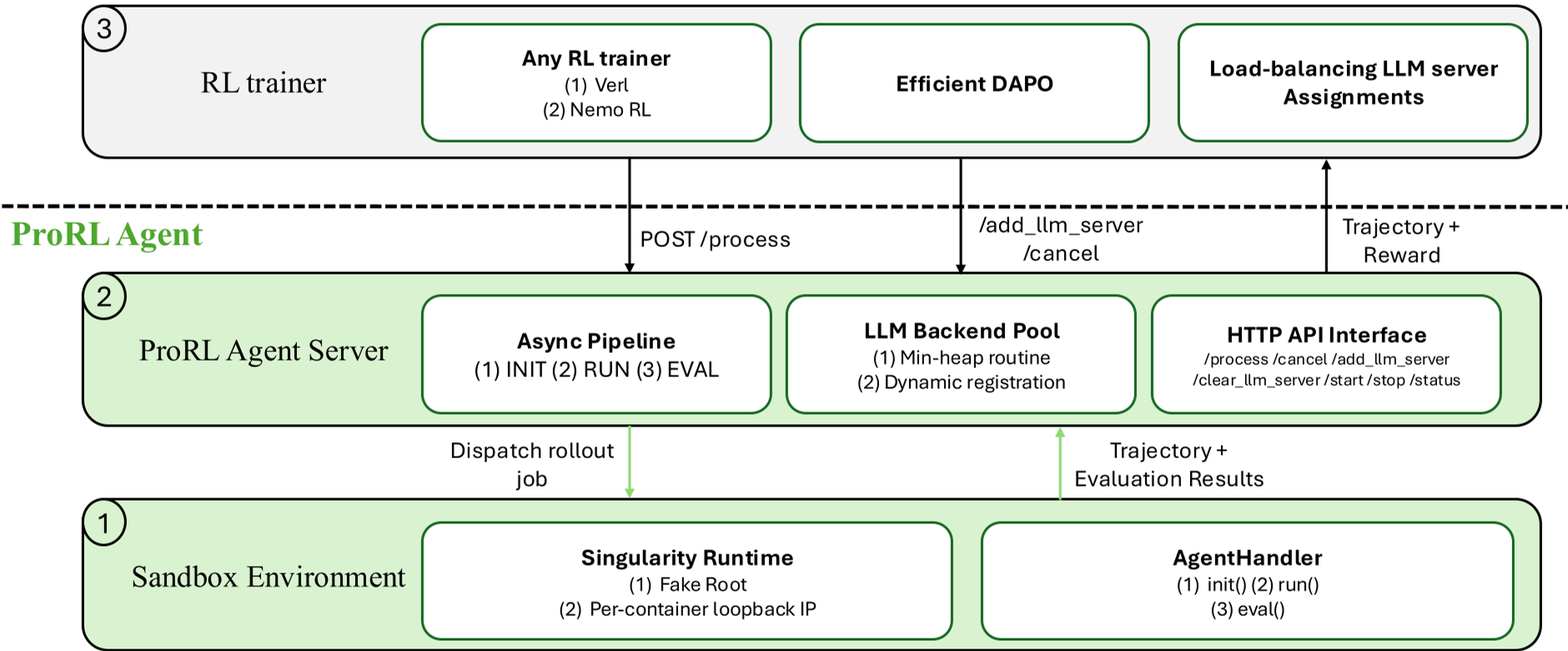
ProRL Agent's primary innovation is the decoupling of these concerns. By exposing rollout as an HTTP service, the trainer just asks for "trajectories for these 32 prompts," and the ProRL Agent Server handles the heavy lifting.
1. The Three-Stage Asynchronous Pipeline
Instead of one worker doing everything, ProRL Agent treats rollouts like an assembly line:
- INIT: Provisions the sandbox (Singularity container).
- RUN: Drives the multi-turn loop (LLM inference + tool execution).
- EVAL: Computes the final reward (running test cases).
This separation allows all three phases to overlap. While one agent is being evaluated, another is mid-rollout, and a third is just starting its sandbox.
2. HPC-Native & Rootless Execution
To solve the "Docker problem," ProRL Agent uses SingularityRuntime. This allows agents to run in isolated containers without root privileges. They also optimized the overhead of the tools themselves (Bash, IPython) by switching from terminal multiplexers like tmux to direct ptyprocess communication and Unix Domain Sockets (UDS), slashing tool latency.
3. Killing Token Drift
A subtle but lethal problem in Agent RL is re-tokenization drift. If you convert tokens to text and back again during multi-turn turns, the IDs might shift, causing "off-policy" data. ProRL Agent uses a Token-in/Token-out protocol, ensuring the trainer sees the exact token IDs the model generated.
Experiments: Breaking the SOTA
The authors validated ProRL Agent across four high-stakes domains: Software Engineering (SWE), Math, STEM, and Code.
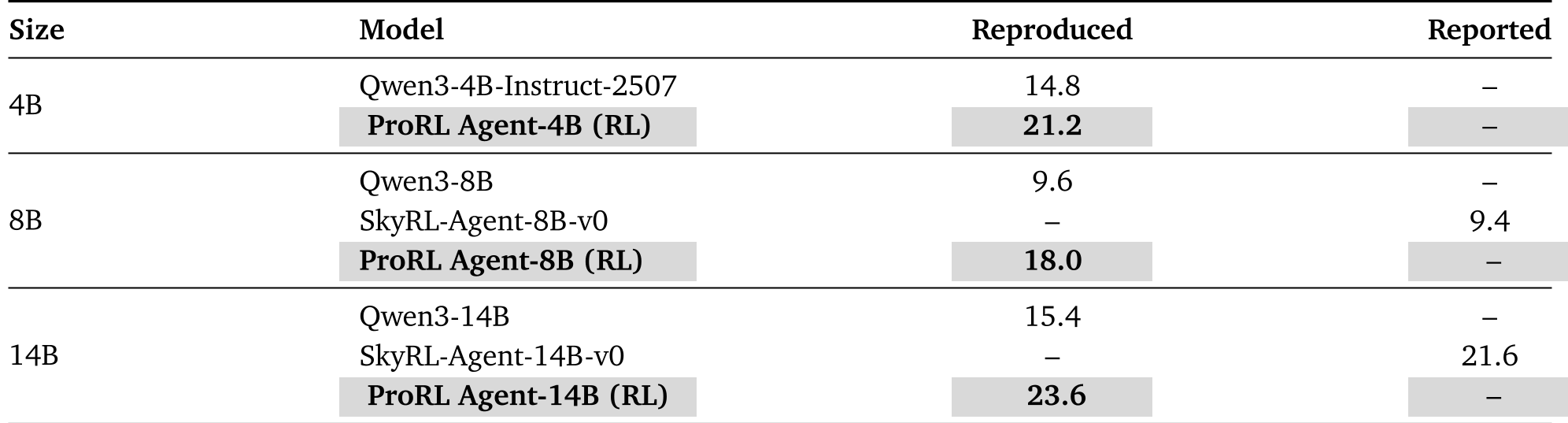
- SWE-Bench Verified: The ProRL-8B model achieved a 18.0 score, nearly doubling the performance of the SkyRL-Agent-8B-v0 baseline (9.4).
- Scalability: Throughput scales linearly with the number of compute nodes, proving the RaaS model is ready for industrial-scale clusters.
- Generalization: The same infrastructure handled web-search agents (STEM) and symbolic math agents (IPython) by simply plugging in different
AgentHandlers.
Deep Insight: Why This Matters
The shift from "Model-centric RL" to "Agent-centric RL" requires a fundamental rethink of the system stack. ProRL Agent identifies that infrastructure is the new bottleneck. By abstracting the "environment" as a service, it allows AI researchers to treat the physical world (or a CLI/Browser) as just another high-latency inference layer.
Limitations: While robust, the system currently assumes reliable network connectivity between the trainer and the rollout service. Future work will likely focus on even more aggressive data-persistence and fault-tolerance at cluster scales.
Conclusion
ProRL Agent is a major step toward making RL for agents as easy as RL for chat. By integrating with NVIDIA NeMo Gym, it provides a production-ready path for organizations to build "thinking" agents that can debug code, solve math, and browse the web with verifiable improvements.
Explore ProRL Agent on GitHub and within NVIDIA NeMo Gym.