
Socially-Aware Proactive Caching: Bridging the Gap Between P2P and SOTA CDNs
Proactive Cache Placement on Cooperative Client Caches for Online Social Networks
This paper introduces "Proactive Cache Placement," a novel strategy for cooperative client-side caching in Online Social Networks (OSNs). By leveraging social graph relationships and workload statistics, the method proactively pushes content to clients likely to request it, achieving a near-optimal Local Hit Ratio (LHR).
TL;DR
Delivering content for Online Social Networks (OSNs) is a billion-dollar challenge usually reserved for massive CDNs. This paper proposes a paradigm shift: leveraging the social graph to proactively push content to client-side browser caches. The result? A system that achieves near-optimal hit rates and handles the chaotic "churn" of users far better than traditional P2P methods.
The "Reactionary" Problem in Distributed Caching
Most caching systems are reactive: they wait for a user to request data before deciding to store a copy locally. In a P2P environment, this leads to three primary failures:
- High Latency: The first requester always pays the full price of a server miss.
- Inefficiency: Replicas are often placed randomly rather than strategically.
- Churn Fragility: When the only user holding a specific object goes offline, the global cache loses that data entirely.
The authors observed that OSN workloads are highly predictable. If Alice posts a photo, her social "neighborhood" (friends) are statistically the most likely to view it next.
Methodology: The Proactive Push
The core innovation lies in the Cache Directive system. Instead of simply serving content, the service acts as an intelligent coordinator that maps content to social interest.
1. Basic Proactive Approach
When a piece of content is accessed, the server doesn't just send it to the requester. It identifies the "neighborhood" of the content owner and proactively "pushes" replicas to a fraction of those clients.
2. Common Neighbors Proactive
To optimize bandwidth, this variant only pushes content to clients who are friends of both the owner and the current requester. This exploits the "clustering" effect found in real-world social graphs.
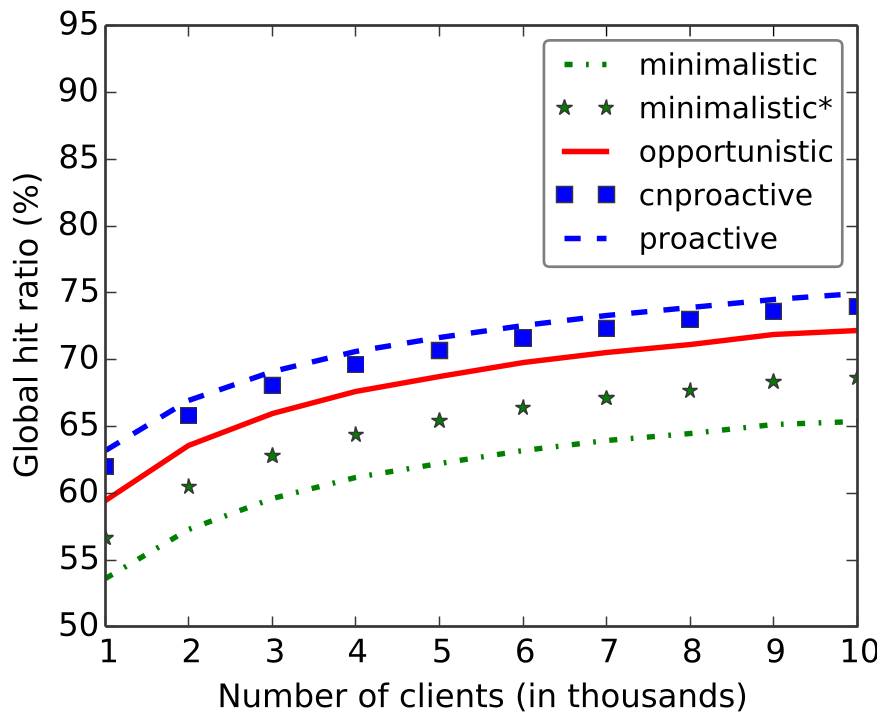 Fig: The growth of client neighborhoods and replicas per key as the network scales.
Experiments: Performance vs. Churn
The authors compared their methods against Belady’s Optimal Algorithm (an "oracle" with full future knowledge) and several baselines:
- Opportunistic: Standard P2P (like BitTorrent).
- Minimalistic: Aims for exactly one copy to save space.
Key Findings:
- Local Hit Ratio (LHR): The Proactive approach achieved ~60% LHR, dwarfing the 45% of Opportunistic methods and the 10% of Minimalistic ones.
- Churn Resilience: When 10% of users leave the system per session, the Proactive approach maintains a high Global Hit Ratio (GHR) because it maintains multiple "smart" replicas.
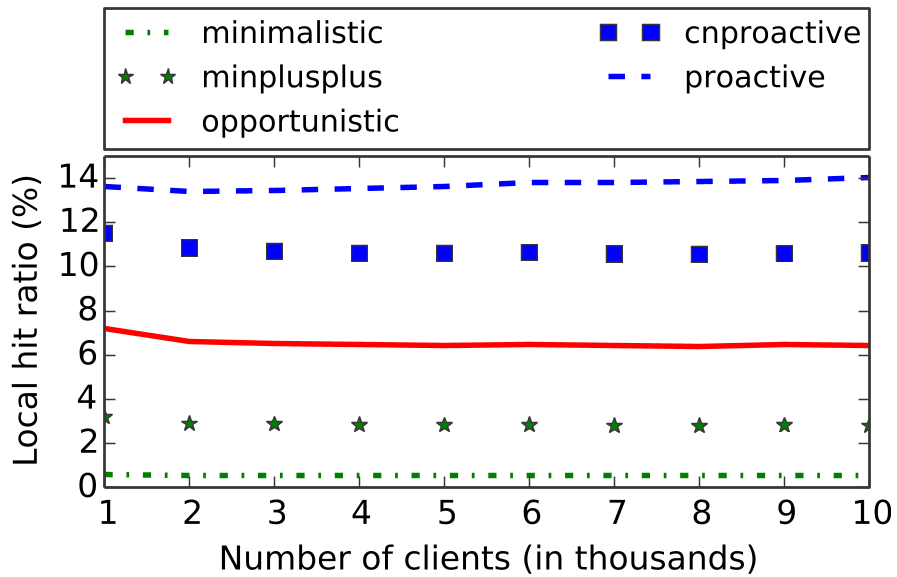 Fig: Performance of Proactive vs. Baseline strategies across different system scales.
Deep Insight: The Bandwidth-Latency Tradeoff
The primary "cost" of proactive caching is increased client bandwidth (due to "pushes"). However, the authors argue this is a feature, not a bug. By using more client-to-client bandwidth, the system dramatically reduces Server Load and Access Latency.
Specifically, the "Common Neighbors" variant keeps bandwidth costs nearly as low as opportunistic caching while delivering significantly better hit rates. It finds the "Sweet Spot" in the Inductive Bias of social networks.
Critical Analysis & Conclusion
This work demonstrates that context is king. By moving from general-purpose caching to social-aware caching, we can approximate "Oracle-level" performance (within 7% of optimal).
Limitations: The model assumes a static social graph, which might not hold for rapidly evolving networks. Additionally, the privacy implications—while addressed via "plausible deniability"—remain a concern in highly sensitive contexts.
Future Outlook: As WebRTC and browser-based storage (HTML5) mature, this proactive logic could become a standard component of decentralized social media, offloading massive costs from the backbone network to the "smart" edge.