
Proactive Heritage Preservation: Crowdsourcing the Survival of Angkor Thom
Proactive preservation of world heritage by crowdsourcing and 3D reconstruction technology
This paper introduces a proactive preservation framework for the Angkor ruins, specifically the Bayon Temple, combining crowdsourced image acquisition with Structure from Motion (SfM) for 3D reconstruction. The approach enables high-frequency monitoring of structural damage and biological growth (bryophytes) by leveraging photos taken by tourists and local residents.
TL;DR
Researchers have developed a proactive preservation system for the Angkor ruins that utilizes crowdsourcing and 3D reconstruction technology. By outsourcing image collection to tourists (microtasks), the project generates high-frequency, high-accuracy 3D models to monitor structural damage and biological deterioration, such as bryophyte growth.
Positioning: This work represents a shift from "reactive" restoration (fixing what is broken) to "proactive" preservation (monitoring changes before collapse), leveraging the massive foot traffic of world heritage sites as a distributed sensor network.
The Challenge: Vibrations, Moss, and Scaling
The Angkor ruins face a dual threat: mechanical vibration from over a million annual visitors and biological erosion caused by bryophytes (moss and algae) that degrade the stone reliefs.
Current digital archiving often relies on laser scanning or professional aerial sensors. However, these are:
- Low frequency: You cannot deploy a sensor-equipped balloon every day.
- Costly: Expert labor for large-scale sites like Bayon Temple is prohibitive.
- Fragile: External factors like wind distort sensor data.
The authors' insight is simple yet powerful: Use the people already visiting the site. By turning tourists into "workers" who capture specific damaged areas, they can collect a temporal sequence of the ruins' state at almost zero cost.
Methodology: From Ground-Level Photos to 3D Insights
The workflow follows a 6-step cycle aimed at creating a living digital twin of the ruins.
1. The Crowdsourcing Loop
Archaeologists and vibration sensors first identify "areas of interest" (damaged zones). These are converted into microtasks for the crowd. Workers take photos from multiple angles using their own mobile devices, ensuring a diverse dataset that improves SfM (Structure from Motion) accuracy.
2. Digital Reconstruction
The system utilizes SfM to estimate camera positions and create a sparse point cloud, followed by PMVS (Patch-based Multi-View Stereo) to generate a dense, textured 3D mesh.
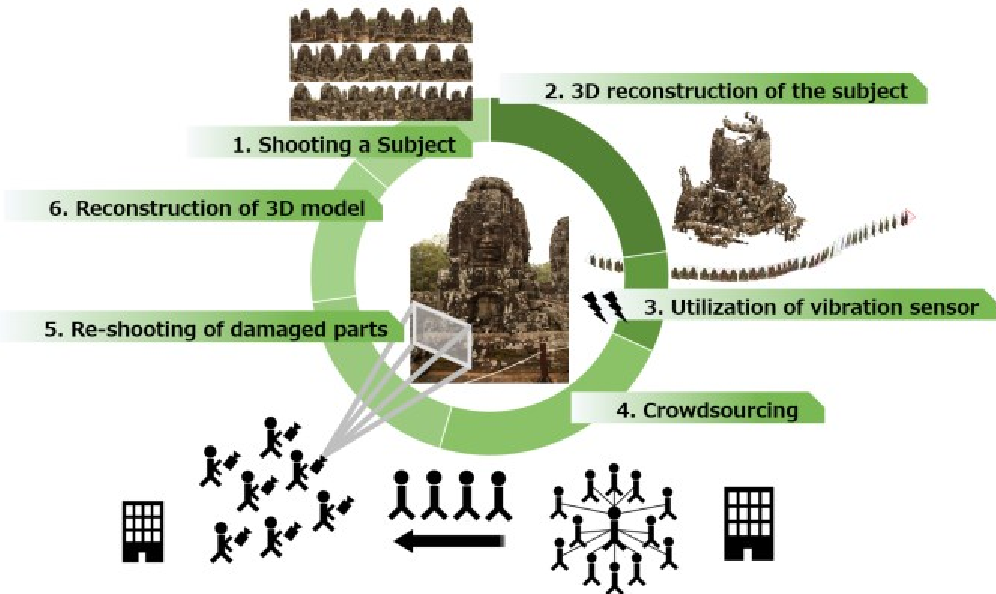 Figure: The technical flow from data acquisition to expert visualization.
Experiments: Validating Heterogeneous Data
A major concern with crowdsourcing is consistency. Can a random smartphone photo truly be used for scientific monitoring?
To test this, the authors compared rendered images from their 3D model (using a virtual camera) against actual "live-action" photos taken by different mobile devices.
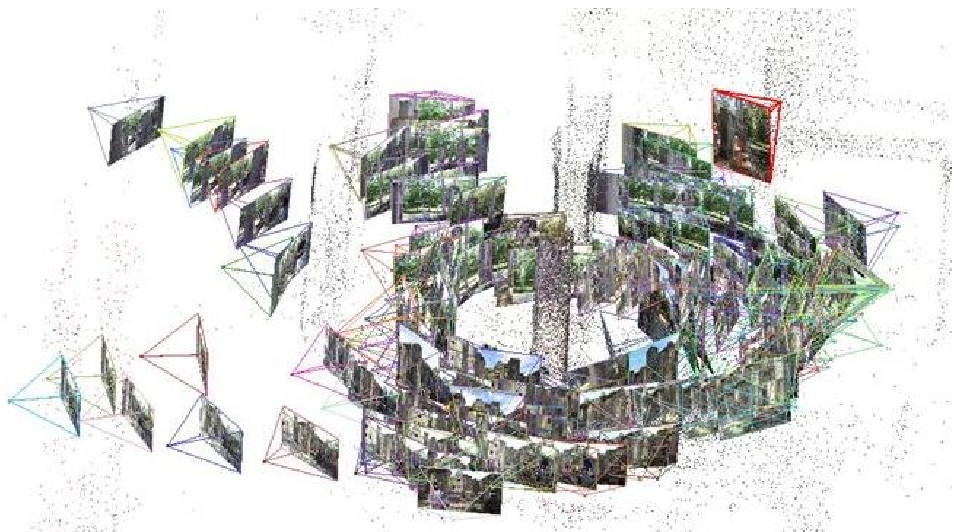 Figure: The estimated camera postures and sparse 3D point cloud of a stone pillar.
Key Results:
- High Fidelity: The visual difference between the rendered 3D model and actual photos was negligible, proving that heterogeneous mobile data can successfully update the master model.
- Bryophyte Monitoring: By analyzing the textures of the 3D models over time, experts can track the "breeding process" of organisms on the stone surfaces and evaluate chemical conservation treatments.
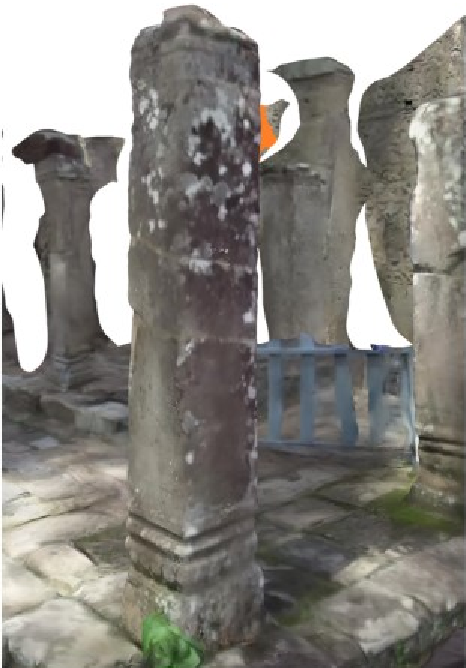 Figure: (a) Rendered image from virtual camera; (b) Live-action photo. The alignment proves the model's accuracy.
Critical Insight & Future Outlook
The genius of this approach lies in its scalability. In heritage preservation, the "data bottleneck" is usually the physical presence of experts. By decentralizing the data collection, the experts can focus on the judgment—using the visualization interface to decide where intervention is needed.
Limitations: The paper currently focuses on the 3D reconstruction pipeline. The next hurdles will be incentivization (how to pay or reward tourists for their "work") and automated quality control (filtering out blurry or irrelevant photos).
Future Impact: If successful, this model could be applied to any world heritage site with high tourism, creating a global, community-driven database for historical preservation.