
Smart Commuting: Leveraging Geosocial Ties and Markov Chains for Proactive Carpooling
Proactive and reactive carpooling recommendation system based on spatiotemporal and geosocial data
The paper introduces a Proactive and Reactive Carpooling Recommendation System that leverages spatiotemporal check-in data and geosocial network information. It utilizes a Continuous-Time Markov Chain (CTMC) for mobility prediction and a dual-similarity metric (Interest and Friendship) to identify optimal carpooling matches among social circles.
TL;DR
Researchers have developed a carpooling recommendation system that doesn't wait for you to ask for a ride. By analyzing your Gowalla check-in history and your social graph, the system uses Continuous-Time Markov Chains (CTMC) to predict your next destination and proactively suggests carpooling with friends or "friends-of-friends" who share similar interests and travel patterns.
Problem & Motivation: The HOV Paradox
Despite the proliferation of High Occupancy Vehicle (HOV) lanes, they remain notoriously underutilized. Existing carpooling apps suffer from two fatal flaws:
- High Cognitive Load: They are reactive, meaning users must actively plan, schedule, and search for matches.
- The Trust Gap: Commuting with total strangers is often perceived as stressful or unsafe.
The authors' insight is simple yet powerful: People prefer to work and travel within communities. If we can predict where a user is going and match them with someone they already trust (or are socially connected to), the barriers to carpooling vanish.
Methodology: How it Works
The system architecture rests on two pillars: Mobility Prediction and User Similarity Detection.
1. Mobility Modeling via CTMC
To move from reactive to proactive, the system must know where you are going before you do. The authors use a Continuous-Time Markov Chain (CTMC).
- The State Space: Each unique location is a state.
- The Virtual Home State: Real-world check-in data is "leaky"—people don't check in everywhere. The authors solve this by injecting a "virtual home state" whenever the gap between check-ins exceeds 12 hours, ensuring the mathematical model (the Markov chain) remains irreducible and continuous.
2. Dual-Similarity Matching
Not all friends are good carpool partners. The system calculates:
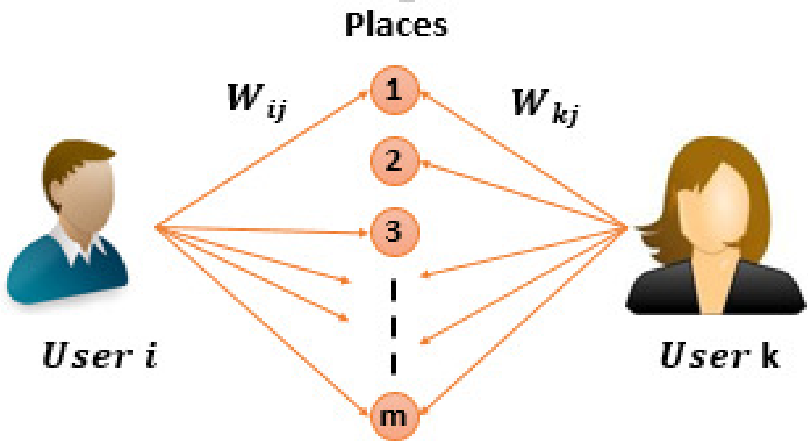
- Interest-based Similarity (): Uses a weighted bipartite graph between users and places. It applies a modified TF-IDF (Term Frequency-Inverse Document Frequency) where a "rare" venue (like a niche hobby shop) carries more weight in defining similarity than a common venue (like a massive shopping mall).
- Friendship-based Similarity (): Measures the overlap in social circles (mutual friends) to ensure a baseline of trust.
Experiments & Results
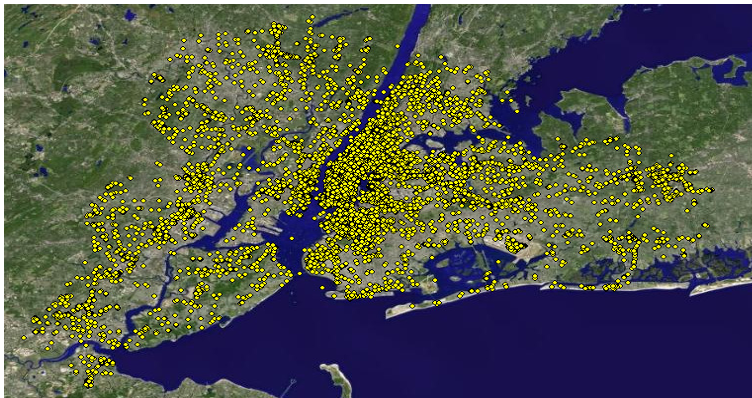
The system was tested on NYC and USA-wide data from the Gowalla dataset (6 million+ check-ins).
Prediction Accuracy
The CTMC model was compared against a "Visiting Ratio" baseline (which simply predicts destinations based on how often you've been there). The CTMC significantly outperformed the baseline, with 34% of visited places appearing in the top 10% of predicted ranks.
Recommendation Performance
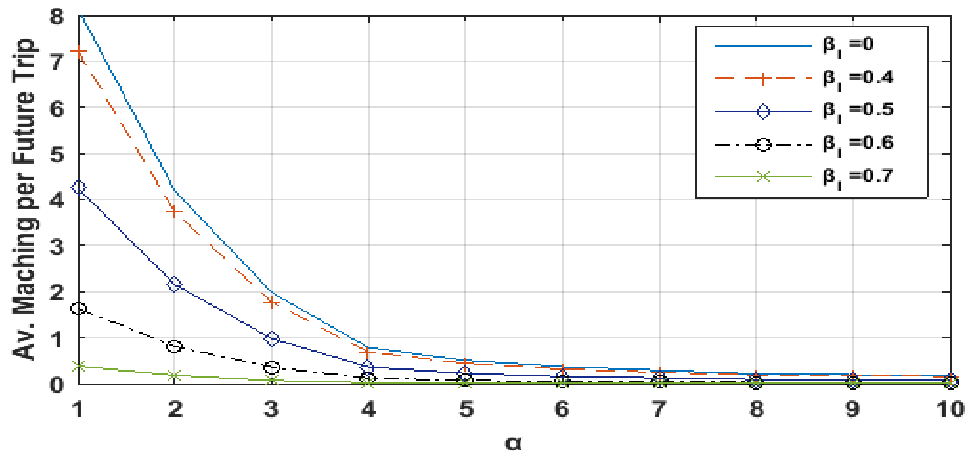
The system's effectiveness was measured by the average number of "matches" found per trip. As social similarity thresholds () and system sensitivity () are adjusted, the system yields different densities of recommendations.
- Key Finding: With an acceptance rate of 50%, the system efficiently matches users for 4-passenger vehicles, providing between 1.5 and 6 recommendations per trip—plenty to fill a car without overwhelming the user with "spam."
Critical Insight & Conclusion
The true value of this work lies in the Virtual Home State innovation. Human mobility data is notoriously sparse; by recognizing that "long silence" in data usually means a return to a "base" (home or hotel), the authors transformed a broken mathematical graph into a functional predictive engine.
Limitations: The model assumes "memoryless" movement (the next stop only depends on the current one). In reality, humans have long-term dependencies (e.g., leaving work usually leads to the gym, then home). Future iterations using Higher-Order Markov Chains or RNNs could potentially sharpen these predictions further.
Takeaway: The future of urban mobility isn't just better roads; it's smarter algorithms that turn our social networks into transportation assets.